Fisher Lucas A B, Schöck Frieder
Department of Biology, McGill University, Montreal, QC, Canada.
Front Cell Dev Biol. 2022 Dec 1;10:963608. doi: 10.3389/fcell.2022.963608. eCollection 2022.
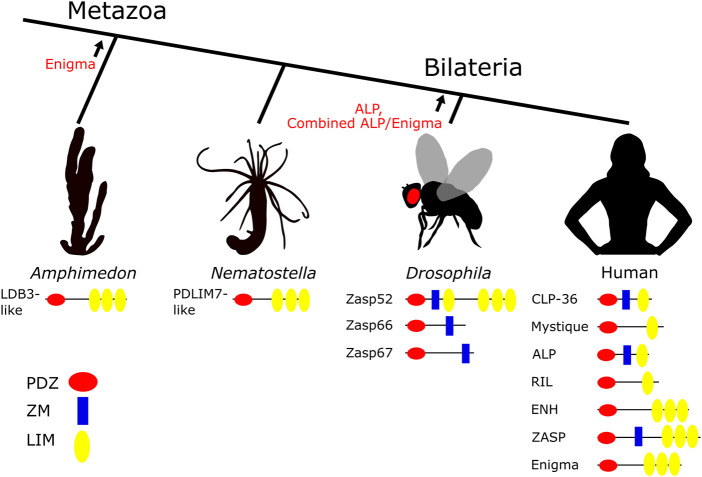
One of the most intriguing features of multicellular animals is their ability to move. On a cellular level, this is accomplished by the rearrangement and reorganization of the cytoskeleton, a dynamic network of filamentous proteins which provides stability and structure in a stationary context, but also facilitates directed movement by contracting. The ALP/Enigma family proteins are a diverse group of docking proteins found in numerous cellular milieus and facilitate these processes among others. In vertebrates, they are characterized by having a PDZ domain in combination with one or three LIM domains. The family is comprised of CLP-36 (PDLIM1), Mystique (PDLIM2), ALP (PDLIM3), RIL (PDLIM4), ENH (PDLIM5), ZASP (PDLIM6), and Enigma (PDLIM7). In this review, we will outline the evolution and function of their protein domains which confers their versatility. Additionally, we highlight their role in different cellular environments, focusing specifically on recent advances in muscle research using as a model organism. Finally, we show the relevance of this protein family to human myopathies and the development of muscle-related diseases.
多细胞动物最引人入胜的特征之一是它们的运动能力。在细胞水平上,这是通过细胞骨架的重排和重组来实现的,细胞骨架是一个由丝状蛋白组成的动态网络,在静止状态下提供稳定性和结构,但也通过收缩促进定向运动。ALP/Enigma家族蛋白是一类多样的对接蛋白,存在于众多细胞环境中,并在其他过程中促进这些过程。在脊椎动物中,它们的特征是具有一个PDZ结构域以及一个或三个LIM结构域。该家族由CLP-36(PDLIM1)、Mystique(PDLIM2)、ALP(PDLIM3)、RIL(PDLIM4)、ENH(PDLIM5)、ZASP(PDLIM6)和Enigma(PDLIM7)组成。在这篇综述中,我们将概述赋予其多功能性的蛋白结构域的进化和功能。此外,我们将强调它们在不同细胞环境中的作用,特别关注以 为模式生物的肌肉研究的最新进展。最后,我们展示了这个蛋白家族与人类肌病以及肌肉相关疾病发展的相关性。