Choi Jung Ho, Choi Hyo Jung, Kim Dong Hyun, Park Ji Hye, An Yong-Hwi, Shim Hyun Joon
Department of Otorhinolaryngology-Head and Neck Surgery, Nowon Eulji Medical Center, Eulji University School of Medicine, Seoul, South Korea.
Front Neurosci. 2022 Dec 1;16:1036767. doi: 10.3389/fnins.2022.1036767. eCollection 2022.
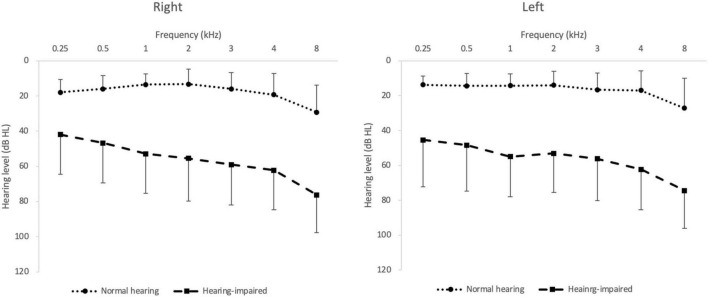
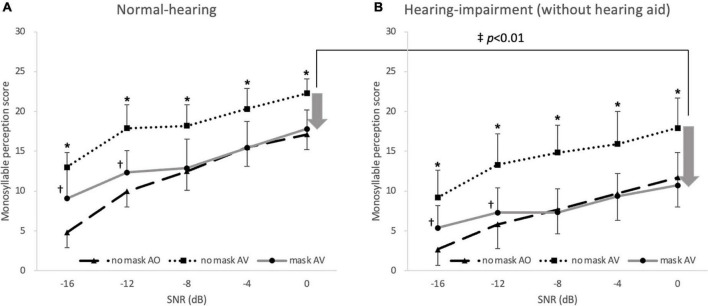
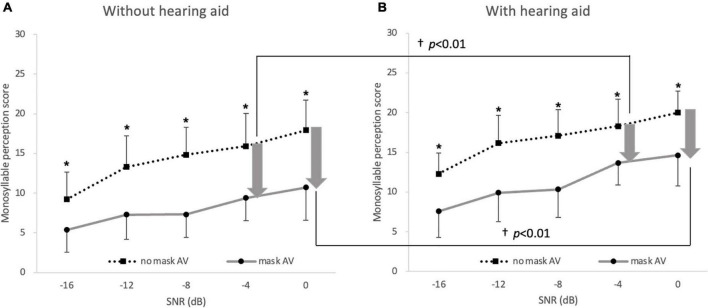
Although several previous studies have confirmed that listeners find it difficult to perceive the speech of face-mask-wearing speakers, there has been little research into how masks affect hearing-impaired individuals using hearing aids. Therefore, the aim of this study was to compare the effects of masks on the speech perception in noise of hearing-impaired individuals and normal-hearing individuals. We also investigated the effect of masks on the gain conferred by hearing aids. The hearing-impaired group included 24 listeners (age: = 69.5, = 8.6; M:F = 13:11) who had used hearing aids in everyday life for >1 month ( = 20.7, = 24.0) and the normal-hearing group included 26 listeners (age: = 57.9, = 11.1; M:F = 13:13). Speech perception in noise was measured under no mask-auditory-only (no-mask-AO), no mask-auditory-visual (no-mask-AV), and mask-AV conditions at five signal-to-noise ratios (SNRs; -16, -12, -8, -4, 0 dB) using five lists of 25 monosyllabic Korean words. Video clips that included a female speaker's face and sound or the sound only were presented through a monitor and a loudspeaker located 1 m in front of the listener in a sound-attenuating booth. The degree of deterioration in speech perception caused by the mask (no-mask-AV minus mask-AV) was significantly greater for hearing-impaired vs. normal-hearing participants only at 0 dB SNR (Bonferroni's corrected < 0.01). When the effects of a mask on speech perception, with and without hearing aids, were compared in the hearing-impaired group, the degree of deterioration in speech perception caused by the mask was significantly reduced by the hearing aids compared with that without hearing aids at 0 and -4 dB SNR (Bonferroni's corrected < 0.01). The improvement conferred by hearing aids (unaided speech perception score minus aided speech perception score) was significantly greater at 0 and -4 dB SNR than at -16 dB SNR in the mask-AV group (Bonferroni's corrected < 0.01). These results demonstrate that hearing aids still improve speech perception when the speaker is masked, and that hearing aids partly offset the effect of a mask at relatively low noise levels.
尽管此前的多项研究已证实,听众觉得很难理解佩戴口罩的说话者的言语,但对于口罩如何影响使用助听器的听力受损者,却鲜有研究。因此,本研究的目的是比较口罩对听力受损者和听力正常者在噪声环境中言语感知的影响。我们还研究了口罩对助听器增益的影响。听力受损组包括24名受试者(年龄:均值 = 69.5,标准差 = 8.6;男:女 = 13:11),他们在日常生活中使用助听器超过1个月(均值 = 20.7,标准差 = 24.0),听力正常组包括26名受试者(年龄:均值 = 57.9,标准差 = 11.1;男:女 = 13:13)。在无口罩 - 仅听觉(无口罩 - AO)、无口罩 - 听觉视觉(无口罩 - AV)和口罩 - AV条件下,使用五组包含25个韩语单音节词的词表,在五个信噪比(SNR;-16、-12、-8、-4、0 dB)下测量噪声环境中的言语感知。包含女性说话者面部和声音或仅有声音的视频片段通过显示器和位于隔音室内听众前方1米处的扬声器播放。仅在0 dB SNR时,听力受损受试者因口罩导致的言语感知恶化程度(无口罩 - AV减去口罩 - AV)显著大于听力正常受试者(Bonferroni校正P < 0.01)。在听力受损组中,比较有和无助听器时口罩对言语感知的影响,在0和 -4 dB SNR时,与无助听器相比,助听器显著降低了口罩导致的言语感知恶化程度(Bonferroni校正P < 0.01)。在口罩 - AV组中,助听器带来的改善(未佩戴助听器时的言语感知得分减去佩戴助听器时的言语感知得分)在0和 -4 dB SNR时显著大于 -16 dB SNR时(Bonferroni校正P < 0.01)。这些结果表明,当说话者戴口罩时,助听器仍能改善言语感知,并且在相对低的噪声水平下,助听器能部分抵消口罩的影响。