Institute for Biomedical Ethics, University of Basel, Bernoullistr. 28, 4056, Basel, Switzerland.
Philos Ethics Humanit Med. 2022 Dec 21;17(1):15. doi: 10.1186/s13010-022-00127-z.
Normality is both a descriptive and a normative concept. Undoubtedly, the normal often operates normatively as an exclusionary tool of cultural authority. While it has prominently found its way into the field of medicine, it remains rather unclear in what sense it is used. Thus, our study sought to elucidate people's understanding of normality in medicine and to identify concepts that are linked to it.
Using convenient sampling, we carried out a cross-sectional survey. Since the survey was advertised through social media, we employed an online survey. We performed descriptive and inferential analyses. Predictors were chosen in a theory-driven manner.
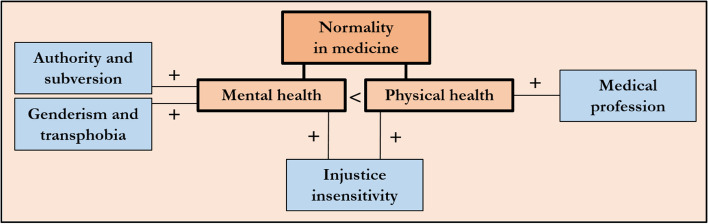
In total, 323 persons from 21 countries completed the survey. Analysis revealed that the overall acceptance of normality in medicine was associated with notions of injustice, authority, discrimination, and with having a medical profession. More precisely, for the field of mental health, injustice insensitivity, genderism and transphobia, and authority were positively associated with a person's acceptance of normality; and, for the field of physical health, injustice insensitivity and having a medical profession were positively associated with a person's acceptance of normality. Finally, participants' acceptance of the use of normality in the area of mental health was lower than in the area of physical health.
What is considered normal has implications for clinical practice, both at an individual and at a policy-level. Acknowledging its normalistic condition, the discipline of medicine has to confront itself with its own contribution to the augmentation of social inequalities through the excessive reliance on the concept of normality. Research that centers the lived experiences of those who are being systematically marginalized because they are deemed abnormal is needed. By empirically elucidating the conceptual relationships between normality in medicine and other variables, we provide points of leverage to deprive normality of its normative power. For medicine, this is needed to first do no harm.
常态既是描述性的,也是规范性的概念。毫无疑问,常态通常作为文化权威的排斥性工具发挥规范性作用。尽管它在医学领域中占有突出地位,但它的使用意义仍不清楚。因此,我们的研究旨在阐明人们对医学常态的理解,并确定与之相关的概念。
我们采用便利抽样法进行了一项横断面调查。由于调查是通过社交媒体发布的,因此我们采用了在线调查。我们进行了描述性和推断性分析。预测因子是通过理论驱动的方式选择的。
共有来自 21 个国家的 323 人完成了调查。分析表明,医学中常态的总体接受度与不公正、权威、歧视以及医学专业有关。更具体地说,对于心理健康领域,不公正的麻木、性别主义和跨性别恐惧症以及权威与人们对常态的接受度呈正相关;而对于身体健康领域,不公正的麻木和医学专业与人们对常态的接受度呈正相关。最后,参与者对常态在心理健康领域的使用的接受度低于在身体健康领域的接受度。
被认为是正常的事物对临床实践具有影响,无论是在个体层面还是在政策层面。医学学科承认其常态性,就必须面对自己通过过度依赖常态概念而对社会不平等的加剧所做出的贡献。需要进行以那些因被视为异常而被系统边缘化的人的生活经历为中心的研究。通过实证阐明医学常态与其他变量之间的概念关系,我们提供了剥夺常态规范性力量的杠杆。对于医学来说,这是首先不造成伤害的必要条件。