Zhao Fu-Jun, Chen Qing-Wei, Wu Yunxiao, Xie Xiaohong, Xu Zhifei, Ni Xin
Department of Otolaryngology, Head and Neck Surgery, Beijing Children's Hospital, National Center for Children's Health, Capital Medical University, Beijing 100045, China.
National Center for International Research on Green Optoelectronics, South China Normal University, Guangzhou 510006, China.
Brain Sci. 2022 Dec 8;12(12):1688. doi: 10.3390/brainsci12121688.
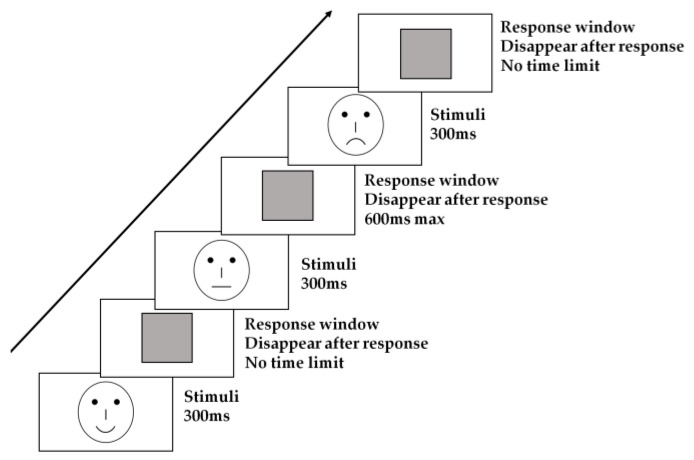
Although previous studies have reported a facial expression classification deficit among adults with SDB, we do not know whether these findings can be generalized to children. In our study, children with sleep-disordered breathing (SDB) were divided into three groups: primary snoring ( = 51), mild obstructive sleep apnea (OSA) ( = 39), and moderate/severe OSA ( = 26). All participants, including 20 healthy controls, underwent an overnight polysomnography recording and the Emotional Expression Recognition Task. Psychosocial problems were evaluated using the parent-reported Strengths and Difficulties Questionnaire (SDQ). There was a borderline significant interaction between expression category and group on reaction times. Further analysis revealed that positive classification advantage (PCA) disappeared in the moderate/severe OSA group, whereas it persisted in the control, primary snoring, and mild OSA groups. Emotional symptoms were positively correlated with OAHI. In both the happy and sad conditions, RT was negatively related to age and body mass index (BMI) but was independent of the obstructive apnea-hypopnea index (OAHI), arterial oxygen (SaO) and total sleep time. The accuracy of identifying a sad expression was negatively related to conduct problems. Children with moderate/severe OSA exhibited dysfunction in facial expression categorization, which could potentially affect social communication ability.
尽管先前的研究报告称患有睡眠呼吸障碍(SDB)的成年人存在面部表情分类缺陷,但我们尚不清楚这些发现是否能推广到儿童身上。在我们的研究中,患有睡眠呼吸紊乱(SDB)的儿童被分为三组:原发性打鼾组(n = 51)、轻度阻塞性睡眠呼吸暂停(OSA)组(n = 39)和中度/重度OSA组(n = 26)。所有参与者,包括20名健康对照者,均接受了夜间多导睡眠图记录和情感表达识别任务。使用家长报告的优势与困难问卷(SDQ)评估心理社会问题。在反应时间上,表情类别和组别之间存在边缘显著的交互作用。进一步分析表明,中度/重度OSA组的积极分类优势(PCA)消失,而在对照组、原发性打鼾组和轻度OSA组中仍然存在。情绪症状与阻塞性睡眠呼吸暂停低通气指数(OAHI)呈正相关。在快乐和悲伤两种情境下,反应时间均与年龄和体重指数(BMI)呈负相关,但与阻塞性呼吸暂停低通气指数(OAHI)、动脉血氧饱和度(SaO)和总睡眠时间无关。识别悲伤表情的准确性与行为问题呈负相关。中度/重度OSA儿童在面部表情分类方面表现出功能障碍,这可能会潜在影响社交沟通能力。