Vallejo Raquel, Benavides Julio, Arteche-Villasol Noive, Fernández-Escobar Mercedes, Ferreras María Del Carmen, Pérez Valentín, Gutiérrez-Expósito Daniel
SANPATRUM, Animal Health Department, University of León, Campus de Vegazana s/n, 24071 León, Spain.
Instituto de Ganadería de Montaña (CSIC-ULE), Grulleros, 24346 León, Spain.
Animals (Basel). 2022 Dec 7;12(24):3453. doi: 10.3390/ani12243453.
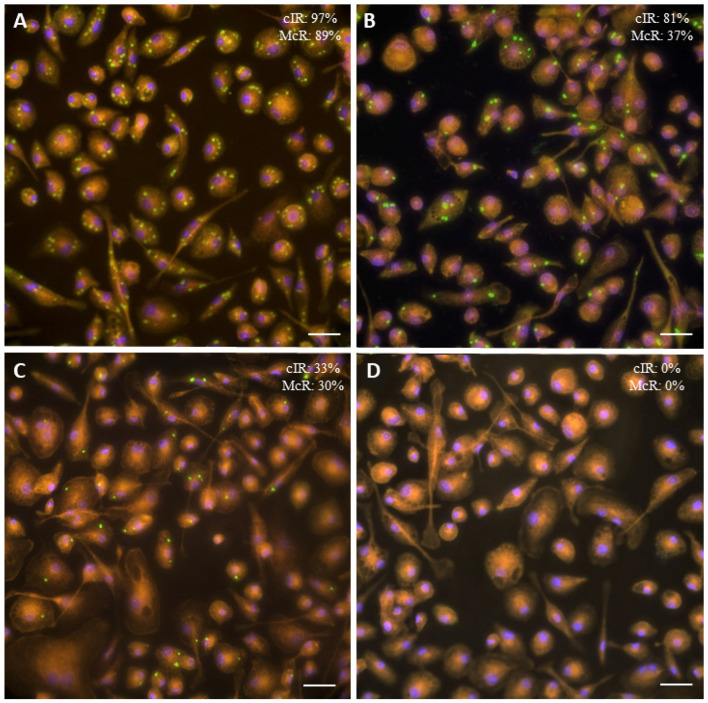
Ovine toxoplasmosis is one the most relevant reproductive diseases in sheep. The genetic variability among different isolates is known to be related to different degrees of virulence in mice and humans, but little is known regarding its potential effects in sheep. The aim of this study was to investigate the effect of genetic variability (types II (ToxoDB #1 and #3) and III (#2)) of six recently isolated strains that showed different phenotypic traits both in a normalized mouse model and in ovine trophoblasts, in ovine monocyte-derived macrophages and the subsequent transcript expression of cytokines and iNOS (inducible nitric oxide synthase). The type III isolate (TgShSp24) showed the highest rate of internalization, followed by the type II clonal isolate (TgShSp2), while the type II PRU isolates (TgShSp1, TgShSp3, TgShSp11 and TgShSp16) showed the lowest rates. The type II PRU strains, isolated from abortions, exhibited higher levels of anti-inflammatory cytokines and iNOS than those obtained from the myocardium of chronically infected sheep (type II PRU strains and type III), which had higher levels of pro-inflammatory cytokines. The present results show the existence of significant intra- and inter-genotypic differences in the parasite-macrophage relationship that need to be confirmed in in vivo experiments.
绵羊弓形虫病是绵羊中最相关的生殖疾病之一。已知不同分离株之间的遗传变异性与小鼠和人类不同程度的毒力有关,但关于其在绵羊中的潜在影响知之甚少。本研究的目的是调查六种最近分离的菌株的遗传变异性(II型(ToxoDB #1和#3)和III型(#2))在标准化小鼠模型和绵羊滋养层细胞、绵羊单核细胞衍生的巨噬细胞中的影响,以及随后细胞因子和诱导型一氧化氮合酶(iNOS)的转录表达。III型分离株(TgShSp24)的内化率最高,其次是II型克隆分离株(TgShSp2),而II型PRU分离株(TgShSp1、TgShSp3、TgShSp11和TgShSp16)的内化率最低。从流产中分离出的II型PRU菌株比从慢性感染绵羊心肌中获得的菌株(II型PRU菌株和III型)表现出更高水平的抗炎细胞因子和iNOS,后者具有更高水平的促炎细胞因子。目前的结果表明,寄生虫与巨噬细胞关系中存在显著的基因型内和基因型间差异,这需要在体内实验中得到证实。