Al-Khairy Dina, Fu Weiqi, Alzahmi Amnah Salem, Twizere Jean-Claude, Amin Shady A, Salehi-Ashtiani Kourosh, Mystikou Alexandra
Division of Science and Math, New York University Abu Dhabi, Abu Dhabi 129188, United Arab Emirates.
Department of Marine Science, Ocean College, Zhejiang University & Donghai Laboratory, Zhoushan 316021, China.
Microorganisms. 2022 Nov 23;10(12):2320. doi: 10.3390/microorganisms10122320.
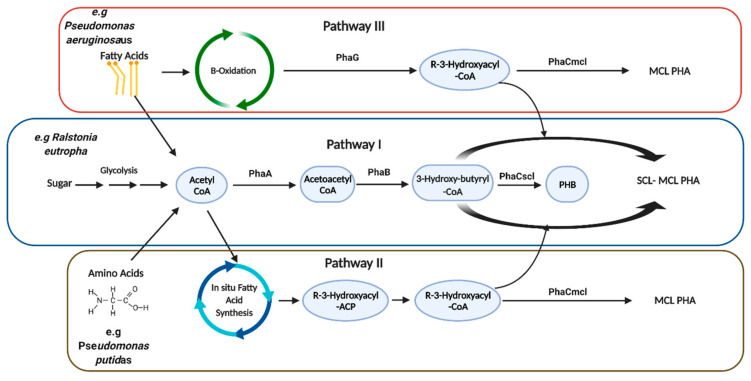
Bioplastics, which are plastic materials produced from renewable bio-based feedstocks, have been investigated for their potential as an attractive alternative to petroleum-based plastics. Despite the harmful effects of plastic accumulation in the environment, bioplastic production is still underdeveloped. Recent advances in strain development, genome sequencing, and editing technologies have accelerated research efforts toward bioplastic production and helped to advance its goal of replacing conventional plastics. In this review, we highlight bioengineering approaches, new advancements, and related challenges in the bioproduction and biodegradation of plastics. We cover different types of polymers, including polylactic acid (PLA) and polyhydroxyalkanoates (PHAs and PHBs) produced by bacterial, microalgal, and plant species naturally as well as through genetic engineering. Moreover, we provide detailed information on pathways that produce PHAs and PHBs in bacteria. Lastly, we present the prospect of using large-scale genome engineering to enhance strains and develop microalgae as a sustainable production platform.
生物塑料是由可再生生物基原料生产的塑料材料,其作为石油基塑料的有吸引力的替代品的潜力已得到研究。尽管塑料在环境中积累会产生有害影响,但生物塑料生产仍不发达。菌株开发、基因组测序和编辑技术的最新进展加快了生物塑料生产的研究工作,并有助于推进其取代传统塑料的目标。在这篇综述中,我们重点介绍了生物塑料生产和生物降解中的生物工程方法、新进展及相关挑战。我们涵盖了不同类型的聚合物,包括细菌、微藻和植物自然产生以及通过基因工程产生的聚乳酸(PLA)和聚羟基脂肪酸酯(PHA和PHB)。此外,我们提供了细菌中产生PHA和PHB的途径的详细信息。最后,我们展示了利用大规模基因组工程来强化菌株并将微藻开发为可持续生产平台的前景。