Institute of Medicine, Jan Grodek State University in Sanok, ul. Mickiewicza 21, 38-500 Sanok, Poland.
Department of General Paediatrics, University Hospital No 1 in Zabrze, Medical University of Silesia in Katowice, ul. 3 Maja 13-15, 41-800 Zabrze, Poland.
Nutrients. 2022 Dec 11;14(24):5282. doi: 10.3390/nu14245282.
The aim of this study was to assess the nutritional status and serum concentrations of adipokines in children with irritable bowel syndrome (IBS) and healthy controls. We also sought to evaluate their relation to metabolic parameters.
We studied 33 IBS patients (11 girls, 22 boys) aged 5-17 years and 30 healthy age-matched controls (11 girls, 19 boys). The analysis included anthropometric measurements, body composition parameter measurements using bioimpedance, and biochemical tests and measurements of serum concentrations of leptin, adiponectin, chemerin, and omentin-1.
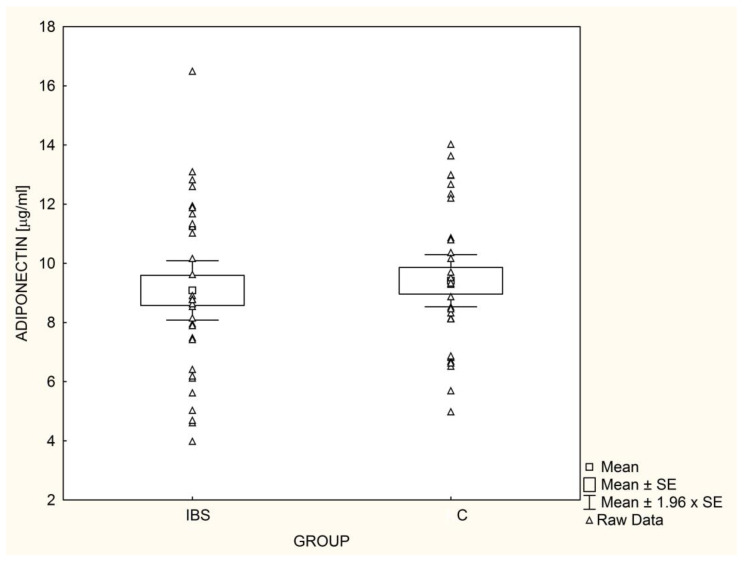
The results of the anthropometric measurements were comparable between the patients and the controls. The patients had higher triglycerides, HOMA-IRs, and chemerin concentrations than the healthy subjects. The HDL cholesterol and omentin-1 levels were lower than in the controls. Leptin and adiponectin did not differ significantly between the groups. An analysis of the receiver operator curves (ROCs) showed that serum concentrations of chemerin ≥ 232.8 ng/mL had 30% sensitivity and 87% specificity when they were used to differentiate between children with IBS and healthy subjects. In the case of serum omentin-1 concentrations ≤ 279.4 ng/mL, the sensitivity and specificity were 60% and 80%, respectively.
The nutritional status of children with IBS did not differ from that of the healthy controls. We found significant differences in serum chemerin and omentin-1 concentrations between IBS patients and healthy children. These adipokines could be used as IBS biomarkers as they demonstrate good specificity and moderate sensitivity. The serum concentrations of chemerin and omentin-1 in IBS patients were related to nutritional status and insulin resistance.
本研究旨在评估肠易激综合征(IBS)患儿的营养状况和血清脂肪因子浓度,并探讨其与代谢参数的关系。
我们研究了 33 名 5-17 岁的 IBS 患儿(11 名女孩,22 名男孩)和 30 名年龄匹配的健康对照者(11 名女孩,19 名男孩)。分析包括人体测量学测量、生物电阻抗法测量身体成分参数以及生化测试和血清瘦素、脂联素、趋化素和网膜素-1 浓度的测量。
患儿和对照组的人体测量学测量结果相当。患儿的甘油三酯、HOMA-IR 和趋化素浓度高于健康受试者,HDL 胆固醇和网膜素-1水平低于对照组。瘦素和脂联素在两组间无显著差异。受试者工作特征曲线(ROC)分析显示,血清趋化素浓度≥232.8ng/mL 时,对 IBS 患儿和健康受试者的区分具有 30%的敏感性和 87%的特异性;血清网膜素-1浓度≤279.4ng/mL 时,敏感性和特异性分别为 60%和 80%。
IBS 患儿的营养状况与健康对照组无差异。我们发现 IBS 患儿与健康儿童的血清趋化素和网膜素-1浓度存在显著差异。这些脂肪因子可作为 IBS 的生物标志物,具有良好的特异性和中等的敏感性。IBS 患儿的血清趋化素和网膜素-1浓度与营养状况和胰岛素抵抗有关。