Arruda Laíza Vianna, Salomão Natália Gedeão, Alves Felipe de Andrade Vieira, Rabelo Kíssila
Interdisciplinary Laboratory of Medical Research, Instituto Oswaldo Cruz, Oswaldo Cruz Foundation, Rio de Janeiro 21040900, Brazil.
Department of Histology and Embryology, Roberto Alcantara Gomes Institute of Biology, Rio de Janeiro State University, Rio de Janeiro 20551030, Brazil.
Pathogens. 2022 Nov 24;11(12):1410. doi: 10.3390/pathogens11121410.
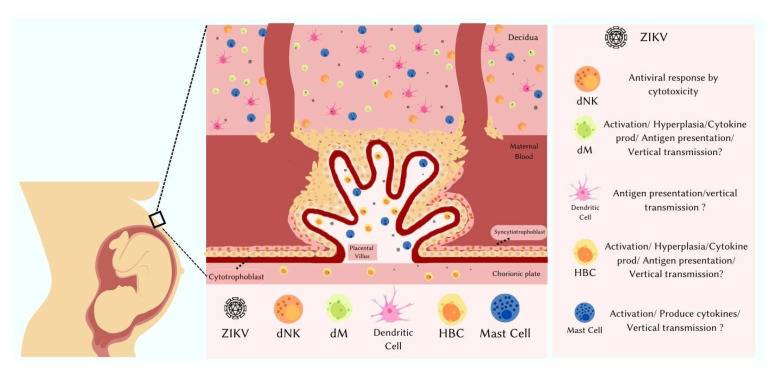
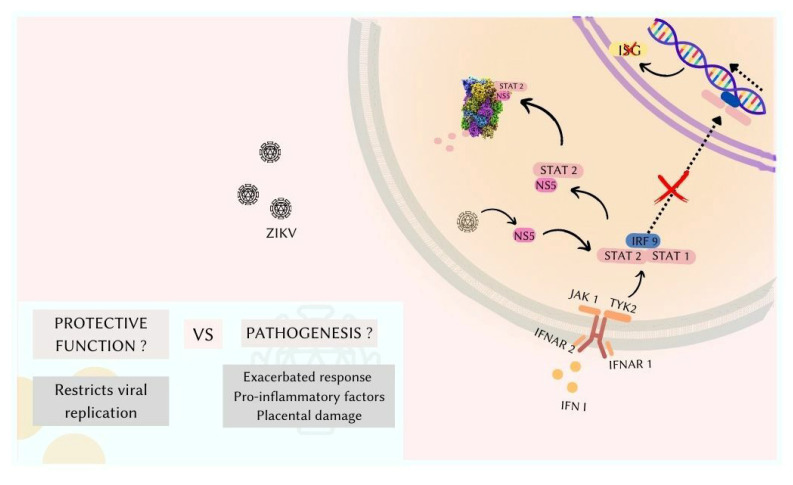
Zika virus (ZIKV) is an arthropod-borne virus that belongs to the family, genus and was first isolated 1947 in Uganda, Africa, from the serum of a sentinel Rhesus monkey. Since its discovery, the virus was responsible for major outbreaks in several different countries, being linked to severe complications in pregnant women, neonatal birth defects and the congenital zika syndrome. Maternal-fetal transmission of ZIKV can occur in all trimesters of pregnancy, and the role of the placenta and its cells in these cases is yet to be fully understood. The decidua basalis and chorionic villi, maternal-fetal components of the placenta, contain a rich immunological infiltrate composed by Hofbauer cells, mastocytes, dendritic cells and macrophages, primary cells of the innate immune response that have a role that still needs to be better investigated in ZIKV infection. Recent studies have already described several histopathological features and the susceptibility and permissiveness of placenta cells to infection by the Zika virus. In this review, we address some of the current knowledge on the innate immune responses against ZIKV, especially in the placenta.
寨卡病毒(ZIKV)是一种节肢动物传播病毒,属于黄病毒科黄病毒属,于1947年首次在非洲乌干达从一只哨兵恒河猴的血清中分离出来。自发现以来,该病毒在几个不同国家引发了重大疫情,与孕妇的严重并发症、新生儿出生缺陷和先天性寨卡综合征有关。寨卡病毒的母婴传播可发生在妊娠的所有阶段,而胎盘及其细胞在这些情况下的作用尚未完全了解。胎盘的母胎组成部分基蜕膜和绒毛膜绒毛含有丰富的免疫浸润,由霍夫鲍尔细胞、肥大细胞、树突状细胞和巨噬细胞组成,这些先天性免疫反应的主要细胞在寨卡病毒感染中的作用仍需进一步深入研究。最近的研究已经描述了几种组织病理学特征以及胎盘细胞对寨卡病毒感染的易感性和允许性。在这篇综述中,我们阐述了目前关于针对寨卡病毒的先天性免疫反应的一些知识,特别是在胎盘中的免疫反应。