Campos Fernanda C, Castilho Ivana G, Rossi Bruna F, Bonsaglia Érika C R, Dantas Stéfani T A, Dias Regiane C B, Fernandes Júnior Ary, Hernandes Rodrigo T, Camargo Carlos H, Ribeiro Márcio G, Pantoja José C F, Langoni Hélio, Rall Vera L M
Department of Chemical and Biological Sciences, Institute of Biosciences, São Paulo State University, Botucatu 18618-691, Brazil.
Bacteriology Division, Adolfo Lutz Institute, São Paulo 01246-000, Brazil.
Pathogens. 2022 Nov 28;11(12):1435. doi: 10.3390/pathogens11121435.
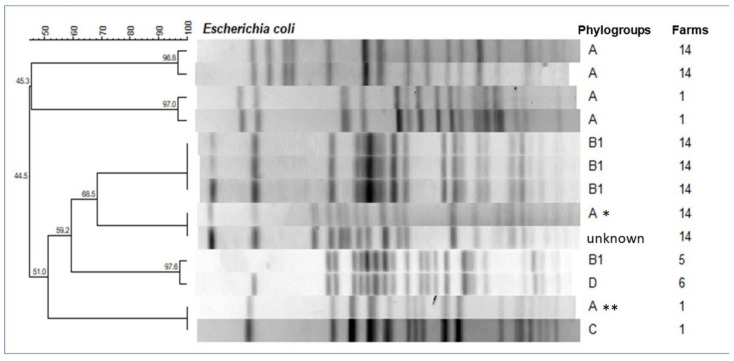
Mammary pathogenic (MPEC) is one of the main pathogens of environmental origin responsible for causing clinical mastitis worldwide. Even though are strongly associated with transient or persistent mastitis and the economic impacts of this disease, the virulence factors involved in the pathogenesis of MPEC remain unknown. Our aim was to characterize 110 MPEC isolates obtained from the milk of cows with clinical mastitis, regarding the virulence factor-encoding genes present, adherence patterns on HeLa cells, and antimicrobial resistance profile. The MPEC isolates were classified mainly in phylogroups A (50.9%) and B1 (38.2%). None of the isolates harbored genes used for diarrheagenic classification, but 26 (23.6%) and 4 (3.6%) isolates produced the aggregative or diffuse adherence pattern, respectively. Among the 22 genes investigated, encoding virulence factors associated with extraintestinal pathogenic pathogenesis, (93.6%) was the most frequent, followed by (77.3%) and (68.2%). Pulsed-field gel electrophoresis analysis revealed six pulse-types with isolates obtained over time, thus indicating persistent intramammary infections. The genes encoding beta-lactamases detected were as follows: (35/31.8%); / (2/1.8%); and (1/0.9%); five isolates were classified as extended spectrum beta-lactamase (ESBL) producers. As far as we know, , , , and were detected for the first time in MPEC. In summary, the genetic profile of the MPEC studied was highly heterogeneous, making it impossible to establish a common genetic profile useful for molecular MPEC classification. Moreover, the detection of ESBL-producing isolates is a serious public health concern.
乳腺致病性大肠杆菌(MPEC)是环境源主要病原菌之一,在全球范围内导致临床乳腺炎。尽管其与短暂性或持续性乳腺炎以及该疾病的经济影响密切相关,但MPEC发病机制中涉及的毒力因子仍不清楚。我们的目的是对从临床乳腺炎奶牛乳汁中分离得到的110株MPEC菌株进行特征分析,包括存在的毒力因子编码基因、在HeLa细胞上的黏附模式以及抗菌药物耐药谱。MPEC分离株主要分为A群(50.9%)和B1群(38.2%)。没有分离株携带用于致泻性大肠杆菌分类的基因,但分别有26株(23.6%)和4株(3.6%)分离株产生聚集性或弥漫性黏附模式。在所研究的22个与肠外致病性大肠杆菌发病机制相关的毒力因子编码基因中,cvaC(93.6%)最为常见,其次是fimH(77.3%)和traT(68.2%)。脉冲场凝胶电泳分析显示,随着时间推移获得的分离株有六种脉冲型,表明存在持续性乳腺内感染。检测到的编码β-内酰胺酶的基因如下:blaCMY(35/31.8%);blaTEM/blaSHV(2/1.8%);blaOXA和blaCTX-M(1/0.9%);五株分离株被归类为超广谱β-内酰胺酶(ESBL)产生菌。据我们所知,在MPEC中首次检测到blaCMY、blaOXA、blaCTX-M、aggR和cvaC。总之,所研究的MPEC的基因图谱高度异质,无法建立一个用于分子MPEC分类的通用基因图谱。此外,产ESBL分离株的检测是一个严重的公共卫生问题。