Kim Yoo Jin, Shin You Kyoung, Seo Eunhye, Seol Geun Hee
Department of Basic Nursing Science, College of Nursing, Korea University, Seoul 02841, Republic of Korea.
BK21 FOUR Program of Transdisciplinary Major in Learning Health Systems, Graduate School, Korea University, Seoul 02841, Republic of Korea.
Pharmaceuticals (Basel). 2022 Dec 7;15(12):1521. doi: 10.3390/ph15121521.
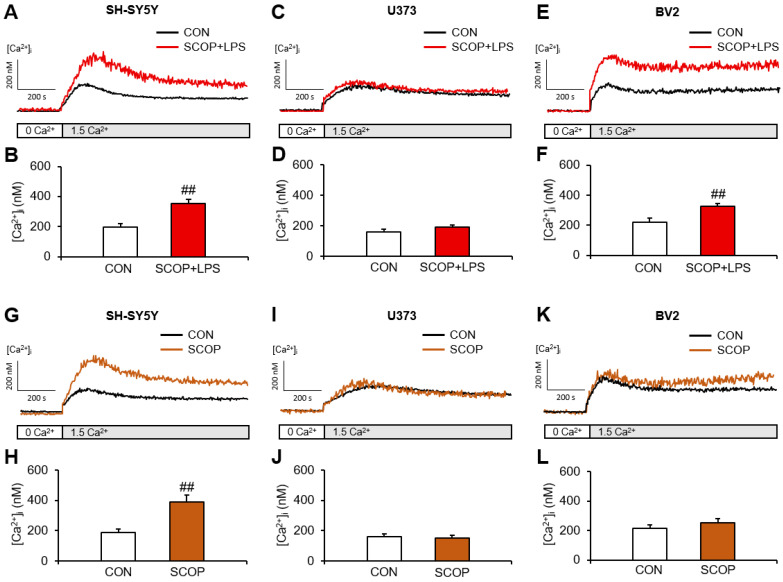
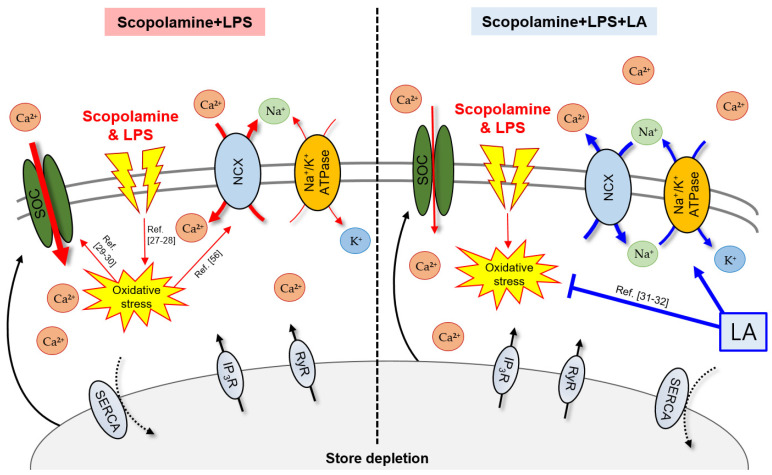
Inflammation and loss of cholinergic transmission are involved in neurodegenerative diseases, but possible interactions between them within neurons, astrocytes, and microglia have not yet been investigated. We aimed to compare store-operated Ca entry (SOCE) in neurons, astrocytes, and microglia following cholinergic dysfunction in combination with (or without) an inflammatory stimulus and to investigate the effects of linalyl acetate (LA) on this process. We used the SH-SY5Y, U373, and BV2 cell lines related to neurons, astrocytes, and microglia, respectively. Scopolamine or lipopolysaccharide (LPS) was used to antagonize the muscarinic receptors or induce inflammatory responses, respectively. The concentration of intracellular Ca was measured using Fura-2 AM. Treatment with scopolamine and LPS significantly increased SOCE in the neuron-like cells and microglia but not in the scopolamine-pretreated astrocytes. LA significantly reduced SOCE in the scopolamine-pretreated neuron-like cells and microglia exposed to LPS, which was partially inhibited by the Na-K ATPase inhibitor ouabain and the Na/Ca exchanger (NCX) inhibitor Ni. Notably, SOCE was significantly reduced in the LPS plus scopolamine-pretreated cells mixed with astrocytes and microglia, with a two-fold increase in the applied number of astrocytes. LA may be useful in protecting neurons and microglia by reducing elevated SOCE that is induced by inflammatory responses and inhibiting the muscarinic receptors via Na-K ATPase and the forward mode of NCX. Astrocytes may protect microglia by reducing increased SOCE under the conditions of inflammation and a muscarinic receptor blockade.
炎症和胆碱能传递丧失与神经退行性疾病有关,但它们在神经元、星形胶质细胞和小胶质细胞内的可能相互作用尚未得到研究。我们旨在比较胆碱能功能障碍联合(或不联合)炎症刺激后神经元、星形胶质细胞和小胶质细胞中的储存-操作性钙内流(SOCE),并研究乙酸芳樟酯(LA)对这一过程的影响。我们分别使用了与神经元、星形胶质细胞和小胶质细胞相关的SH-SY5Y、U373和BV2细胞系。东莨菪碱或脂多糖(LPS)分别用于拮抗毒蕈碱受体或诱导炎症反应。使用Fura-2 AM测量细胞内钙浓度。东莨菪碱和LPS处理显著增加了神经元样细胞和小胶质细胞中的SOCE,但在经东莨菪碱预处理的星形胶质细胞中未增加。LA显著降低了经东莨菪碱预处理的神经元样细胞和暴露于LPS的小胶质细胞中的SOCE,这被钠钾ATP酶抑制剂哇巴因和钠钙交换器(NCX)抑制剂镍部分抑制。值得注意的是,在与星形胶质细胞和小胶质细胞混合的LPS加东莨菪碱预处理细胞中,SOCE显著降低,星形胶质细胞应用数量增加了两倍。LA可能通过降低由炎症反应诱导的升高的SOCE并通过钠钾ATP酶和NCX的正向模式抑制毒蕈碱受体来保护神经元和小胶质细胞。在炎症和毒蕈碱受体阻断的条件下,星形胶质细胞可能通过降低增加的SOCE来保护小胶质细胞。