Ng William Hao Syuen, Smith Saxon D
Greenslopes Private Hospital, Brisbane, QLD 4120, Australia.
ANU Medical School, ANU College of Health and Medicine, Australian National University, Canberra, ACT 2601, Australia.
Pharmaceutics. 2022 Dec 7;14(12):2738. doi: 10.3390/pharmaceutics14122738.
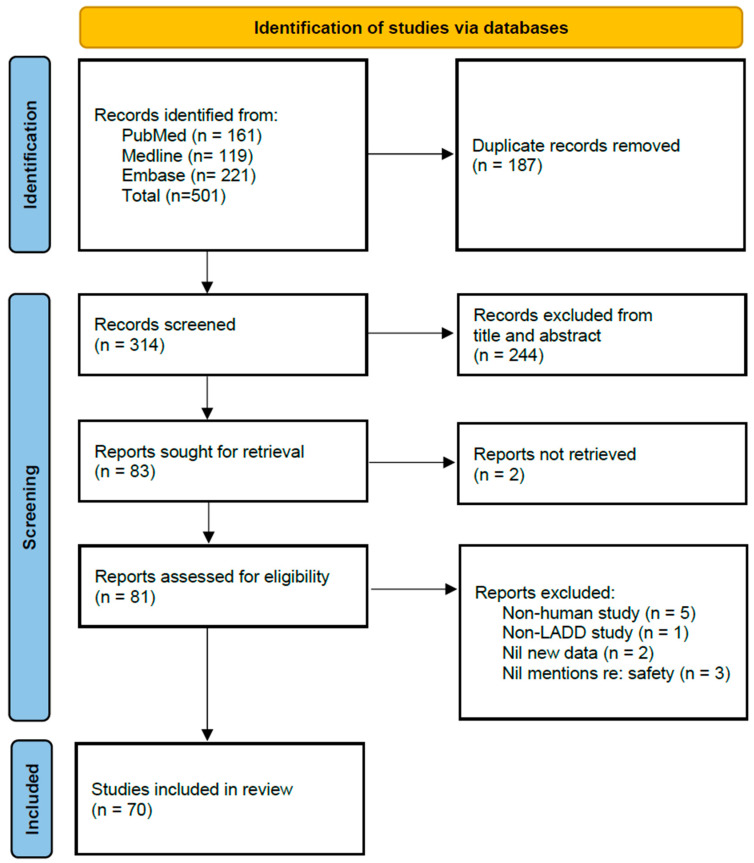
Laser-assisted drug delivery (LADD) is an increasingly studied and applied methodology for drug delivery. It has been used in a wide variety of clinical applications. Given the relatively low barrier to entry for clinicians as well as ongoing research in this area, the authors aimed to review outcomes relating to safety in laser-assisted drug delivery. A systematic review was conducted, with the databases PubMed, Medline and Embase searched in September 2022. Included articles were those that mentioned laser-assisted drug delivery in human subjects that also reported adverse effects or safety outcomes. There were no language-based exclusions. Conference abstracts and literature reviews were excluded. The results were then tabulated and categorized according to the application of LADD. In total, 501 articles were obtained. Following deduplication, screening, and full text review 70 articles of various study designs were included. Common findings were erythema, oedema, pain, and crusting following LADD. Several notably more severe adverse effects such as generalized urticaria, infection, scarring and dyspigmentation were noted. However, these events were varied depending on the clinical use of LADD. Relevant negatives were also noted whereby no studies reported life-threatening adverse effects. Limitations included limited details regarding the adverse effects within the full texts, lack of follow-up, and risk of bias. In conclusion, there were multiple adverse effects that clinicians should consider prior to carrying out LADD, where treatment goals and patient tolerability should be considered. Further evidence is needed to quantitatively determine these risks.
激光辅助给药(LADD)是一种越来越受到研究和应用的给药方法。它已被用于广泛的临床应用中。鉴于临床医生开展该技术的门槛相对较低以及该领域正在进行的研究,作者旨在综述与激光辅助给药安全性相关的结果。进行了一项系统综述,于2022年9月检索了PubMed、Medline和Embase数据库。纳入的文章是那些提及在人体受试者中进行激光辅助给药且还报告了不良反应或安全结果的文章。没有基于语言的排除标准。会议摘要和文献综述被排除。然后根据激光辅助给药的应用将结果制成表格并分类。总共获得了501篇文章。经过重复数据删除、筛选和全文审查,纳入了70篇各种研究设计的文章。常见的发现是激光辅助给药后出现红斑、水肿、疼痛和结痂。还注意到了一些明显更严重的不良反应,如全身性荨麻疹、感染、瘢痕形成和色素沉着异常。然而,这些事件因激光辅助给药的临床用途而异。也注意到了相关的阴性结果,即没有研究报告危及生命的不良反应。局限性包括全文中关于不良反应的细节有限、缺乏随访以及存在偏倚风险。总之,临床医生在进行激光辅助给药之前应考虑多种不良反应,其中应考虑治疗目标和患者耐受性。需要进一步的证据来定量确定这些风险。