Riad Abanoub, Drobov Anton, Rozmarinová Jana, Drapáčová Pavla, Klugarová Jitka, Dušek Ladislav, Pokorná Andrea, Klugar Miloslav
Czech National Centre for Evidence-Based Healthcare and Knowledge Translation (Cochrane Czech Republic, Czech EBHC: JBI Centre of Excellence, Masaryk University GRADE Centre), Faculty of Medicine, Masaryk University, 625 00 Brno, Czech Republic.
Institute of Health Information and Statistics of the Czech Republic (IHIS-CR), 128 01 Prague, Czech Republic.
Vaccines (Basel). 2022 Nov 26;10(12):2022. doi: 10.3390/vaccines10122022.
The recent human monkeypox virus (HMPXV) outbreak in non-endemic countries that started in May 2022 has raised concerns among public health authorities worldwide. Healthcare workers (HCWs) play a decisive role during epidemics in transmitting accurate information to the public and motivating them to pursue protective behaviours, including immunisation.
A cross-sectional survey-based study was conducted in the Czech Republic in September 2022 to evaluate HMPXV-related knowledge and vaccination perceptions among HCWs. The study utilised a digital self-administered questionnaire (SAQ) to collect data from the target population. The proposed SAQ inquired about participants' sociodemographic and anamnestic characteristics, perceived knowledge of HMPXV, factual knowledge, and vaccination perceptions according to the health belief model (HBM).
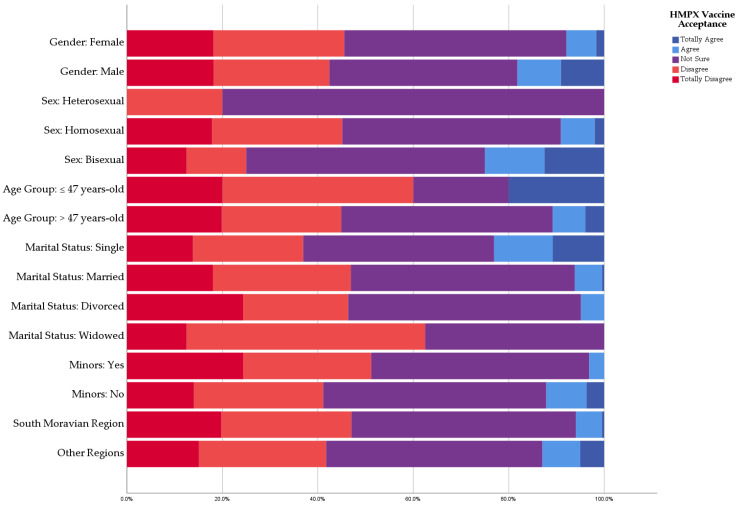
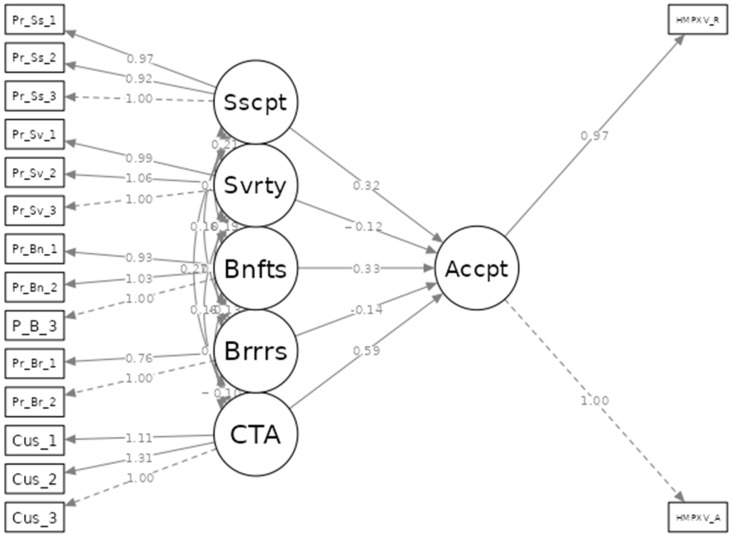
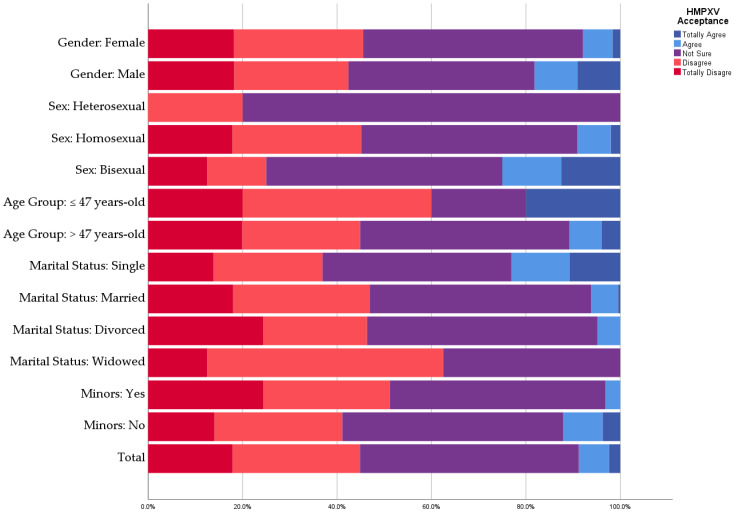
A total of 341 participants were included in this study; most of them were females (88.9%), allied HCWs (89.4%), heterosexuals (87.1%), married (61.9%), and vaccinated against COVID-19 (91.2%). Only 8.8% of the participants agreed to receive vaccination against HMPXV; 44.9% rejected it, while 46.3% were hesitant. While digital news portals (47.5%) and social media (25.8%) were among the most utilised sources of information about HMPXV, the scientific journals (5.6%), ECDC (5%), and the U.S. CDC (1.5%) were the least common sources. The participants demonstrated suboptimal levels of factual knowledge, especially regarding HMPXV vaccines (1.5 ± 1.2 (0-4)) and treatments (0.9 ± 0.9 (0-4)). Additionally, several misconceptions were detectable among the participants, regarding topics such as the availability of effective vaccines and antivirals against HMPXV, the risk of vertical transmission, and homosexual stigmatisation. The HBM indicated that the cues to action and perceived susceptibility were the most important constructs to predict HMPXV vaccine acceptance.
the findings of this study call upon public health practitioners and health policymakers in the Czech Republic to act accordingly in order to determine the drivers of vaccine hesitancy among Czech HCWs. Dedicated educational campaigns should aim to counter the HCWs' misconceptions around HMPXV, and future studies should aim to explore the prevalence and drivers of HMPXV vaccine hesitancy among the general population.
2022年5月开始在非流行国家爆发的近期人类猴痘病毒(HMPXV)疫情引发了全球公共卫生当局的关注。医护人员在疫情期间对于向公众传播准确信息并促使他们采取保护行为(包括免疫接种)起着决定性作用。
2022年9月在捷克共和国开展了一项基于横断面调查的研究,以评估医护人员对HMPXV相关知识及疫苗接种看法。该研究利用数字自填式问卷(SAQ)从目标人群收集数据。拟议的SAQ询问了参与者的社会人口统计学和既往史特征、对HMPXV的认知、事实性知识以及根据健康信念模型(HBM)的疫苗接种看法。
本研究共纳入341名参与者;其中大多数为女性(88.9%)、辅助医护人员(89.4%)、异性恋者(87.1%)、已婚(61.9%)且接种过新冠疫苗(91.2%)。只有8.8%的参与者同意接种HMPXV疫苗;44.9%拒绝接种,而46.3%持犹豫态度。虽然数字新闻门户网站(47.5%)和社交媒体(25.8%)是最常被利用的HMPXV信息来源,但科学期刊(5.6%)、欧洲疾病预防控制中心(ECDC,5%)和美国疾病控制与预防中心(1.5%)是最不常见的信息来源。参与者展示出的事实性知识水平欠佳,尤其是关于HMPXV疫苗(1.5±1.2(0 - 4))和治疗方法(0.9±0.9(0 - 4))方面。此外,在参与者中可检测到一些误解,涉及诸如针对HMPXV的有效疫苗和抗病毒药物的可获得性、垂直传播风险以及同性恋污名化等主题。健康信念模型表明,行动线索和感知易感性是预测HMPXV疫苗接受度的最重要因素。
本研究结果呼吁捷克共和国的公共卫生从业者和卫生政策制定者据此采取行动,以确定捷克医护人员中疫苗犹豫的驱动因素。专门的教育活动应旨在消除医护人员对HMPXV的误解,未来的研究应旨在探索普通人群中HMPXV疫苗犹豫的流行情况和驱动因素。