Center for Infectious Disease Education and Research, Osaka University, Suita, Japan.
Faculty of Letters, Keio University, Minatoku, Japan.
PeerJ. 2022 Dec 19;10:e14545. doi: 10.7717/peerj.14545. eCollection 2022.
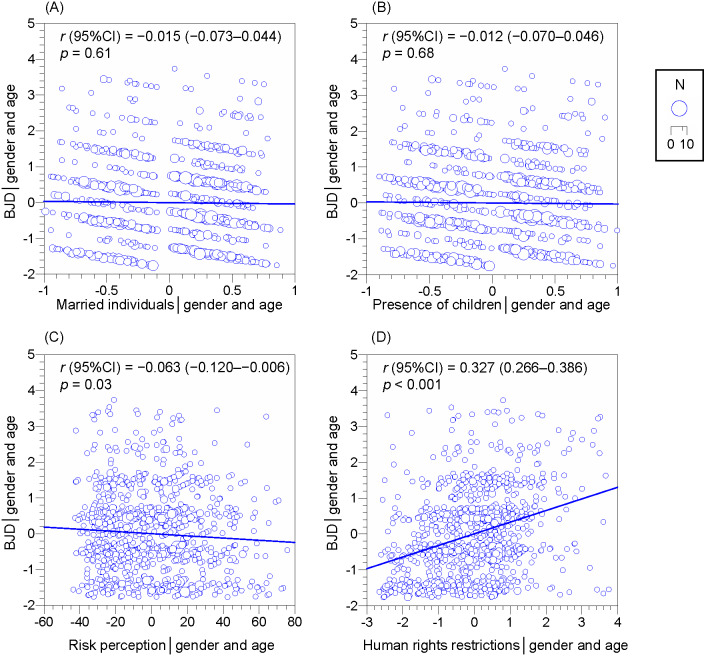
Prejudice related to the coronavirus disease 2019 (COVID-19) is a social issue worldwide. A possible psychological factor that promotes prejudice is the belief in just deserts (BJD) regarding individuals infected with COVID-19 (, the belief that the infected individual deserves to be infected). The BJD is based on the belief in immanent justice. It is reportedly higher in Japan than in other countries. Therefore, we conducted a cross-sectional study to investigate the BJD among Japanese individuals and clarify its associations with demographic factors or infection-related and socio-psychological characteristics. To this end, we conducted an online questionnaire survey in Japan from August 7-8, 2020, with 1,207 respondents aged 20-69 years. We performed screening to exclude inappropriate responses. We investigated the association between the BJD and demographic factors such as gender and age. We also investigated the association between the BJD and infection-related and socio-psychological characteristics, including risk perception of COVID-19 infection and human rights restrictions (, the degree of agreement with government restrictions on individuals' behavior during emergencies). Among the surveyed items, human rights restrictions showed a strong association with BJD, followed by risk perception of COVID-19 infection. Men had a slightly higher BJD than women. Our study is significant in that it is the first to investigate the items associated with the BJD, thereby providing foundational information for revising individual perceptions of justice related to COVID-19 and solving prejudice-related issues.
与 2019 年冠状病毒病(COVID-19)相关的偏见是一个全球性的社会问题。可能促进偏见的一个心理因素是对感染 COVID-19 的个体的应得报应信念(BJD),即感染个体理应被感染的信念。BJD 基于内在正义的信念。据报道,日本的 BJD 比其他国家高。因此,我们进行了一项横断面研究,以调查日本个体中的 BJD,并阐明其与人口统计学因素或感染相关和社会心理特征的关系。为此,我们于 2020 年 8 月 7 日至 8 日在日本进行了一项在线问卷调查,共有 1207 名 20-69 岁的受访者。我们进行了筛选,以排除不适当的回答。我们调查了 BJD 与性别和年龄等人口统计学因素的关系。我们还调查了 BJD 与感染相关和社会心理特征的关系,包括对 COVID-19 感染风险的感知和对人权限制(即,对政府在紧急情况下对个人行为的限制的同意程度)。在所调查的项目中,人权限制与 BJD 密切相关,其次是对 COVID-19 感染风险的感知。男性的 BJD 略高于女性。我们的研究意义重大,因为它首次调查了与 BJD 相关的项目,从而为修订与 COVID-19 相关的个人正义观念和解决偏见相关问题提供了基础信息。