Center for Infectious Disease Education and Research, Osaka University, Suita, Osaka, Japan.
Faculty of Letters, Keio University, Minato-ku, Tokyo, Japan.
PeerJ. 2023 Sep 28;11:e16147. doi: 10.7717/peerj.16147. eCollection 2023.
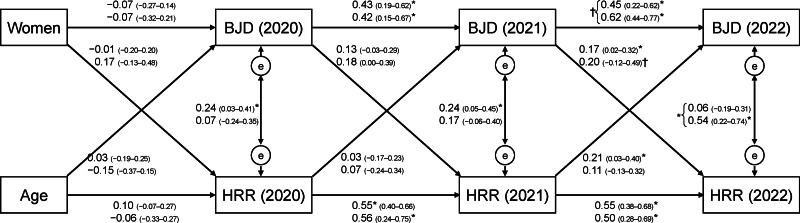
Discrimination, which arose during the coronavirus disease 2019 outbreak, is a global public health issue. This study aimed to provide fundamental knowledge in proposing control measures to mitigate discrimination. We focused on two psychological variables: belief in just deserts (BJD, , the belief that the infected individual deserves to be infected), a psychological factor that potentially promotes discrimination and prejudice, and human rights restrictions (HRR; , the degree of individuals' agreement with government restrictions on citizens' behavior during emergencies). Differences in these items, as well as their annual trends from 2020 to 2022, were examined in Japan, the United States (US), the United Kingdom (UK), Italy, and China. In addition, the associations between BJD and HRR by country and year and the direction of the associations between them in Japan and Italy were analyzed. Online surveys were conducted annually, with 392-518 participants per country and year. The BJD was higher in Japan and lower in the UK. BJD increased significantly from 2020 to 2021 in all countries, except in China. Meanwhile, HRR was higher in China and lower in Japan. The HRR decreased from 2020 to 2021 in Japan and decreased from 2020 to 2022 in the US, the UK, and Italy. There were significant positive associations between BJD and HRR in Japan and Italy. Cross-lagged panel models revealed positive bidirectional associations between BJD and HRR in Japan and Italy, respectively, indicating that the HRR declined among those with weak BJD and that the BJD increased among those with high HRR. In Japan and Italy, the dissemination of public messages targeting those with a high HRR in the early stages of an infectious disease outbreak could potentially mitigate the adverse impact of the BJD, eventually reducing discrimination, especially when the infection is not attributed to the fault of the infected individuals.
歧视是在 2019 冠状病毒病大流行期间出现的一个全球公共卫生问题。本研究旨在提供基本知识,提出控制措施以减轻歧视。我们重点关注两个心理变量:应得报应信念(Belief in Just Deserts,BJD,即感染个体理应被感染的信念),这是一种潜在促进歧视和偏见的心理因素,以及人权限制(Human Rights Restrictions,HRR,即个人对政府在紧急情况下限制公民行为的程度的认同)。本研究考察了日本、美国、英国、意大利和中国在这些项目上的差异,以及这些项目从 2020 年到 2022 年的年度趋势。此外,还分析了日本和意大利的 BJD 和 HRR 之间的关联以及它们之间关联的方向。每年进行在线调查,每个国家和年份的参与者人数为 392-518 人。结果显示,日本的 BJD 较高,英国的 BJD 较低。除中国外,所有国家的 BJD 均从 2020 年到 2021 年显著增加。同时,中国的 HRR 较高,日本的 HRR 较低。日本的 HRR 从 2020 年到 2021 年下降,美国、英国和意大利的 HRR 从 2020 年到 2022 年下降。日本和意大利的 BJD 和 HRR 之间存在显著的正相关关系。交叉滞后面板模型显示,日本和意大利的 BJD 和 HRR 之间存在正的双向关联,这表明 HRR 在 BJD 较弱的人群中下降,而 BJD 在 HRR 较高的人群中上升。在日本和意大利,传染病暴发初期针对 HRR 较高人群传播公共信息,可能会减轻 BJD 的不利影响,从而减少歧视,尤其是当感染不是感染个体的过错时。