Department of Medical Psychology, Center for Psychosocial Medicine, University Medical Center Hamburg-Eppendorf, Hamburg, Germany.
Department of Child and Adolescent Psychiatry, Psychosomatics and Psychotherapy, University Medical Center Hamburg-Eppendorf, Hamburg, Germany.
Orphanet J Rare Dis. 2022 Dec 26;17(1):449. doi: 10.1186/s13023-022-02595-0.
The COVID-19 pandemic is affecting many areas of life and has posed additional strains on the highly vulnerable group of caregivers of children with rare diseases (RDs). The psychosocial situation of the family caregivers deserves more attention, both in research and practice. The current study explores the distress level of caregivers of children with RDs, their psychosocial information needs, and caregiver-reported health-related quality of life (HRQoL) of children with RDs in times of the COVID-19 pandemic.
Data from a cross-sectional online survey conducted within the German CARE-FAM-NET project (children affected by rare diseases and their families-network) between March and August 2020 were examined. The study sample included 149 family caregivers, mostly mothers (83.2%) of 167 children with RDs. The survey assessed demographic and disease-related characteristics, distress and everyday problems of caregivers (Distress Thermometer for Parents; scale 0-10), psychosocial information needs (self-developed items; scale 0-100), and caregiver-reported HRQoL of the children with RDs (DISABKIDS Chronic Generic Measure, short-form; scale 0-100). Using descriptive statistics, we analyzed the psychosocial situation of families during the COVID-19 pandemic. We further conducted correlation analysis to investigate interrelations.
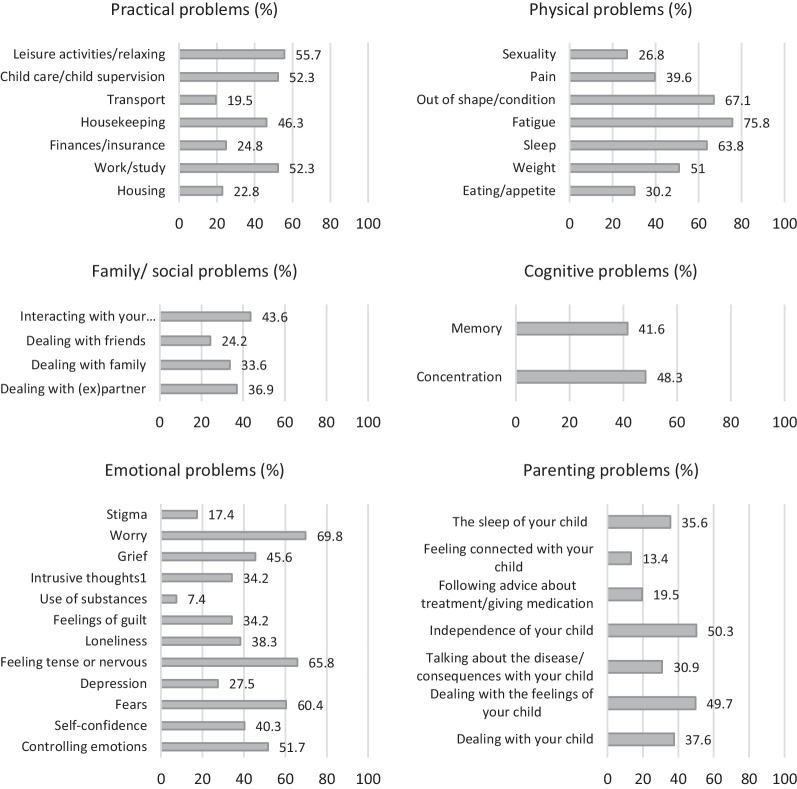
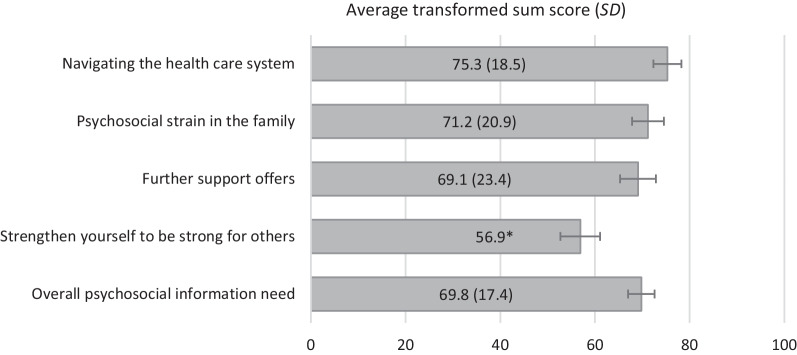
The distress level among caregivers was high (M = 6.84, SD = 2.43); 89.6% reported clinical distress (≥ 4). Everyday problems (e.g., sleep problems, fatigue, being out of shape, fears, feeling tense or nervous, and worry) were frequent. Caregivers reported a wide range of psychosocial information needs. In about half of the children (49.5%), caregiver-reported HRQoL was low, while average HRQoL (M = 58.7, SD = 19.5) was comparable to parent-reported norm data of children with severe clinical conditions. Distress correlated positively with psychosocial information needs (r = 0.40), and negatively with the caregiver-reported HRQoL of the children (r = - 0.46).
This study indicates a high psychosocial burden on family caregivers of children with RDs during the early COVID-19 pandemic, characterized by high distress levels and wide-ranging everyday problems, unmet psychosocial information needs, and reduced caregiver-reported HRQoL in children with RDs. The findings highlight the ongoing need for target group-specific, low-threshold support services (e.g., websites) during and after the pandemic.
COVID-19 大流行正在影响生活的许多方面,并给儿童罕见病(RDs)护理者这一高度脆弱群体带来了额外的压力。家庭护理者的心理社会状况在研究和实践中都值得更多关注。本研究旨在探讨 COVID-19 大流行期间 RD 患儿家庭护理者的困扰程度、他们的心理社会信息需求以及患儿报告的健康相关生活质量(HRQoL)。
本研究对 2020 年 3 月至 8 月期间在德国 CARE-FAM-NET 项目(受罕见病影响的儿童及其家庭网络)中进行的横断面在线调查的数据进行了分析。研究样本包括 149 名家庭护理者,他们大多是 167 名 RD 患儿的母亲(83.2%)。该调查评估了护理者的人口统计学和疾病相关特征、困扰和日常问题(父母困扰温度计;0-10 分制)、心理社会信息需求(自定项目;0-100 分制)以及患儿报告的 RD 患儿 HRQoL(DISABKIDS 慢性通用量表,短式;0-100 分制)。我们使用描述性统计方法分析了 COVID-19 大流行期间家庭的心理社会状况。我们还进行了相关分析以调查相互关系。
护理者的困扰程度较高(M=6.84,SD=2.43);89.6%报告存在临床困扰(≥4)。日常问题(例如,睡眠问题、疲劳、身体不适、恐惧、紧张或紧张、担忧)很常见。护理者报告了广泛的心理社会信息需求。大约一半的患儿(49.5%)报告患儿报告的 HRQoL 较低,而平均 HRQoL(M=58.7,SD=19.5)与患有严重临床疾病的患儿的父母报告的正常数据相当。困扰与心理社会信息需求呈正相关(r=0.40),与患儿报告的 HRQoL 呈负相关(r=-0.46)。
本研究表明,COVID-19 大流行早期 RD 患儿家庭护理者的心理社会负担沉重,表现为困扰程度高、日常问题广泛、心理社会信息需求未得到满足以及 RD 患儿报告的 HRQoL 降低。这些发现突出表明,在大流行期间和之后,需要针对特定目标群体提供低门槛的支持服务(例如,网站)。