Laboratory of Biomedical Optics and Applied Biophysics, School of Electrical and Computer Engineering, National Technical University of Athens, Zografou Campus, 15780, Athens, Greece.
Division of Pharmaceutical Technology, School of Pharmacy, National and Kapodistrian University of Athens, Panepistimioupoli, Zografou Campus, 15771, Athens, Greece.
Lasers Med Sci. 2022 Dec 27;38(1):27. doi: 10.1007/s10103-022-03670-5.
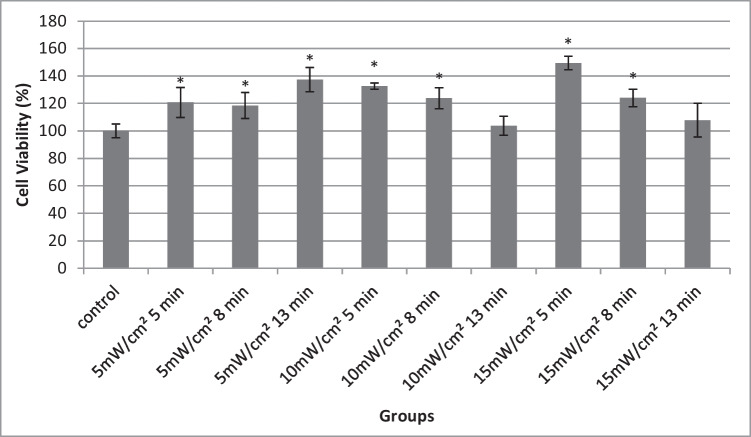
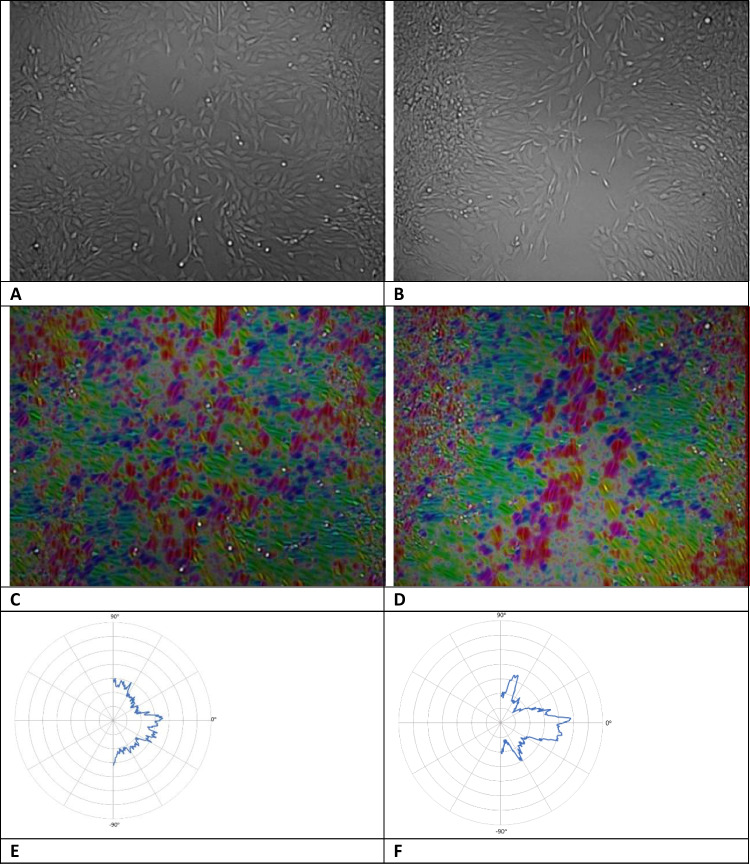
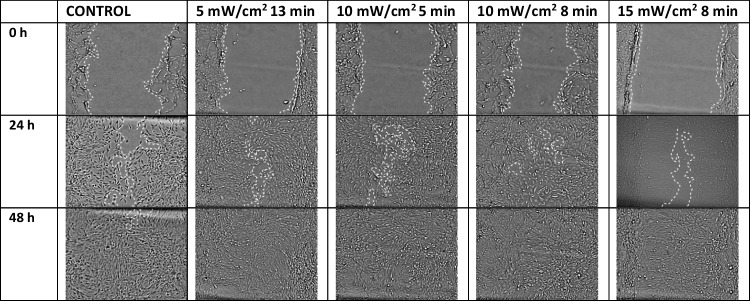
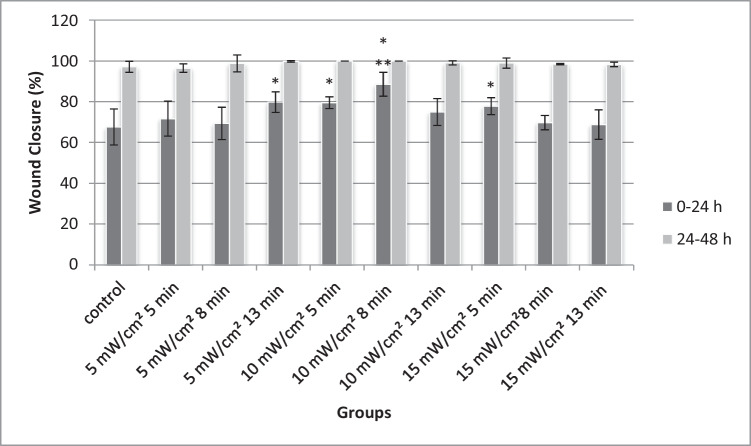
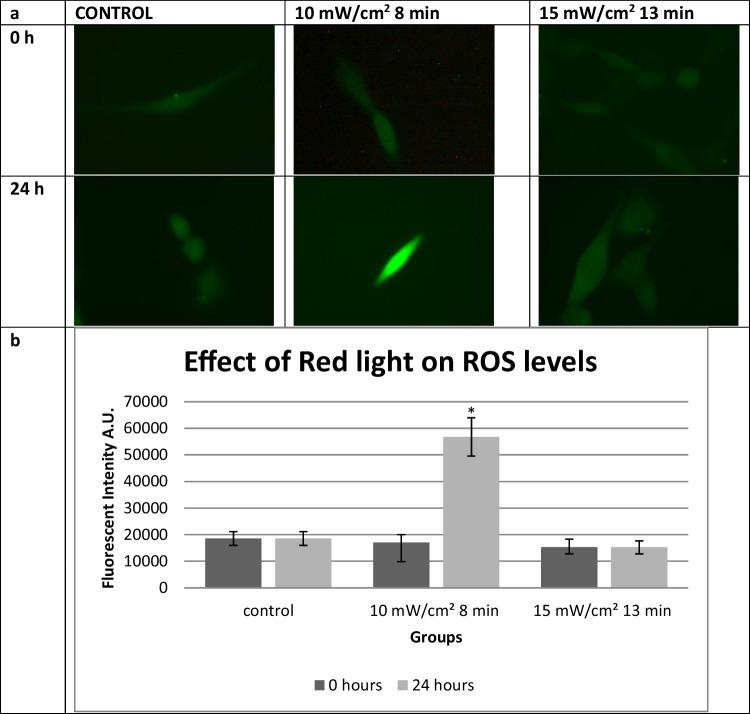
Wound treatment, especially for chronic and infected wounds, has been a permanent socio-economical challenge. This study aimed to investigate the ability of red light at 661 nm to accelerate wound healing an in vitro wound model using 3T3 fibroblasts. The purpose is further specified in clarifying the mechanisms of wound closure by means of intracellular ROS production, proliferation and migration of cells, and cellular orientation. Illumination effects of red light from a diode laser (661 nm) at different doses on 3T3 cell viability was assessed via MTT assay and tested in a scratch wound model. Wound closure rates were calculated by image analysis at 0, 24, and 48 h after laser treatment. ROS production was monitored and quantified immediately and 24 h after the treatment by fluorescence microscopy. Cellular orientation was quantified by image analysis. No phototoxic energy doses used and increased cell viability in most of the groups. Scratch assay revealed an energy interval of 3 - 4.5 J/cm that promote higher wound healing rate 24 h post treatment. An increase in ROS production was also observed 24 h post irradiation higher in the group with the highest wound healing rate. Also, cellular orientation toward the margin of the wound was observed and quantified after irradiation. Low power laser light at 661 nm activated both the migration and proliferation in the in vitro model used, providing evidence that it could also accelerate wound healing in vivo. Also, ROS production and cellular orientation seem to play an important role in wound healing process.
伤口处理,特别是慢性和感染性伤口的处理,一直是一个持久的社会经济挑战。本研究旨在探讨 661nm 红光在体外伤口模型中加速 3T3 成纤维细胞伤口愈合的能力。目的是进一步阐明通过细胞内 ROS 产生、细胞增殖和迁移以及细胞定向来闭合伤口的机制。通过 MTT 测定评估二极管激光(661nm)的红光在不同剂量下对 3T3 细胞活力的辐照效应,并在划痕伤口模型中进行测试。通过图像分析计算激光处理后 0、24 和 48 小时的伤口闭合率。用荧光显微镜立即和处理后 24 小时监测和量化 ROS 产生。通过图像分析量化细胞定向。使用的光毒性能量剂量不高,并且大多数组的细胞活力增加。划痕试验显示,在 3 至 4.5 J/cm 的能量间隔内,促进了治疗后 24 小时更高的伤口愈合率。照射后 24 小时还观察到 ROS 产生增加,在愈合速度最高的组中增加更多。照射后还观察到并量化了细胞向伤口边缘的定向。661nm 的低功率激光光在体外模型中既激活了迁移又激活了增殖,这为它也能加速体内伤口愈合提供了证据。此外,ROS 产生和细胞定向似乎在伤口愈合过程中起着重要作用。