Division of Research, Kaiser Permanente Northern California, 2000 Broadway, 5Th Floor, Oakland, CA, 94612, USA.
Channing Division of Network Medicine, Brigham and Women's Hospital, Boston, MA, 02115, USA.
BMC Cancer. 2022 Dec 29;22(1):1361. doi: 10.1186/s12885-022-10430-9.
Research on the impact of metabolic abnormalities on breast cancer prognosis is limited by small samples and assessment of laboratory values at a single time point, often prior to cancer diagnosis and treatment. In this population-based cohort, time-updated laboratory values were adjusted for cancer treatment to assess the association between metabolic risk factors (glucose, high-density lipoprotein cholesterol (HDL-C), low-density lipoprotein cholesterol (LDL-C), triglycerides) and breast cancer survival.
13,434 women diagnosed with stage I-III breast cancer from 2005-15 at Kaiser Permanente were included. All outpatient fasting glucose, HDL-C, LDL-C, and triglyceride values from diagnosis through 2019 or death were extracted from electronic medical records. Risk of breast cancer-specific mortality was evaluated with Cox proportional hazards models adjusted for metabolic labs, demographics, body mass index, diabetes, dyslipidemia and anti-hypertensive medications, tumor characteristics (stage, ER and HER2 receptor status) and cancer treatment (use of chemotherapy, tamoxifen, and aromatase inhibitors).
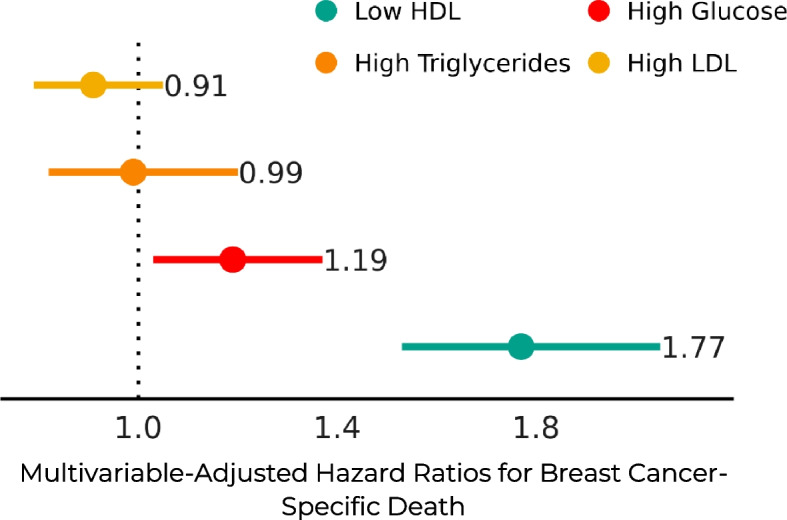
Mean (SD) age at diagnosis was 62.3 (11.8) years. Over a median follow-up of 8.6 years, 2,876 patients died; 1,080 of breast cancer. Patients with low HDL-C (≤ 45 vs. > 45 mg/dL) had higher breast cancer-specific mortality (HR, 1.77; 95% CI, 1.53-2.05), as did those with elevated fasting glucose (> 99 vs. 60-99 mg/dL) (HR, 1.19; 95% CI, 1.03-1.37). Elevated levels of triglycerides and LDL-C were not associated with breast cancer-specific mortality.
High fasting glucose and low HDL-C evaluated over time after cancer diagnosis were associated with higher breast cancer mortality independent of cancer treatments and changes in other metabolic risk factors. Future studies should address whether pharmacologic or lifestyle treatment of glucose and lipids after breast cancer diagnosis can optimize survival outcomes.
代谢异常对乳腺癌预后影响的研究受到样本量小和实验室值评估的限制,通常是在癌症诊断和治疗之前的单一时间点进行评估。在这项基于人群的队列研究中,我们根据癌症治疗情况调整了时间更新的实验室值,以评估代谢危险因素(血糖、高密度脂蛋白胆固醇(HDL-C)、低密度脂蛋白胆固醇(LDL-C)、甘油三酯)与乳腺癌生存之间的关系。
本研究纳入了 2005 年至 2015 年期间在 Kaiser Permanente 诊断为 I-III 期乳腺癌的 13434 名女性。从诊断到 2019 年或死亡,从电子病历中提取所有门诊空腹血糖、HDL-C、LDL-C 和甘油三酯值。使用 Cox 比例风险模型评估乳腺癌特异性死亡率,该模型调整了代谢实验室检查、人口统计学、体重指数、糖尿病、血脂异常和抗高血压药物、肿瘤特征(分期、ER 和 HER2 受体状态)和癌症治疗(化疗、他莫昔芬和芳香酶抑制剂的使用)。
诊断时的平均(标准差)年龄为 62.3(11.8)岁。中位随访 8.6 年后,2876 名患者死亡;其中 1080 人死于乳腺癌。与 HDL-C 水平较高(≤45 与>45mg/dL)的患者相比,HDL-C 水平较低(≤45 与>45mg/dL)的患者乳腺癌特异性死亡率更高(HR,1.77;95%CI,1.53-2.05),空腹血糖水平较高(>99 与 60-99mg/dL)的患者(HR,1.19;95%CI,1.03-1.37)也是如此。甘油三酯和 LDL-C 水平升高与乳腺癌特异性死亡率无关。
在癌症诊断后进行的时间评估中,高空腹血糖和低 HDL-C 与癌症治疗和其他代谢危险因素变化无关,与更高的乳腺癌死亡率相关。未来的研究应探讨乳腺癌诊断后葡萄糖和脂质的药物或生活方式治疗是否可以优化生存结果。