Department of Endocrinology and Metabolism, The First Affiliated Hospital of USTC, Division of Life Sciences and Medicine, University of Science and Technology of China, Hefei, Anhui, China.
Department of Endocrinology and Metabolism, The Third Affiliated Hospital of Sun Yat-sen University, Guangzhou, Guangdong, China.
Front Immunol. 2022 Dec 13;13:1033393. doi: 10.3389/fimmu.2022.1033393. eCollection 2022.
The profile of gut microbiota, serum metabolites, and lipids of type 1 diabetes (T1D) patients with different human leukocyte antigen (HLA) genotypes remains unknown. We aimed to explore gut microbiota, serum metabolites, and lipids signatures in individuals with T1D typed by HLA genotypes.
We did a cross-sectional study that included 73 T1D adult patients. Patients were categorized into two groups according to the HLA haplotypes they carried: those with any two of three susceptibility haplotypes (DR3, DR4, DR9) and without any of the protective haplotypes (DR8, DR11, DR12, DR15, DR16) were defined as high-risk HLA genotypes group (HR, n=30); those with just one or without susceptibility haplotypes as the non-high-risk HLA genotypes group (NHR, n=43). We characterized the gut microbiome profile with 16S rRNA gene amplicon sequencing and analyzed serum metabolites with liquid chromatography-mass spectrometry.
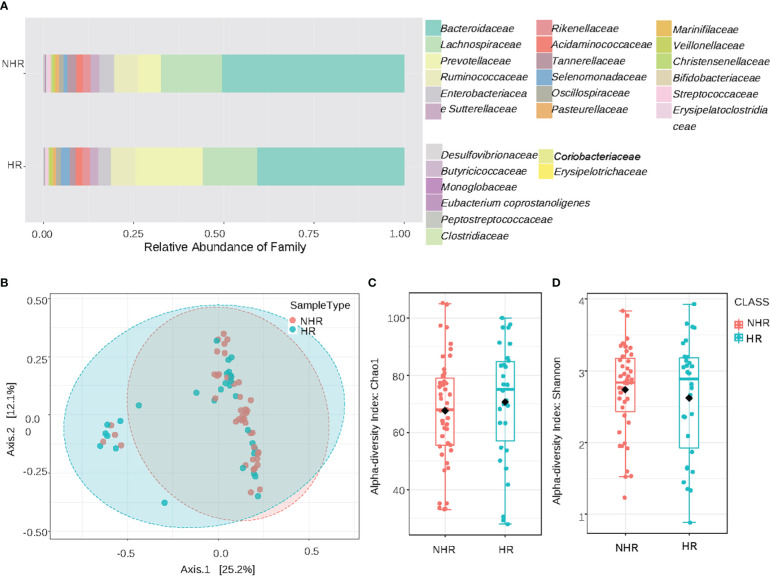
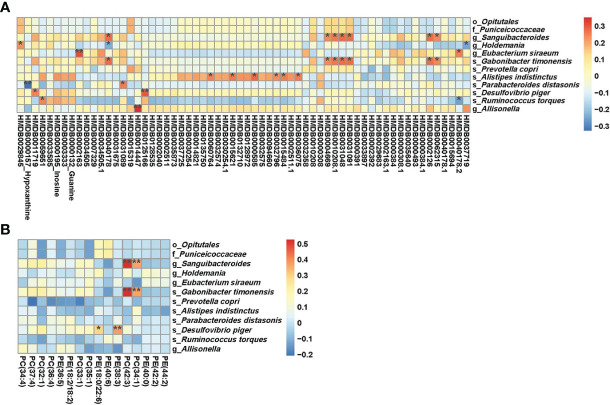
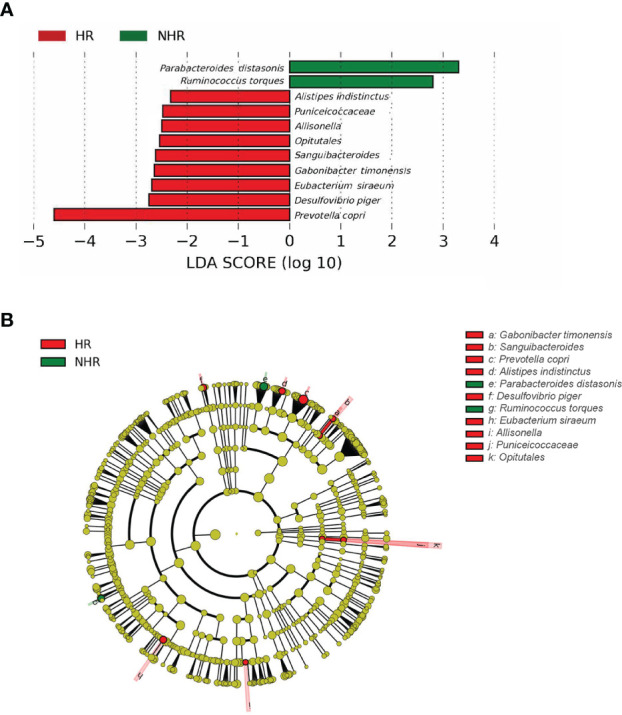
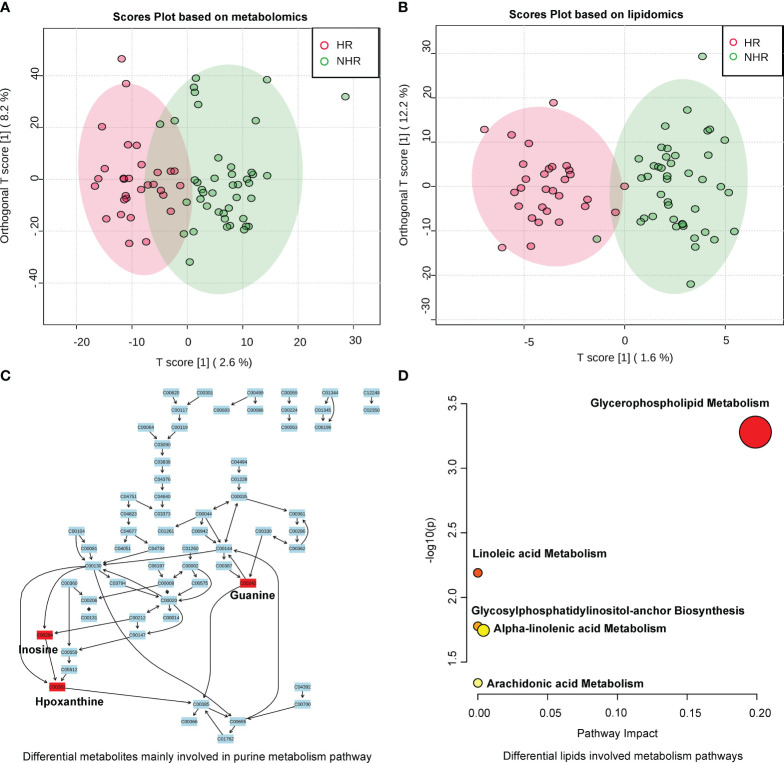
Study individuals were 32.5 (8.18) years old, and 60.3% were female. Compared to NHR, the gut microbiota of HR patients were characterized by elevated abundances of and lowered abundances of . Differential serum metabolites (hypoxanthine, inosine, and guanine) which increased in HR were involved in purine metabolism. Different lipids, phosphatidylcholines and phosphatidylethanolamines, decreased in HR group. Notably, was negatively associated (p ≤ 0.01) with hypoxanthine involved in purine metabolic pathways.
The present findings enabled a better understanding of the changes in gut microbiome and serum metabolome in T1D patients with HLA risk genotypes. Alterations of the gut microbiota and serum metabolites may provide some information for distinguishing T1D patients with different HLA risk genotypes.
不同人类白细胞抗原(HLA)基因型的 1 型糖尿病(T1D)患者的肠道微生物群、血清代谢物和脂质特征尚不清楚。我们旨在探索通过 HLA 基因型分型的 T1D 个体的肠道微生物群、血清代谢物和脂质特征。
我们进行了一项横断面研究,纳入了 73 名成年 T1D 患者。根据携带的 HLA 单倍型,患者分为两组:携带三个易感单倍型(DR3、DR4、DR9)中的任意两个且不携带任何保护性单倍型(DR8、DR11、DR12、DR15、DR16)的患者定义为高风险 HLA 基因型组(HR,n=30);携带一个或不携带易感单倍型的患者定义为非高风险 HLA 基因型组(NHR,n=43)。我们通过 16S rRNA 基因扩增子测序来描述肠道微生物组的特征,并通过液相色谱-质谱分析来分析血清代谢物。
研究对象的年龄为 32.5(8.18)岁,60.3%为女性。与 NHR 相比,HR 患者的肠道微生物群的特征是 和 的丰度增加, 和 的丰度降低。在 HR 中增加的差异血清代谢物(次黄嘌呤、肌苷和鸟嘌呤)参与嘌呤代谢。不同的脂质,磷脂酰胆碱和磷脂酰乙醇胺,在 HR 组中减少。值得注意的是, 与参与嘌呤代谢途径的次黄嘌呤呈负相关(p≤0.01)。
本研究结果使我们更好地了解了具有 HLA 风险基因型的 T1D 患者肠道微生物群和血清代谢组的变化。肠道微生物群和血清代谢物的改变可能为区分具有不同 HLA 风险基因型的 T1D 患者提供一些信息。