Ferl Gregory Z, Barck Kai H, Patil Jasmine, Jemaa Skander, Malamut Evelyn J, Lima Anthony, Long Jason E, Cheng Jason H, Junttila Melissa R, Carano Richard A D
Preclinical & Translational PKPD, Genentech, South San Francisco, CA 94080, USA.
Department of Translational Imaging, Genentech, South San Francisco, CA 94080, USA.
iScience. 2022 Dec 5;25(12):105712. doi: 10.1016/j.isci.2022.105712. eCollection 2022 Dec 22.
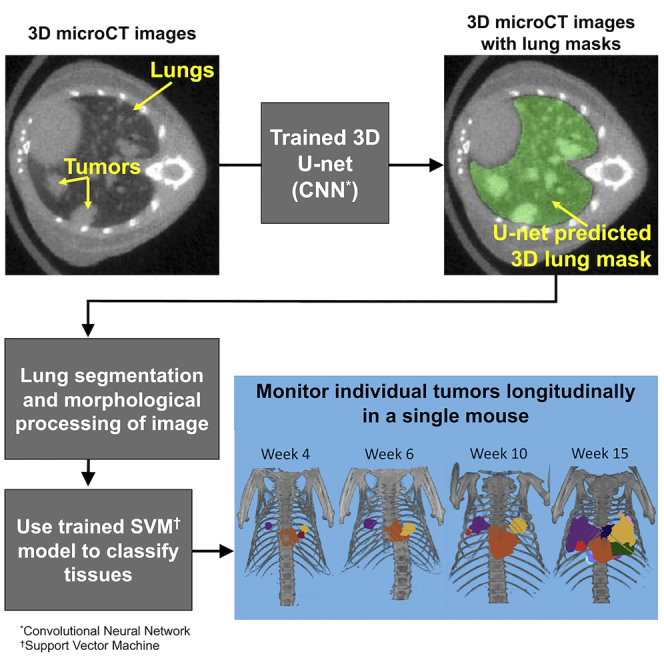
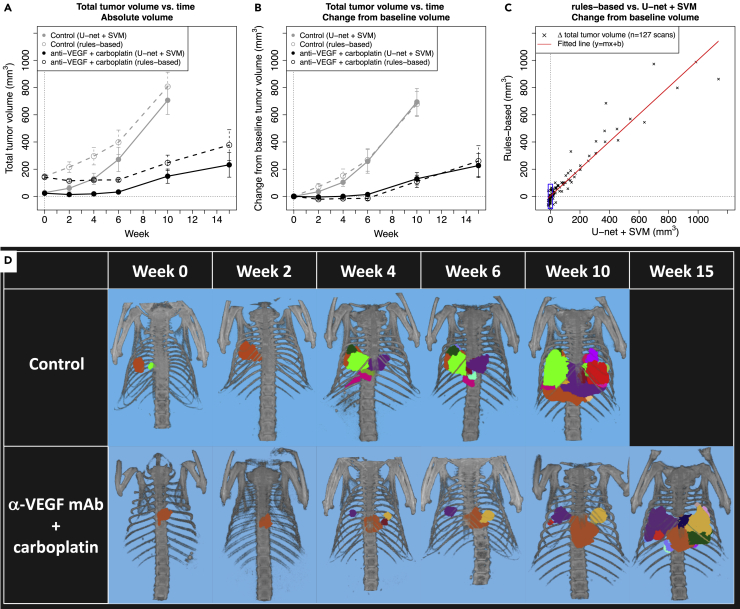
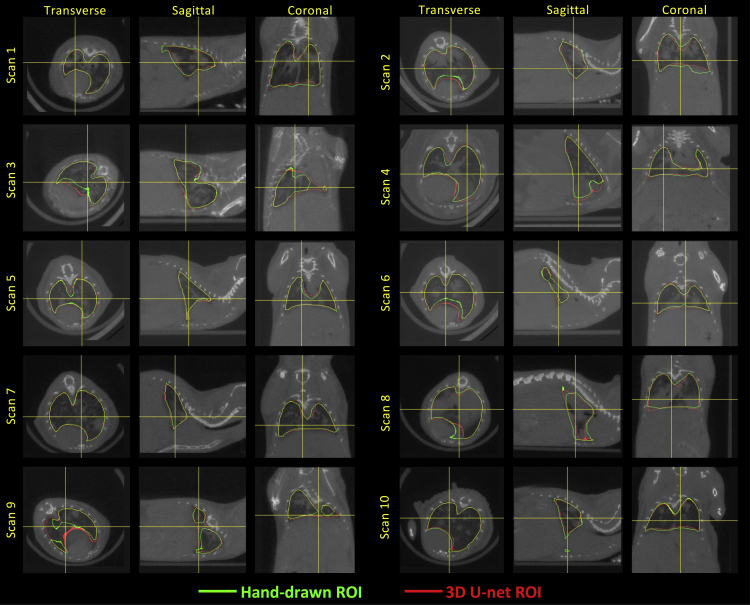
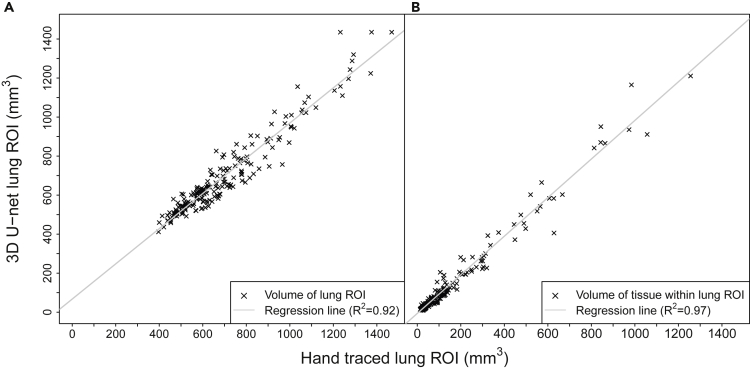
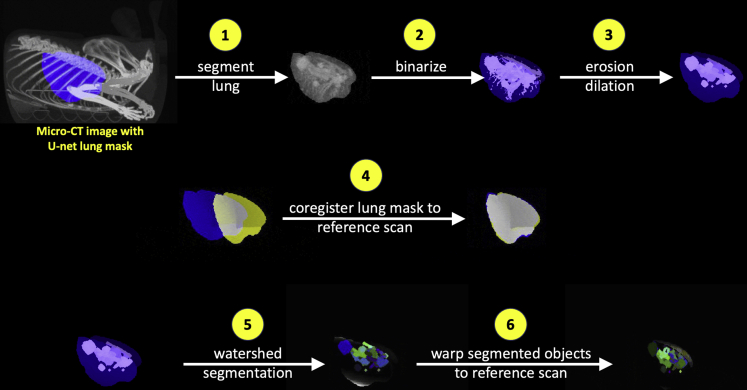
Here, we have developed an automated image processing algorithm for segmenting lungs and individual lung tumors in micro-computed tomography (micro-CT) scans of mouse models of non-small cell lung cancer and lung fibrosis. Over 3000 scans acquired across multiple studies were used to train/validate a 3D U-net lung segmentation model and a Support Vector Machine (SVM) classifier to segment individual lung tumors. The U-net lung segmentation algorithm can be used to estimate changes in soft tissue volume within lungs (primarily tumors and blood vessels), whereas the trained SVM is able to discriminate between tumors and blood vessels and identify individual tumors. The trained segmentation algorithms (1) significantly reduce time required for lung and tumor segmentation, (2) reduce bias and error associated with manual image segmentation, and (3) facilitate identification of individual lung tumors and objective assessment of changes in lung and individual tumor volumes under different experimental conditions.
在此,我们开发了一种自动图像处理算法,用于在非小细胞肺癌和肺纤维化小鼠模型的微型计算机断层扫描(micro-CT)中分割肺部和单个肺肿瘤。在多项研究中获取的3000多张扫描图像用于训练/验证一个3D U-net肺部分割模型和一个支持向量机(SVM)分类器,以分割单个肺肿瘤。U-net肺部分割算法可用于估计肺内软组织体积的变化(主要是肿瘤和血管),而经过训练的SVM能够区分肿瘤和血管并识别单个肿瘤。经过训练的分割算法(1)显著减少了肺部和肿瘤分割所需的时间,(2)减少了与手动图像分割相关的偏差和误差,(3)便于识别单个肺肿瘤,并客观评估不同实验条件下肺和单个肿瘤体积的变化。