Rostropovich Vishnevskaya Foundation, 1776 K Street, NW, Washington, D.C. 20006, USA; MedStar Georgetown University, 4200 Wisconsin Ave NW, Suite 200, Washington D.C2. 200162, USA.
Caritas Baby Hospital, Caritas Street, Bethlehem, West Bank, Palestine.
Vaccine. 2023 Jan 23;41(4):945-954. doi: 10.1016/j.vaccine.2022.12.046. Epub 2022 Dec 28.
Rotavirus infection remains an important cause of morbidity and mortality in children. The introduction of vaccination programs in more than 100 countries has contributed to a decrease in hospitalizations and mortality. This study investigates the epidemiological impact of the rotavirus vaccine ROTAVAC® in the Palestinian Territories, the first country to switch from ROTARIX® to this new vaccine.
Clinical surveillance data was collected fromchildren younger than 5attendingoutpatient clinics throughout Gaza withdiarrhea between 2015 and 2020. The incidence of all-cause diarrhea was assessed using an interrupted time-series approach. Rotavirus prevalence was determined at the Caritas Baby Hospital in the West Bank usingELISA on stool specimen of children younger than 5with diarrhea. Genotyping was performed on 325 randomly selected rotavirus-positive samples from January 2015 through December 2020 using multiplex PCR analysis.
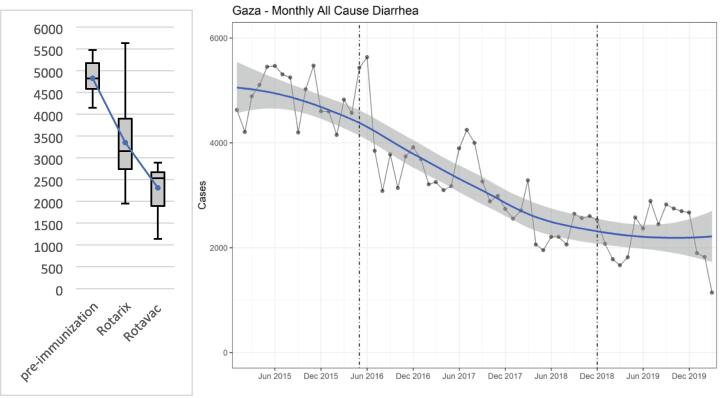
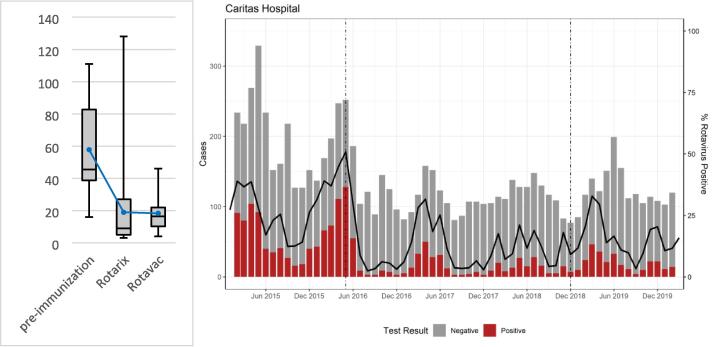
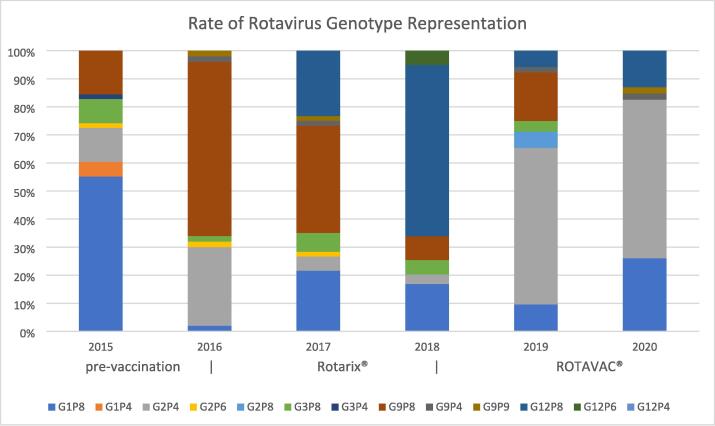
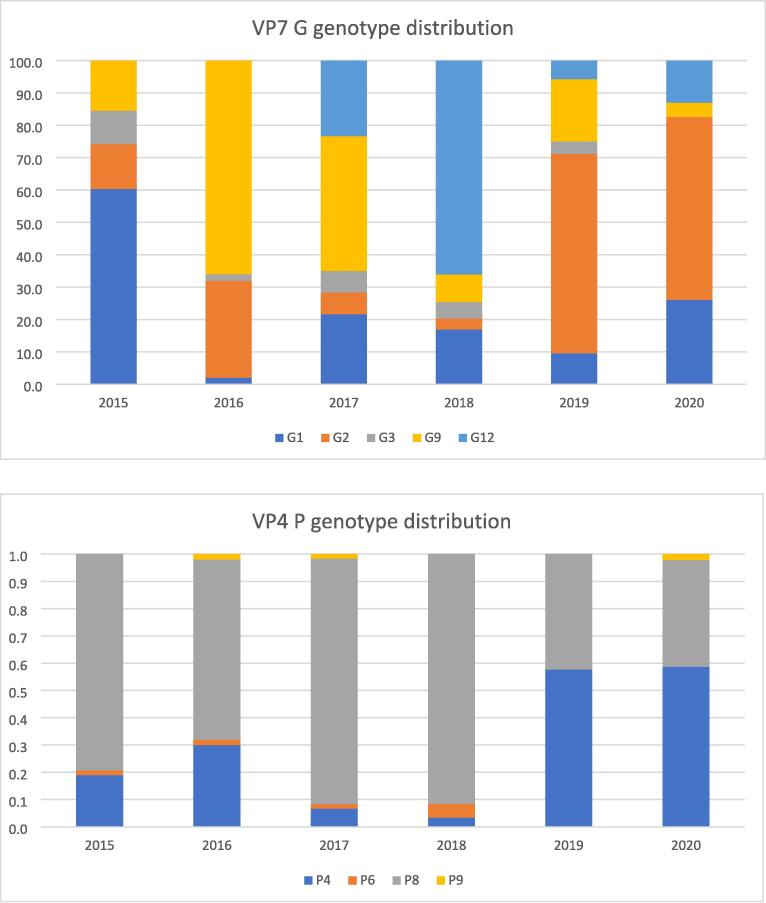
Average monthly diarrhea casesdropped by 16.7% annually fromintroduction of rotavirus vaccination in May 2016 to the beginning of the SARS-CoV-2 epidemic in March 2020 for a total of 53%. Case count declines were maintained afterthe switchto ROTAVAC® in October 2018. Rotavirus positivity in stool samples declined by 67.1% over the same period without change followingthe switch to ROTAVAC®. The distribution of predominant genotypes in rotavirus-positive stool samples changed from a pre-vaccination G1P [8] to G9P[8] and G12P[8] during the ROTARIX® period and G2P[4] after the introduction of ROTAVAC®.
ROTAVAC® has shown epidemiological impact on par with ROTARIX® after its introduction to the national immunization schedule in the Palestinian Territories. A molecular genotype shift from a pre-vaccination predominance of G1P[8] to a current predominance of G2P[4] requires more long-term surveillance.
轮状病毒感染仍然是导致儿童发病和死亡的重要原因。在 100 多个国家推出疫苗接种计划,有助于降低住院率和死亡率。本研究调查了轮状病毒疫苗 ROTAVAC®在巴勒斯坦领土的流行病学影响,该领土是第一个从 ROTARIX®转向这种新疫苗的国家。
从 2015 年至 2020 年,在加沙各地的门诊诊所,收集了 5 岁以下患有腹泻的儿童的临床监测数据。采用中断时间序列法评估全因腹泻的发病率。在西岸的慈善婴儿医院,使用酶联免疫吸附试验(ELISA)检测 5 岁以下腹泻儿童的粪便样本,确定轮状病毒的流行率。2015 年 1 月至 2020 年 12 月,使用多重 PCR 分析对 325 份随机选择的轮状病毒阳性样本进行基因分型。
自 2016 年 5 月轮状病毒疫苗接种引入以来,平均每月腹泻病例每年下降 16.7%,共计 53%。从 2018 年 10 月改用 ROTAVAC®到 2020 年 3 月 SARS-CoV-2 疫情开始,病例数下降仍在持续。在此期间,轮状病毒阳性粪便样本的阳性率下降了 67.1%,改用 ROTAVAC®后没有变化。轮状病毒阳性粪便样本中主要基因型的分布从疫苗接种前的 G1P[8]转变为 ROTARIX®期间的 G9P[8]和 G12P[8],以及 ROTAVAC®引入后的 G2P[4]。
在巴勒斯坦领土的国家免疫计划中引入 ROTAVAC®后,其对流行病学的影响与 ROTARIX®相当。从疫苗接种前 G1P[8]的优势转变为目前 G2P[4]的优势,需要进行更多的长期监测。