Institute of Neuroradiology, University Hospital Leipzig, 04103 Leipzig, Germany.
Department of Radiology, University Hospital Leipzig, 04103 Leipzig, Germany.
Neuroimage Clin. 2023;37:103310. doi: 10.1016/j.nicl.2022.103310. Epub 2022 Dec 29.
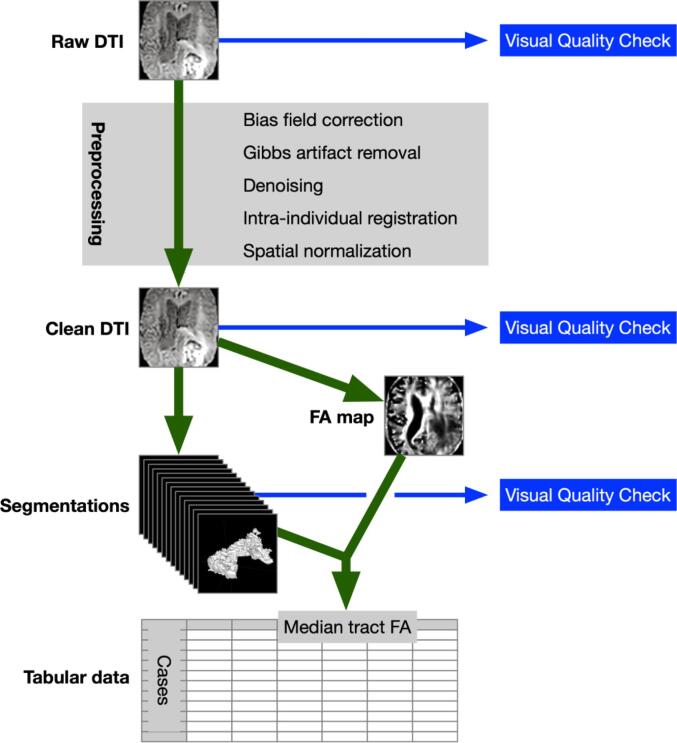
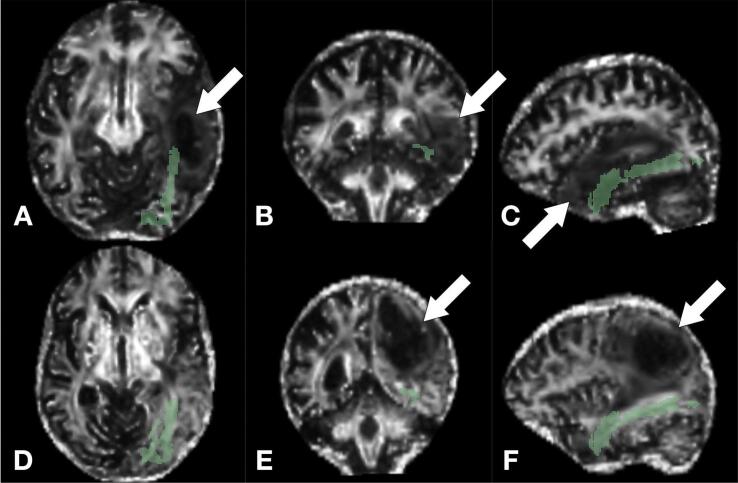
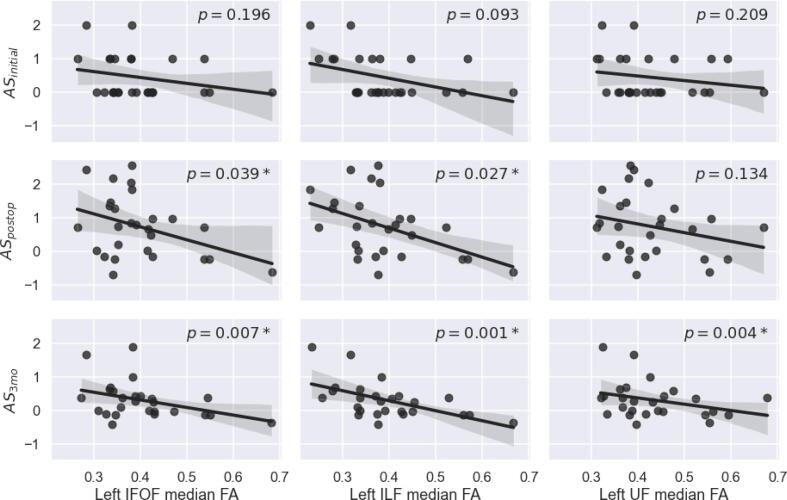
Aphasia can occur in a broad range of pathological conditions that affect cortical or subcortical structures. Here we test the hypothesis that white matter integrity of language pathways assessed by preoperative diffusion tensor imaging (DTI) is associated with language performance and its recovery after glioma resection. 27 patients with preoperative DTI were included. Segmentation of the arcuate fascicle (AF), the inferior fronto-occipital fascicle (IFOF), the inferior longitudinal fascicle (ILF), the superior longitudinal fascicle (SLF), and the uncinate fascicle (UF) was performed with a fully-connected neural network (FCNN, TractSeg). Median fractional anisotropy (FA) was extracted from the resulting volumes as surrogate marker for white matter integrity and tested for correlation with clinical parameters. After correction for demographic data and multiple testing, preoperative white matter integrity of the IFOF, the ILF, and the UF in the left hemisphere were independently and significantly associated with aphasia three months after surgery. Comparison between patients with and without aphasia three months after surgery revealed significant differences in preoperative white matter integrity of the left AF (p = 0.021), left IFOF (p = 0.015), left ILF (p = 0.003), left SLF (p = 0.001, p = 0.021, p = 0.043 for respective sub-bundles 1-3), left UF (p = 0.041) and the right AF (p = 0.027). Preoperative assessment of white matter integrity of the language network by time-efficient MRI protocols and FCNN-driven segmentation may assist in the evaluation of postoperative rehabilitation potential in glioma patients.
失语症可发生于广泛的病理条件下,这些条件影响皮质或皮质下结构。在这里,我们检验了假设,即术前弥散张量成像(DTI)评估的语言通路的白质完整性与语言表现及其在脑胶质瘤切除术后的恢复有关。我们纳入了 27 名术前接受 DTI 的患者。使用全连接神经网络(FCNN,TractSeg)对弓状束(AF)、下额枕束(IFOF)、下纵束(ILF)、上纵束(SLF)和钩束(UF)进行分割。从生成的体积中提取中位数各向异性分数(FA)作为白质完整性的替代标志物,并测试与临床参数的相关性。在对人口统计学数据和多次测试进行校正后,左半球术前 IFOF、ILF 和 UF 的白质完整性与术后 3 个月的失语症独立且显著相关。术后 3 个月有和无失语症的患者之间的比较显示,左 AF(p=0.021)、左 IFOF(p=0.015)、左 ILF(p=0.003)、左 SLF(p=0.001,p=0.021,p=0.043,分别为相应的子束 1-3)、左 UF(p=0.041)和右 AF(p=0.027)的术前白质完整性存在显著差异。通过高效的 MRI 方案和 FCNN 驱动的分割对语言网络的白质完整性进行术前评估,可能有助于评估脑胶质瘤患者术后康复的潜力。