Department of Health Statistics, School of Public Health and Health Management, Gannan Medical University, Ganzhou, China.
Department of Urology, First Affiliated Hospital of Gannan Medical University, Ganzhou, China.
Front Public Health. 2022 Dec 14;10:1075428. doi: 10.3389/fpubh.2022.1075428. eCollection 2022.
Ambient temperature change is a risk factor for urolithiasis that cannot be ignored. The association between temperature and urolithiasis varies from region to region. Our study aimed to analyze the impact of extremely high and low temperatures on the number of inpatients for urolithiasis and their lag effect in Ganzhou City, China.
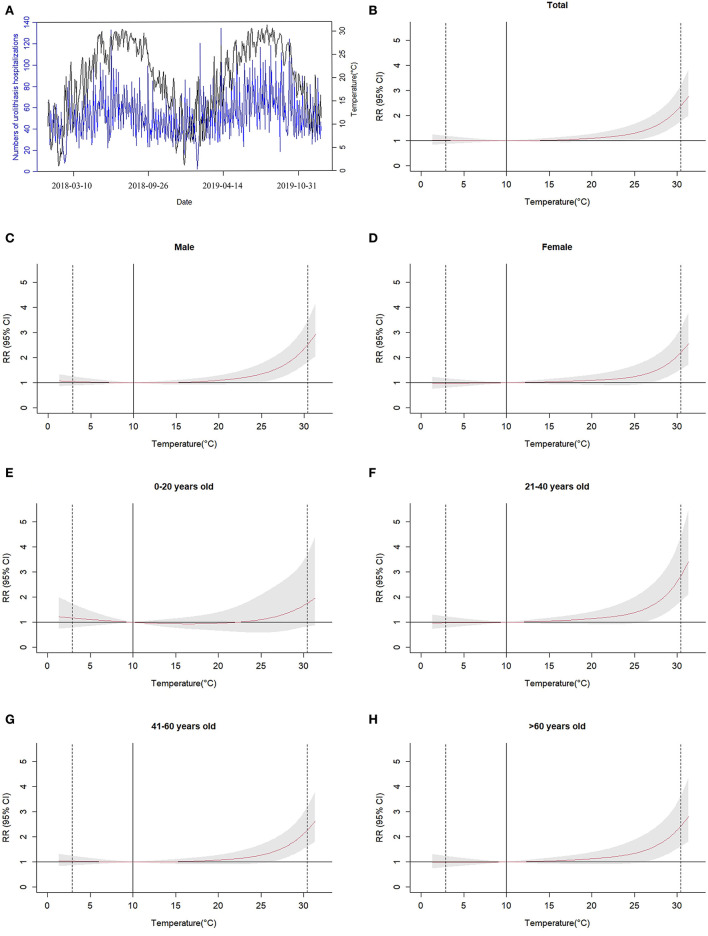
We collected the daily number of inpatients with urolithiasis in Ganzhou from 2018 to 2019 and the meteorological data for the same period. The exposure-response relationship between the daily mean temperature and the number of inpatients with urolithiasis was studied by the distributed lag non-linear model (DLNM). The effect of extreme temperatures was also analyzed. A stratification analysis was performed for different gender and age groups.
There were 38,184 hospitalizations for urolithiasis from 2018 to 2019 in Ganzhou. The exposure-response curve between the daily mean temperature and the number of inpatients with urolithiasis in Ganzhou was non-linear and had an observed lag effect. The warm effects (30.4°C) were presented at lag 2 and lag 5-lag 9 days, and the cold effects (2.9°C) were presented at lag 8 and lag 3-lag 4 days. The maximum cumulative warm effects were at lag 0-10 days (cumulative relative risk, CRR = 2.379, 95% CI: 1.771, 3.196), and the maximum cumulative cold effects were at lag 0-5 (CRR = 1.182, 95% CI: 1.054, 1.326). Men and people between the ages of 21 and 40 were more susceptible to the extreme temperatures that cause urolithiasis.
Extreme temperature was correlated with a high risk of urolithiasis hospitalizations, and the warm effects had a longer duration than the cold effects. Preventing urolithiasis and protecting vulnerable people is critical in extreme temperature environments.
环境温度变化是尿路结石的一个不可忽视的危险因素。温度与尿路结石之间的关系因地区而异。我们的研究旨在分析极高和极低温度对中国赣州市尿路结石住院人数的影响及其滞后效应。
我们收集了 2018 年至 2019 年赣州市尿路结石住院患者的日住院人数和同期气象数据。采用分布式滞后非线性模型(DLNM)研究日平均温度与尿路结石住院人数之间的暴露-反应关系。还分析了极端温度的影响。对不同性别和年龄组进行了分层分析。
2018 年至 2019 年,赣州市共有 38184 例尿路结石住院患者。赣州市日平均温度与尿路结石住院人数之间的暴露-反应曲线是非线性的,存在观察到的滞后效应。温暖效应(30.4°C)出现在滞后 2 天和滞后 5-9 天,寒冷效应(2.9°C)出现在滞后 8 天和滞后 3-4 天。最大累积温暖效应出现在滞后 0-10 天(累积相对风险,CRR=2.379,95%CI:1.771,3.196),最大累积寒冷效应出现在滞后 0-5 天(CRR=1.182,95%CI:1.054,1.326)。男性和 21-40 岁之间的人群更容易受到导致尿路结石的极端温度的影响。
极端温度与尿路结石住院的高风险相关,温暖效应的持续时间长于寒冷效应。在极端温度环境中,预防尿路结石和保护弱势群体至关重要。