Division of Pediatric Research Administration, Department of Pediatrics, Children's Hospital Los Angeles, Los Angeles, CA, United States.
Division of Neurology, Department of Pediatrics, Children's Hospital Los Angeles, Los Angeles, CA, United States.
Front Public Health. 2022 Dec 15;10:1061049. doi: 10.3389/fpubh.2022.1061049. eCollection 2022.
Environmental resources are related to childhood obesity risk and altered brain development, but whether these relationships are stable or if they have sustained impact is unknown. Here, we utilized a multidimensional index of childhood neighborhood conditions to compare the influence of various social and environmental disparities (SED) on body mass index (BMI)-brain relationships over a 2-year period in early adolescence.
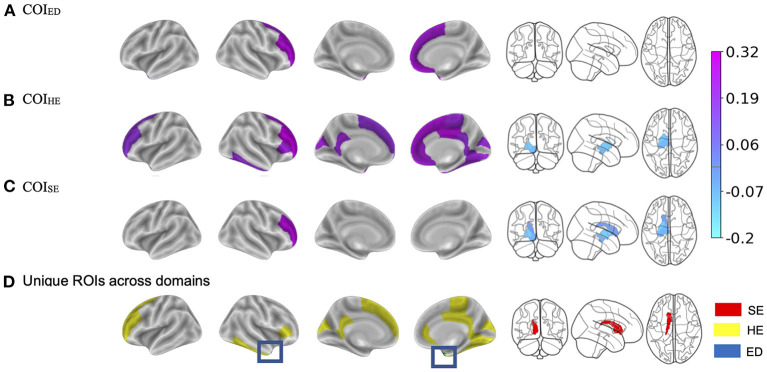
Data were gathered the Adolescent Brain Cognitive Development Study ( = 2,970, 49.8% female, 69.1% White, no siblings). Structure magnetic resonance imaging (sMRI), anthropometrics, and demographic information were collected at baseline (9/10-years-old) and the 2-year-follow-up (11/12-years-old). Region of interest (ROIs; 68 cortical, 18 subcortical) estimates of cortical thickness and subcortical volume were extracted from sMRI Tw images using the Desikan atlas. Residential addresses at baseline were used to obtain geocoded estimates of SEDs from 3 domains of childhood opportunity index (COI): healthy environment (COI), social/economic (COI), and education (COI). Nested, random-effects mixed models were conducted to evaluate relationships of BMI with (1) ROI COI and (2) ROI COI Time. Models controlled for sex, race, ethnicity, puberty, and the other two COI domains of non-interest, allowing us to estimate the unique variance explained by each domain and its interaction with ROI and time.
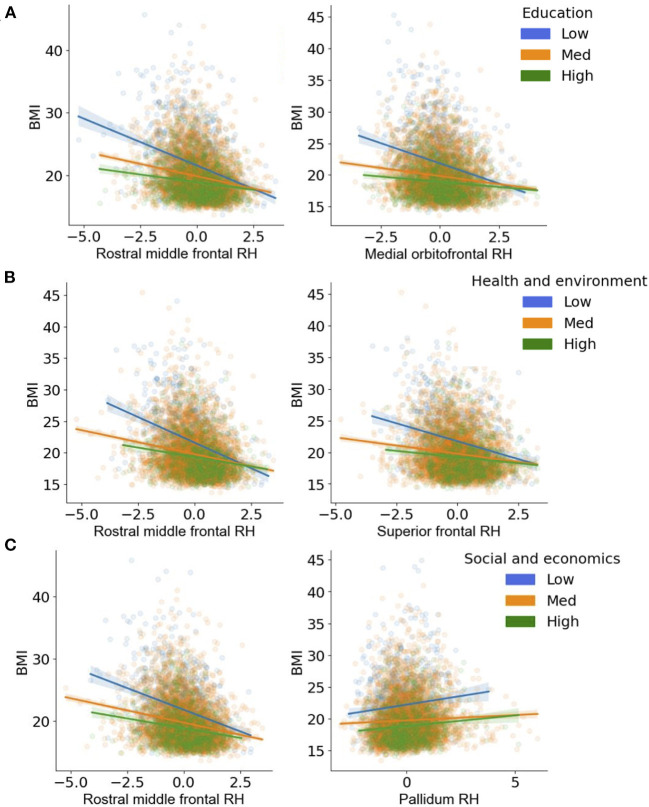
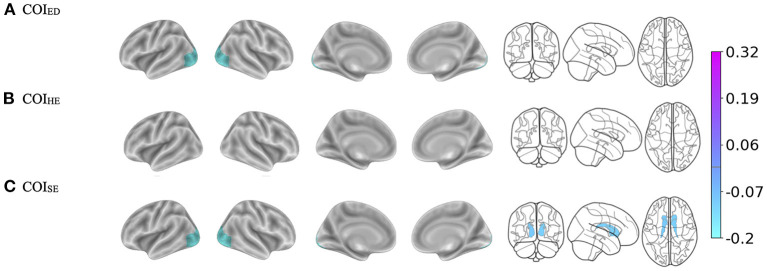
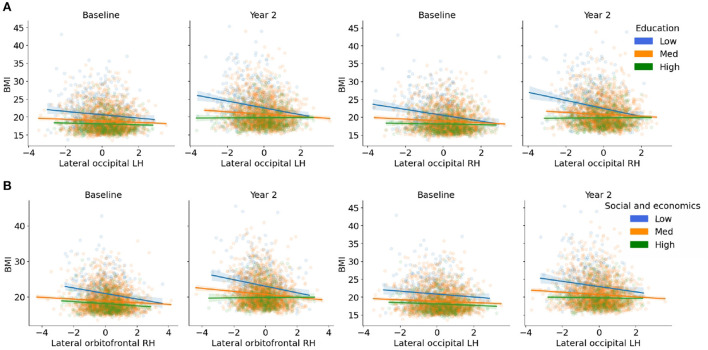
Youth living in areas with lower COI and COI scores were heavier at the 2-year follow-up than baseline and exhibited greater thinning in the bilateral occipital cortex between visits. Lower COI scores corresponded with larger volume of the bilateral caudate and greater BMI at the 2-year follow-up. COI scores showed the greatest associations ( = 20 ROIs) with brain-BMI relationships: youth living in areas with lower COI had thinner cortices in prefrontal regions and larger volumes of the left pallidum and Ventral DC. Time did not moderate the COI x ROI interaction for any brain region during the examined 2-year period. Findings were independent of family income (i.e., income-to-needs).
Collectively our findings demonstrate that neighborhood SEDs for health-promoting resources play a particularly important role in moderating relationships between brain and BMI in early adolescence regardless of family-level financial resources.
环境资源与儿童肥胖风险和大脑发育改变有关,但这些关系是否稳定,或者它们是否具有持续影响尚不清楚。在这里,我们利用儿童期邻里环境的多维指数,比较了各种社会和环境差异(SED)在青少年早期的 2 年内对体重指数(BMI)-大脑关系的影响。
数据来自青少年大脑认知发展研究(n=2970,49.8%为女性,69.1%为白人,无兄弟姐妹)。在基线(9/10 岁)和 2 年随访(11/12 岁)时收集结构磁共振成像(sMRI)、人体测量学和人口统计学信息。使用 Desikan 图谱从 sMRI Tw 图像中提取皮质厚度和皮质下体积的感兴趣区(ROI;68 个皮质,18 个皮质下)估计值。在基线时的居住地址用于从儿童机会指数(COI)的 3 个领域获取 SED 的地理编码估计值:健康环境(COI)、社会/经济(COI)和教育(COI)。采用嵌套随机效应混合模型评估 BMI 与(1)ROI-COI 和(2)ROI-COI-TIME 的关系。模型控制了性别、种族、民族、青春期和另外两个非关注 COI 领域,使我们能够估计每个领域的独特方差及其与 ROI 和时间的相互作用。
在 2 年随访时,生活在 COI 和 COI 评分较低地区的年轻人比基线时体重更重,在随访期间双侧枕叶皮质变薄。较低的 COI 评分与双侧尾状核体积较大和 2 年随访时 BMI 较大相关。COI 评分与大脑-BMI 关系的相关性最大(=20 个 ROI):生活在 COI 较低地区的年轻人在前额叶区域的皮质较薄,左侧苍白球和腹侧 DC 的体积较大。在研究的 2 年期间,时间没有调节 COI x ROI 相互作用的任何大脑区域。研究结果独立于家庭收入(即收入与需求之比)。
总的来说,我们的研究结果表明,促进健康的资源的邻里 SED 在调节青少年早期大脑和 BMI 之间的关系方面发挥着特别重要的作用,而不论家庭层面的经济资源如何。