Department of Oncology, Molecular Oncology Research Institute, The First Affiliated Hospital of Fujian Medical University, Fuzhou 350005, China.
Department of Oncology, National Regional Medical Center, Binhai Campus of the First Affiliated Hospital, Fujian Medical University, Fuzhou 350212, China.
Dis Markers. 2022 Dec 23;2022:3610038. doi: 10.1155/2022/3610038. eCollection 2022.
There is accumulating evidence that the lymphocyte-to-monocyte ratio (LMR) is related to the outcomes of cancer patients treated with immune checkpoint inhibitors (ICIs). However, the results remain controversial.
Electronic databases were searched to retrieve the studies that explore the relationship between LMR and the efficacy of ICIs. The primary endpoints were overall survival (OS) and progression-free survival (PFS), evaluated by the hazard ratios (HRs) with 95% confidence intervals (CI), and the secondary endpoints included disease control rate (DCR) and immune-related adverse events (irAEs), assessed by the odd ratios (ORs) with 95% CI.
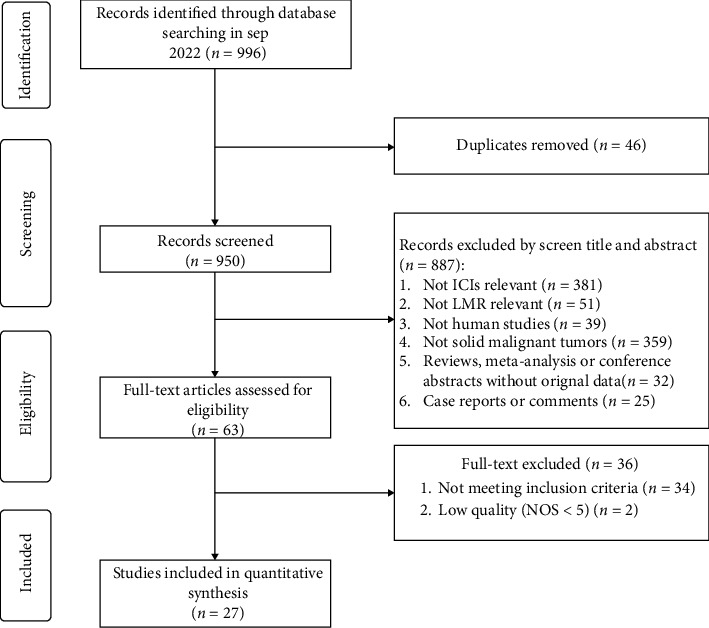
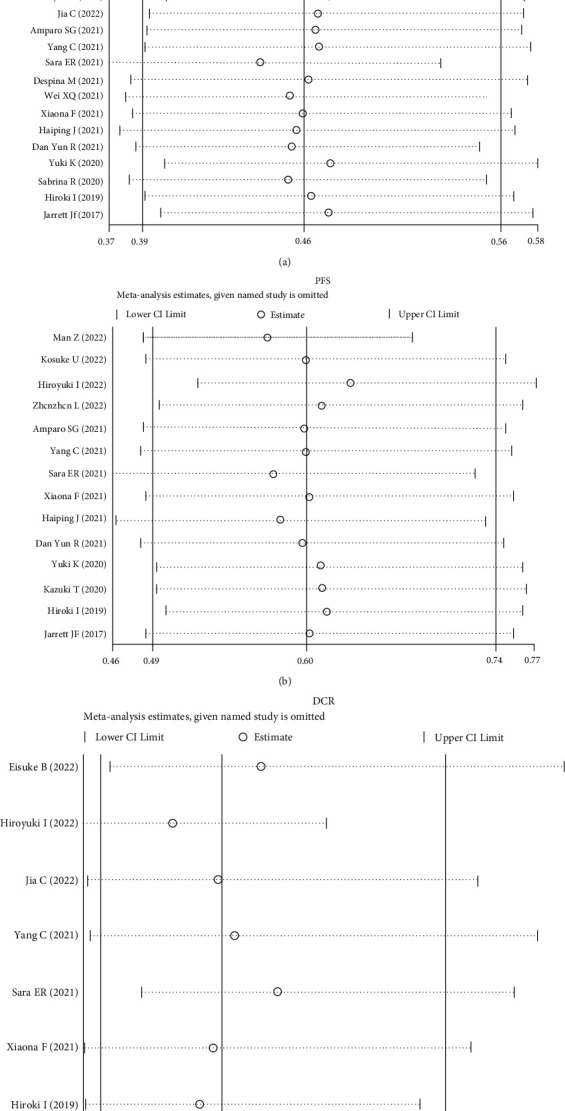
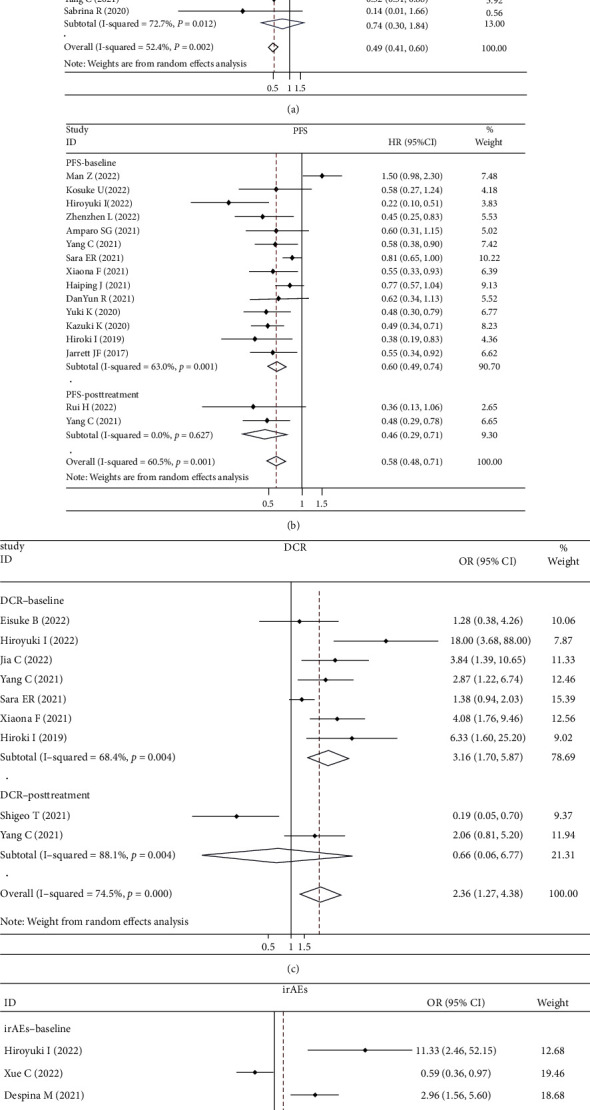
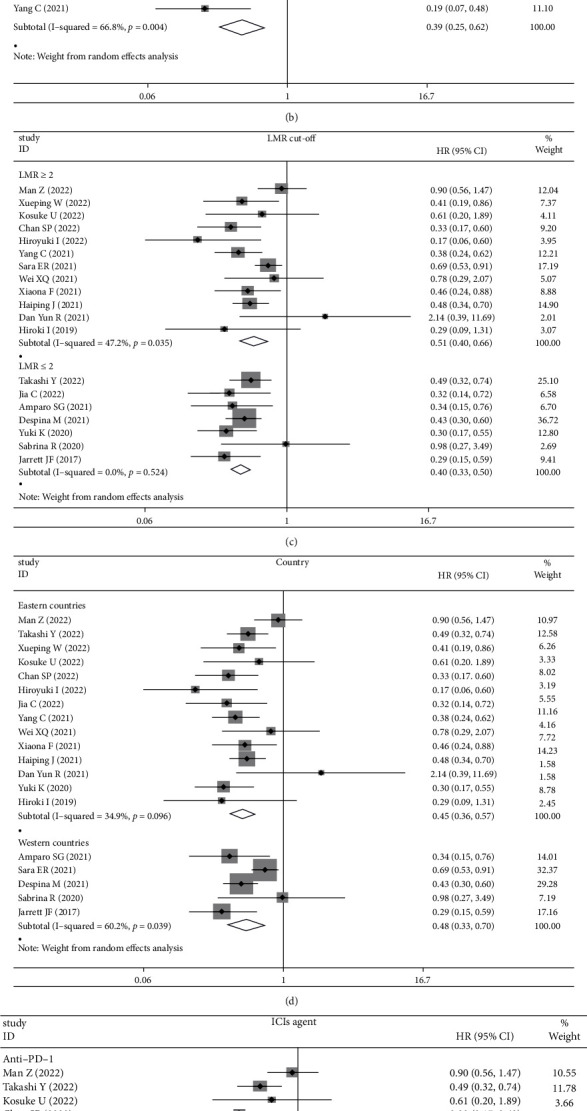
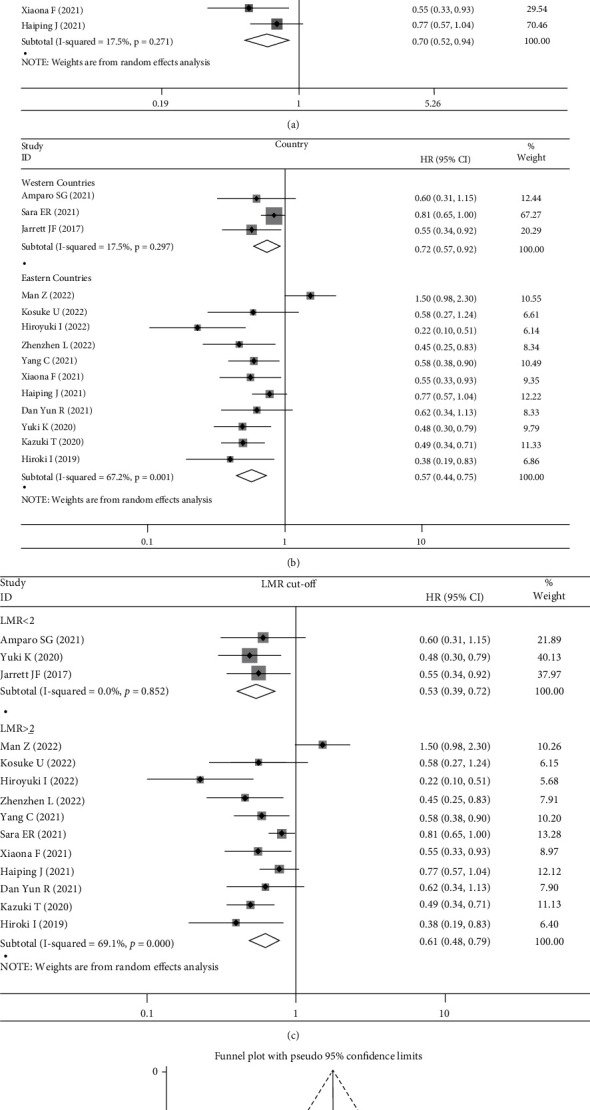
A total of 27 studies involving 4,322 patients were eligible for analysis. The results indicated that increased LMR at baseline was associated with a superior OS (HR: 0.46, 95% CI: 0.39-0.56, < 0.001), PFS (HR: 0.60, 95% CI: 0.49-0.74, < 0.001), and DCR (OR: 3.16, 95% CI: 1.70-5.87, < 0.001). Posttreatment LMR was linked to a better PFS (HR: 0.46, 95% CI: 0.29-0.71, = 0.001), but failed to show this correlation in the analysis of OS and DCR. No correlation existed between LMR and irAEs regardless of the testing time (baseline or posttreatment). Subgroup analyses focusing on baseline LMR revealed that higher baseline LMR possessed a better OS in renal cell cancer (RCC) arm, nonsmall cell lung cancer (NSCLC) arm, multiple cancer arm, monotherapy arm, LMR <2 arm, LMR ≥2 arm, western countries arm, eastern countries arm, and anti-PD-1 arm. Higher baseline LMR correlated with better PFS in RCC arm, NSCLC arm, gastric cancer (GC) arm, multiple cancer arm, LMR <2 arm, LMR ≥2 arm, western countries arm, and eastern countries arm.
Higher LMR at baseline was positively correlated with a superior OS, PFS, and DCR for ICIs, but not with irAEs.
越来越多的证据表明,淋巴细胞与单核细胞比值(LMR)与接受免疫检查点抑制剂(ICIs)治疗的癌症患者的预后相关。然而,结果仍存在争议。
检索电子数据库以获取探讨 LMR 与 ICI 疗效之间关系的研究。主要终点是总生存期(OS)和无进展生存期(PFS),采用风险比(HR)及其 95%置信区间(CI)进行评估,次要终点包括疾病控制率(DCR)和免疫相关不良事件(irAEs),采用比值比(OR)及其 95%CI 进行评估。
共有 27 项研究纳入 4322 例患者,符合分析标准。结果表明,基线时 LMR 升高与 OS(HR:0.46,95%CI:0.39-0.56,<0.001)、PFS(HR:0.60,95%CI:0.49-0.74,<0.001)和 DCR(OR:3.16,95%CI:1.70-5.87,<0.001)的改善相关。治疗后 LMR 与 PFS 的改善相关(HR:0.46,95%CI:0.29-0.71,=0.001),但在 OS 和 DCR 的分析中未显示出相关性。无论检测时间(基线或治疗后)如何,LMR 均与 irAEs 无关。以基线 LMR 为重点的亚组分析表明,在肾细胞癌(RCC)、非小细胞肺癌(NSCLC)、多种癌症、单药治疗、LMR<2、LMR≥2、西方国家和东亚国家以及抗 PD-1 组中,较高的基线 LMR 与更好的 OS 相关。在 RCC、NSCLC、胃癌(GC)、多种癌症、LMR<2、LMR≥2、西方国家和东亚国家中,较高的基线 LMR 与更好的 PFS 相关。
较高的基线 LMR 与 OS、PFS 和 DCR 的改善相关,但与 irAEs 无关。