Department of Thoracic Cancer 1, Cancer Hospital of China Medical University, Liaoning Cancer Hospital & Institute, Xiaoheyan Road, Dadong District, Shenyang, 110042, Liaoning Province, P. R. China.
BMC Cancer. 2022 Jul 28;22(1):824. doi: 10.1186/s12885-022-09744-5.
ICIs have remarkably affected the treatment strategies for numerous malignancies, including lung cancer. However, only a fraction of patients experience durable responses to ICIs; thus, there is an urgent need to identify the parameters related to ICI therapeutic effects. In this study, we investigated nutritional status surrogates and several serum markers to estimate the efficacy of ICIs.
The records of 66 patients with stage III/IV lung cancer who received ICIs were retrospectively analyzed. Features of patients' clinical pathology, including age, sex, histology, line of treatment, BMI, serum albumin, serum creatinine, and serum inflammatory markers such as LMR and PLR, were examined. Progression-free survival was the primary endpoint. Relationships among categorical variables were assessed by the chi-squared test. Survival analysis was performed using the Kaplan-Meier method followed by the log-rank test. Cox multivariate analysis was performed to analyze the association between each variable and the survival time of patients.
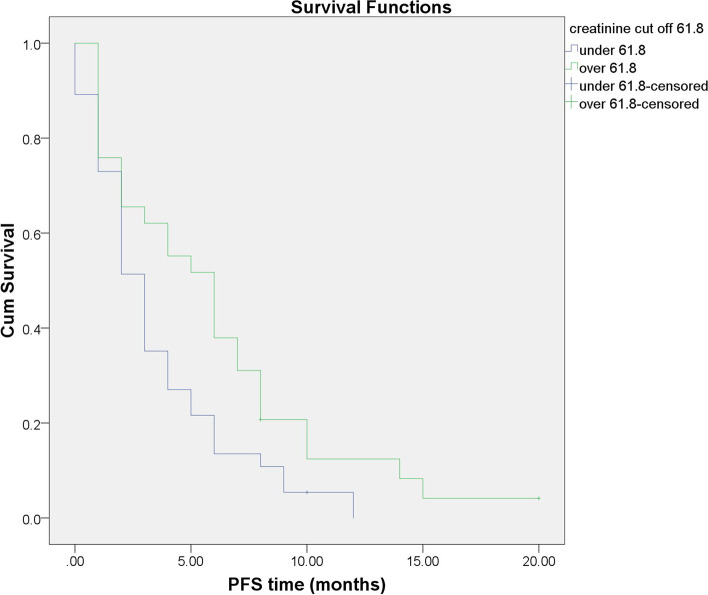
The patients with BMI ≥ 25 (kg/m2), serum ALB≥37 (g/dL), serum creatinine ≥61.8 (μmol/L), LMR ≥ 2.12 had a significantly prolonged PFS in comparison with BMI<25 (kg/m2), ALB<37 (g/dL), creatinine<61.8 (μmol/L), LMR<2.12 (p < 0.05). No statistically significant difference was detected between patients with PLR < 135 and PLR ≥ 135 (p = 0.612). Multivariate analysis revealed that ALB≥37 (g/dL) and creatinine ≥ 61.8 (μmol/L) were associated with prolonged PFS, while statistical significance was not achieved in the BMI groups.
The current results indicated that high BMI is related to longer PFS in lung cancer patients treated with ICIs, which may be correlated with high levels of serum albumin and creatinine.
免疫检查点抑制剂(ICIs)显著影响了包括肺癌在内的多种恶性肿瘤的治疗策略。然而,只有一小部分患者对 ICI 治疗有持久的反应;因此,迫切需要确定与 ICI 治疗效果相关的参数。在这项研究中,我们研究了营养状况替代物和几种血清标志物,以评估 ICI 的疗效。
回顾性分析了 66 例接受 ICI 治疗的 III/IV 期肺癌患者的病历。检查了患者临床病理特征,包括年龄、性别、组织学、治疗线数、BMI、血清白蛋白、血清肌酐和血清炎症标志物,如 LMR 和 PLR。无进展生存期是主要终点。采用卡方检验评估分类变量之间的关系。采用 Kaplan-Meier 法进行生存分析,然后采用对数秩检验进行比较。采用 Cox 多因素分析分析每个变量与患者生存时间的关系。
与 BMI<25(kg/m2)、ALB<37(g/dL)、肌酐<61.8(μmol/L)、LMR<2.12 相比,BMI≥25(kg/m2)、ALB≥37(g/dL)、肌酐≥61.8(μmol/L)、LMR≥2.12 的患者 PFS 明显延长(p<0.05)。PLR<135 和 PLR≥135 之间的患者差异无统计学意义(p=0.612)。多因素分析显示,ALB≥37(g/dL)和肌酐≥61.8(μmol/L)与 PFS 延长有关,而 BMI 组无统计学意义。
目前的结果表明,高 BMI 与接受 ICI 治疗的肺癌患者的 PFS 延长有关,这可能与高水平的血清白蛋白和肌酐有关。