Centro EMA, Guarda, Portugal.
Department of Nursing and Physical Therapy, University of Salamanca, Salamanca, Spain.
Eur J Phys Rehabil Med. 2023 Feb;59(1):42-53. doi: 10.23736/S1973-9087.22.07554-2. Epub 2023 Jan 4.
Neck pain is associated with decreased health-related quality of life, decreased work productivity, and increased visits to health care providers.
The aim of this study was to assess the effectiveness of "Global Postural Re-education" (GPR) versus a neck specific exercise (SE) program on neck pain, disability, cervical range of movement, postural stability, and activity of the superficial cervical flexor muscles.
A parallel-group and single-blinded clinical trial.
Community interventions.
Fifty women with non-specific chronic neck pain (NSCNP).
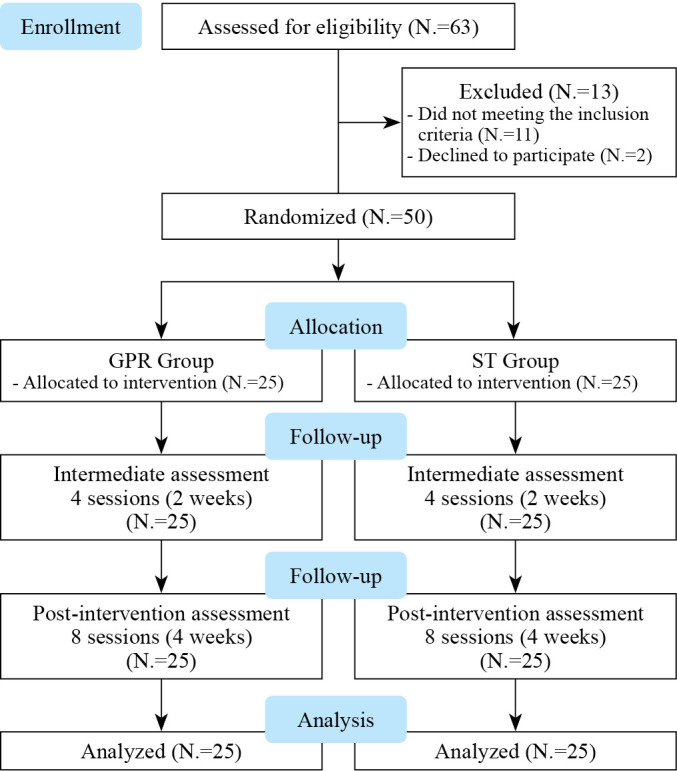
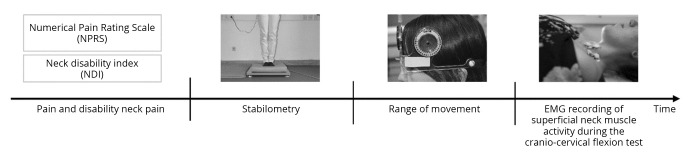
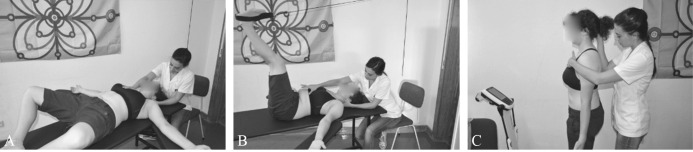
Participants were randomly assigned to one of the two intervention groups (GPR [N.=25] or SE [N.=25]). Both interventions consisted of eight sessions of ~40 minutes duration, performed twice a week, for four weeks. Outcomes included neck pain intensity and disability, cervical range of motion (CROM), postural sway, and activity of the superficial neck flexor muscles during a cranio-cervical flexion test (CCFT). All outcomes were assessed twice before the intervention and immediately following eight treatment sessions over four weeks.
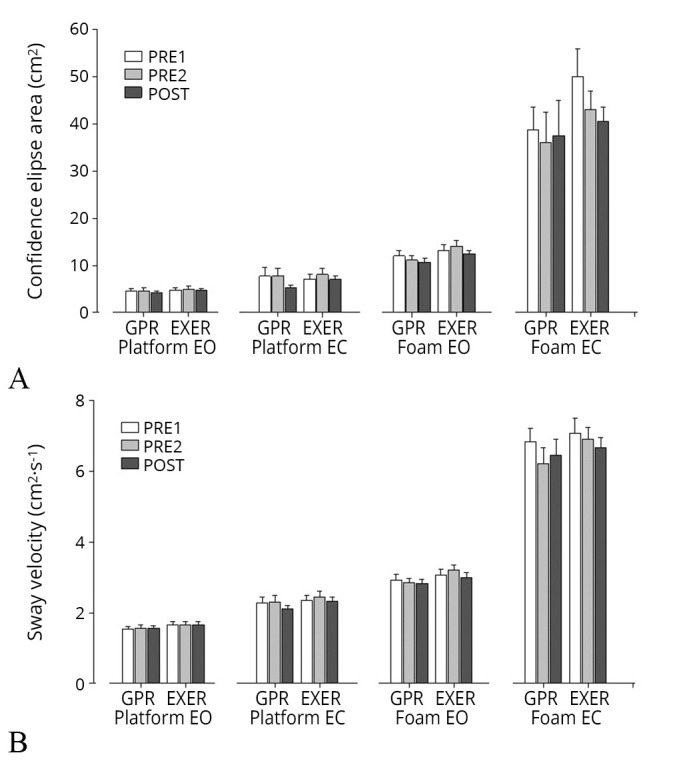
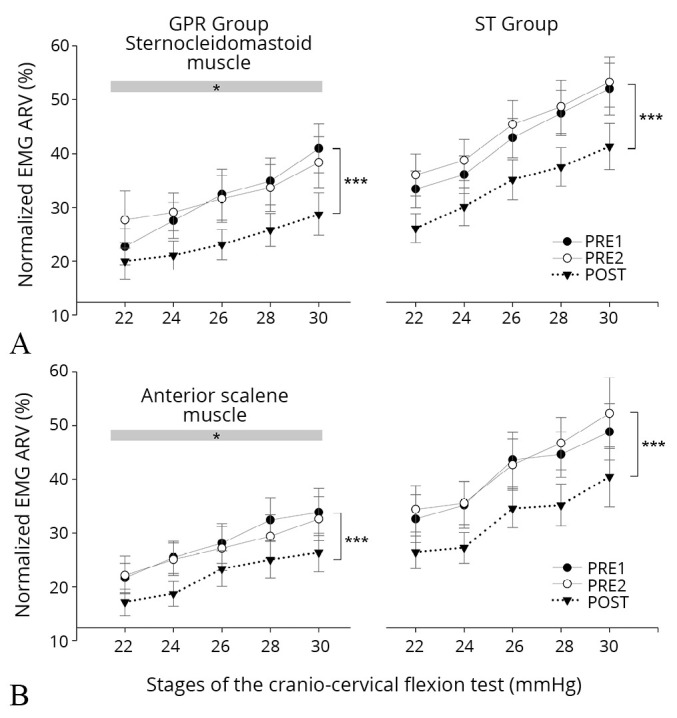
Both interventions were equally effective in reducing neck pain (P<0.001, ŋp=0.770) and disability (P<0.001, ŋp=0.306), improving neck mobility (P<0.001, 0.385≤ŋp≤0.623, for all measurements) and decreasing the activity of the superficial cervical flexor muscles (P>0.001). Neither intervention altered postural sway.
Our results revealed that GPR and SE induced significant positive results in all measures apart from postural stability but with no difference between the interventions.
"Global Postural Re-education" (GPR) and neck SE interventions are equally effective in reducing neck pain and disability, and improving neck mobility in women with NSCNP. Overall, this study indicates that GPR and SE interventions can be used to effectively manage patients with NSCNP.
颈部疼痛与健康相关的生活质量下降、工作生产力下降以及增加对医疗保健提供者的就诊次数有关。
本研究旨在评估“全球姿势再教育”(GPR)与颈部特定运动(SE)方案对颈部疼痛、残疾、颈椎活动范围、姿势稳定性以及颈浅屈肌活动的有效性。
一项平行组、单盲临床试验。
社区干预。
50 名患有非特异性慢性颈部疼痛(NSCNP)的女性。
参与者被随机分配到两个干预组之一(GPR [N=25] 或 SE [N=25])。两种干预措施均由 8 次 40 分钟左右的课程组成,每周进行两次,持续四周。结果包括颈部疼痛强度和残疾、颈椎活动范围(CROM)、姿势摆动以及在头颈部屈曲测试(CCFT)中颈浅屈肌的活动。所有结果在干预前两次和四周内八次治疗结束后立即进行评估。
两种干预措施均能同等有效地减轻颈部疼痛(P<0.001,ŋp=0.770)和残疾(P<0.001,ŋp=0.306),改善颈部活动度(P<0.001,0.385≤ŋp≤0.623,所有测量值),并降低颈浅屈肌的活动(P>0.001)。两种干预措施均未改变姿势摆动。
我们的结果表明,GPR 和 SE 除姿势稳定性外,在所有测量值上均产生显著的积极结果,但两种干预措施之间没有差异。
“全球姿势再教育”(GPR)和颈部 SE 干预在减轻女性 NSCNP 患者的颈部疼痛和残疾以及改善颈部活动度方面同样有效。总体而言,本研究表明 GPR 和 SE 干预可有效治疗 NSCNP 患者。