Department of Psychiatry, Nelson R Mandela School of Medicine, University of KwaZulu-Natal, Durban, South Africa.
Department of Psychiatry, Faculty of Medicine, University of Botswana, Gaborone, Botswana.
AIDS Res Ther. 2023 Jan 4;20(1):2. doi: 10.1186/s12981-022-00490-z.
As children living with HIV transition from adolescence into adulthood, they face a considerable burden of psychiatric disorders (PDs) which may vary between the perinatally and behaviorally infected. The knowledge of the pattern of these PDs in relation to the varying needs of the adolescents living with HIV (ALWHIV) is unclear but necessary for maximizing their linkage to care and improving their quality of life in Botswana. AIM: To determine the pattern of PDs in ALWHIV in Botswana; to compare and explore the differences in the pattern and their associated factors between congenitally infected adolescents (CIAs) and behaviorally infected adolescents (BIAs).
A cross-sectional survey of 622 ALWHIV (399 CIA and 223 BIA) with the Mini International Neuropsychiatric Interview-Kid Screen.
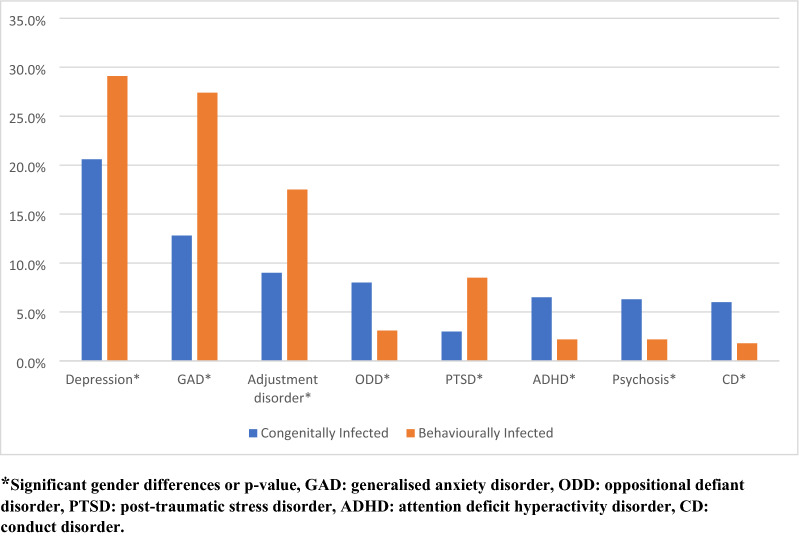
The participants' mean age (SD) was 17.71 (1.60) years, with more males (54%), of whom 52.9% had at least one PD, with depression (23.6%) and generalised anxiety disorder (18.0%) being the most prevalent. The externalising disorders were associated with being CIA (OR = 3.99; 95% CI:1.87-8.54), male gender (OR = 3.93; 95% CI:2.02-7.64), and a viral load of 400 and above copies (OR = 3.53; 95%CI:1.92-6.48). Internalising disorders were associated with being BIA (OR = 3.64; 95%; CI: 2.39-5.56), females (OR = 2.59; 95% CI:1.75-3.83), poor counselling (OR = 2.23; 95% CI: 1.42-3.51) and struggling to accept HIV status (OR = 1.73; 95% CI:1.14-2.62).
Depression and anxiety disorders were the most prevalent PDs in ALWHIV, who differed in psychiatric presentations, the BIAs being more likely to present with internalizing disorders, while the CIAs had more externalizing disorders. Due to the varying needs of ALWHIV, individualized management plans that consider gender, mode of infection, and other psycho-social needs, should be further studied and encouraged.
随着感染艾滋病毒的儿童从青春期过渡到成年期,他们面临着相当大的精神障碍(PDs)负担,这可能因围产期和行为感染而有所不同。了解这些 PDs 与感染艾滋病毒的青少年(ALWHIV)不断变化的需求之间的关系模式尚不清楚,但对于最大限度地将他们与护理联系起来并提高他们在博茨瓦纳的生活质量是必要的。
确定博茨瓦纳 ALWHIV 中 PDs 的模式;比较和探索先天感染青少年(CIA)和行为感染青少年(BIA)之间模式和相关因素的差异。
对 622 名 ALWHIV(399 名 CIA 和 223 名 BIA)进行横断面调查,使用 Mini 国际神经精神访谈-儿童筛查。
参与者的平均年龄(SD)为 17.71(1.60)岁,其中男性(54%)居多,其中 52.9%至少有一种 PD,最常见的是抑郁症(23.6%)和广泛性焦虑症(18.0%)。外显型障碍与 CIA 有关(OR=3.99;95%CI:1.87-8.54)、男性(OR=3.93;95%CI:2.02-7.64)和病毒载量为 400 及以上(OR=3.53;95%CI:1.92-6.48)。内隐型障碍与 BIA 有关(OR=3.64;95%CI:2.39-5.56)、女性(OR=2.59;95%CI:1.75-3.83)、咨询不良(OR=2.23;95%CI:1.42-3.51)和难以接受 HIV 状况(OR=1.73;95%CI:1.14-2.62)。
抑郁和焦虑障碍是 ALWHIV 中最常见的 PDs,他们在精神病表现上有所不同,BIA 更有可能出现内隐型障碍,而 CIA 则更有可能出现外显型障碍。由于 ALWHIV 的需求不同,应该进一步研究和鼓励制定考虑到性别、感染方式和其他心理社会需求的个体化管理计划。