Emergency Medicine, Brigham and Women's Hospital, Boston, Massachusetts, USA.
Massachusetts Institute of Technology Koch Institute for Integrative Cancer Research, Cambridge, Massachusetts, USA.
BMJ Open. 2022 Dec 9;12(12):e062707. doi: 10.1136/bmjopen-2022-062707.
Mask adherence continues to be a critical public health measure to prevent transmission of aerosol pathogens, such as SARS-CoV-2. We aimed to develop and deploy a computer vision algorithm to provide real-time feedback of mask wearing among staff in a hospital.
Single-site, observational cohort study.
An urban, academic hospital in Boston, Massachusetts, USA.
We enrolled adult hospital staff entering the hospital at a key ingress point.
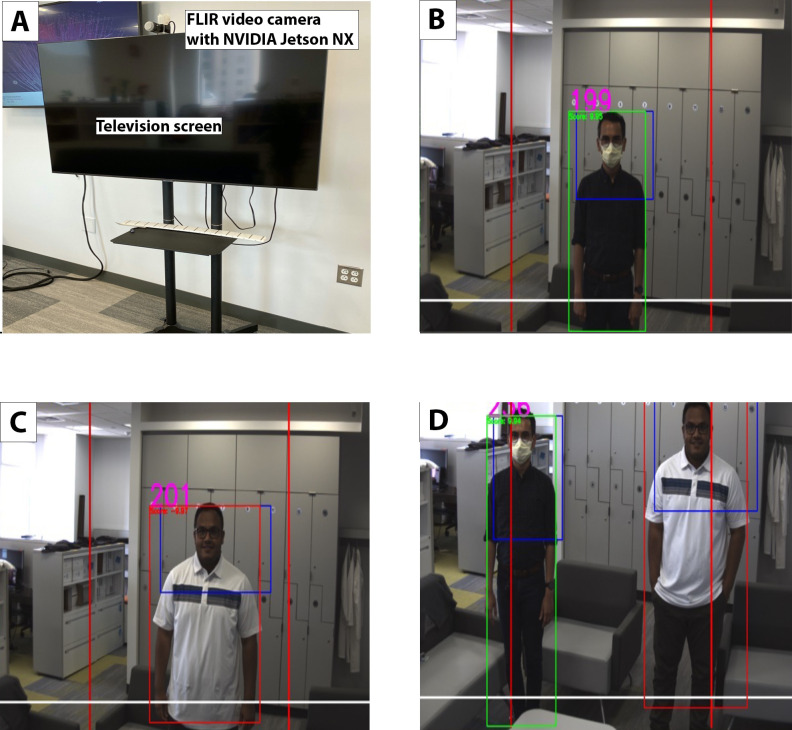
Consenting participants entering the hospital were invited to experience the computer vision mask detection system. Key aspects of the detection algorithm and feedback were described to participants, who then completed a quantitative assessment to understand their perceptions and acceptance of interacting with the system to detect their mask adherence.
Primary outcomes were willingness to interact with the mask system, and the degree of comfort participants felt in interacting with a public facing computer vision mask algorithm.
One hundred and eleven participants with mean age 40 (SD15.5) were enrolled in the study. Males (47.7%) and females (52.3%) were equally represented, and the majority identified as white (N=54, 49%). Most participants (N=97, 87.3%) reported acceptance of the system and most participants (N=84, 75.7%) were accepting of deployment of the system to reinforce mask adherence in public places. One third of participants (N=36) felt that a public facing computer vision system would be an intrusion into personal privacy.Public-facing computer vision software to detect and provide feedback around mask adherence may be acceptable in the hospital setting. Similar systems may be considered for deployment in locations where mask adherence is important.
戴口罩仍然是防止气溶胶病原体(如 SARS-CoV-2)传播的关键公共卫生措施。我们旨在开发和部署一种计算机视觉算法,为医院工作人员的口罩佩戴情况提供实时反馈。
单站点、观察性队列研究。
美国马萨诸塞州波士顿市的一家城市学术医院。
我们招募了进入医院主要入口的成年医院工作人员。
同意参加的参与者被邀请体验计算机视觉口罩检测系统。向参与者描述了检测算法和反馈的关键方面,然后他们完成了一项定量评估,以了解他们对与系统互动以检测口罩佩戴情况的看法和接受程度。
主要结果是愿意与口罩系统互动,以及参与者与公共面对的计算机视觉口罩算法互动的舒适度。
共有 111 名平均年龄为 40 岁(SD15.5)的参与者入组研究。男性(47.7%)和女性(52.3%)的比例相当,大多数参与者(N=54,49%)为白人。大多数参与者(N=97,87.3%)报告接受该系统,大多数参与者(N=84,75.7%)接受在公共场所部署该系统以加强口罩佩戴。三分之一的参与者(N=36)认为面向公众的计算机视觉系统会侵犯个人隐私。用于检测和提供口罩佩戴情况反馈的面向公众的计算机视觉软件在医院环境中可能是可以接受的。在需要遵守口罩佩戴规定的地方,类似的系统可以考虑部署。