Oloyede Ebenezer, Mantell Bethany, Williams Julie, Lai Serena, Jauhar Sameer, Taylor David, MacCabe James H, Harland Robert, McGuire Philip, Blackman Graham
South London and Maudsley NHS Foundation Trust, London, UK.
Department of Psychosis Studies, Institute of Psychiatry, Psychology & Neuroscience, King's College London, DeCriesney, London, UK.
Ther Adv Psychopharmacol. 2022 Dec 26;12:20451253221141222. doi: 10.1177/20451253221141222. eCollection 2022.
Clozapine is the only medication licenced for patients with psychosis that is resistant to conventional antipsychotic treatment. However, despite its effectiveness, it remains widely underutilised. One contributory factor for this may be clinicians' lack of confidence around the management of clozapine.
We conducted a survey of clinicians working in Early Intervention in Psychosis (EIP) services to determine their training needs for clozapine management in EIP services.
An electronic survey was made available to all clinicians working in EIP services in England. The survey assessed confidence and training needs regarding managing clozapine in patients with treatment-resistant psychosis. Quantitative data were analysed using total mean scores and the Mann-Whitney test.
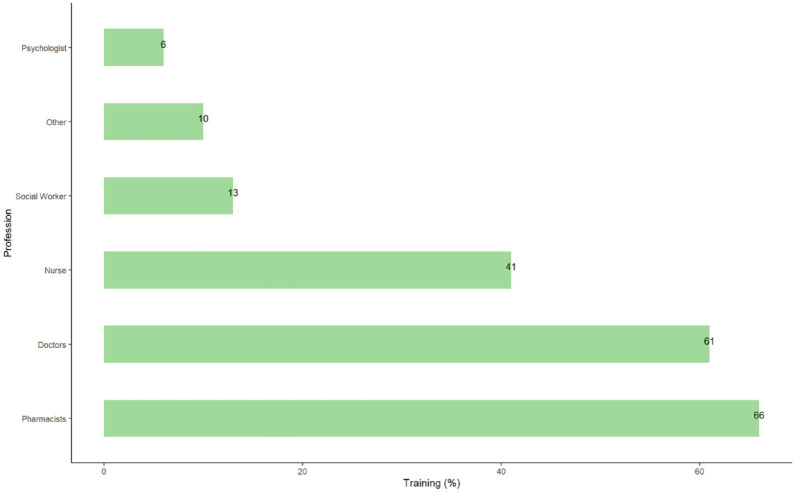
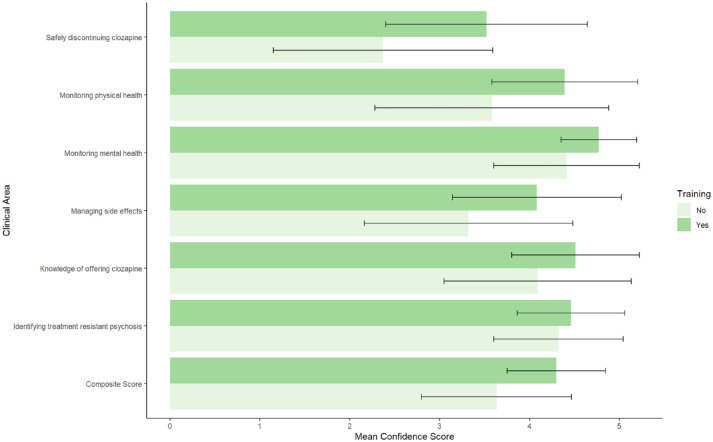
In all, 192 (27%) of approximately 700 clinicians from 35 EIP services completed the survey. Approximately half (54%) had not received training on treatment with clozapine. Experience of training was higher in prescribers than non-prescribers, and among medical than non-medical clinicians. Previous training was associated with significantly higher confidence in offering clozapine and managing treatment-resistant psychosis ( < 0.001). Confidence levels with managing treatment-resistant psychosis and clozapine were relatively high (mean = 4 out of 5, SD = 1). Respondents were most confident about monitoring mental health response to treatment (mean = 5, SD = 1). Participants were least confident about how to discontinue clozapine treatment safely (mean = 3, SD = 1).
Most clinicians working in EIP have not received training on the use of clozapine. This may account, in part, for the underutilisation of clozapine in EIP services. The provision of training in the identification of treatment-resistant psychosis and the use of clozapine will likely improve the detection and management of treatment resistance in the early phase of psychosis.
氯氮平是唯一被批准用于对传统抗精神病药物治疗耐药的精神病患者的药物。然而,尽管其疗效显著,但仍未得到广泛应用。造成这种情况的一个因素可能是临床医生对氯氮平管理缺乏信心。
我们对从事精神病早期干预(EIP)服务的临床医生进行了一项调查,以确定他们在EIP服务中进行氯氮平管理的培训需求。
向英格兰所有从事EIP服务的临床医生提供了一份电子调查问卷。该调查评估了在治疗耐药性精神病患者中管理氯氮平方面的信心和培训需求。使用总平均分和曼-惠特尼检验对定量数据进行分析。
来自35个EIP服务机构的约700名临床医生中,共有192名(27%)完成了调查。约一半(54%)的人未接受过氯氮平治疗方面的培训。开处方者接受培训的经历比非开处方者多,医学临床医生比非医学临床医生多。先前的培训与在提供氯氮平和管理治疗耐药性精神病方面显著更高的信心相关(<0.001)。在管理治疗耐药性精神病和氯氮平方面的信心水平相对较高(平均=5分制中的4分,标准差=1)。受访者对监测心理健康对治疗的反应最有信心(平均=5分,标准差=1)。参与者对如何安全停用氯氮平治疗最缺乏信心(平均=3分,标准差=1)。
大多数从事EIP工作的临床医生未接受过氯氮平使用方面的培训。这可能部分解释了氯氮平在EIP服务中未得到充分利用的原因。提供关于识别治疗耐药性精神病和使用氯氮平的培训可能会改善精神病早期阶段治疗耐药性的检测和管理。