Department of Epidemiology, University of Pittsburgh, Pittsburgh, Pennsylvania, USA
Center for Public Health Genomics, University of Virginia, Charlottesville, Virginia, USA.
BMJ Open Diabetes Res Care. 2023 Jan;11(1). doi: 10.1136/bmjdrc-2022-003068.
DNA methylation (DNAme) has been cross-sectionally associated with type 2 diabetes and hemoglobin A1c (HbA1c) in the general population. However, longitudinal data and data in type 1 diabetes are currently very limited. Thus, we performed an epigenome-wide association study (EWAS) in an observational type 1 diabetes cohort to identify loci with DNAme associated with concurrent and future HbA1cs, as well as other clinical risk factors, over 28 years.
Whole blood DNAme in 683 597 CpGs was analyzed in the Pittsburgh Epidemiology of Diabetes Complications study of childhood onset (<17 years) type 1 diabetes (n=411). An EWAS of DNAme beta values and concurrent HbA1c was performed using linear models adjusted for diabetes duration, sex, pack years of smoking, estimated cell type composition variables, and technical/batch covariates. A longitudinal EWAS of subsequent repeated HbA1c measures was performed using mixed models. We further identified methylation quantitative trait loci (meQTLs) for significant CpGs and conducted a Mendelian randomization.
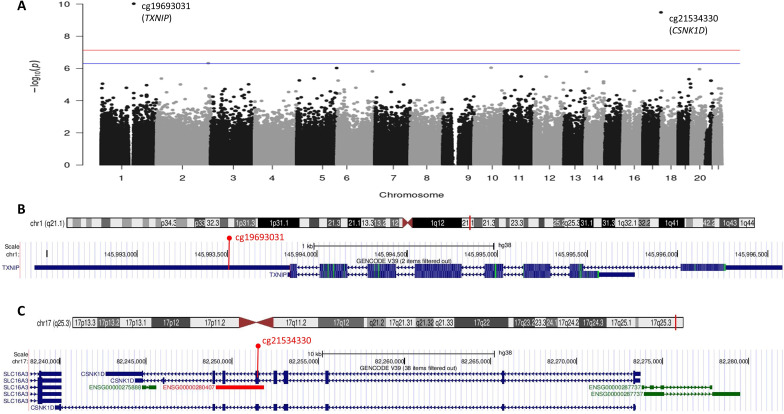
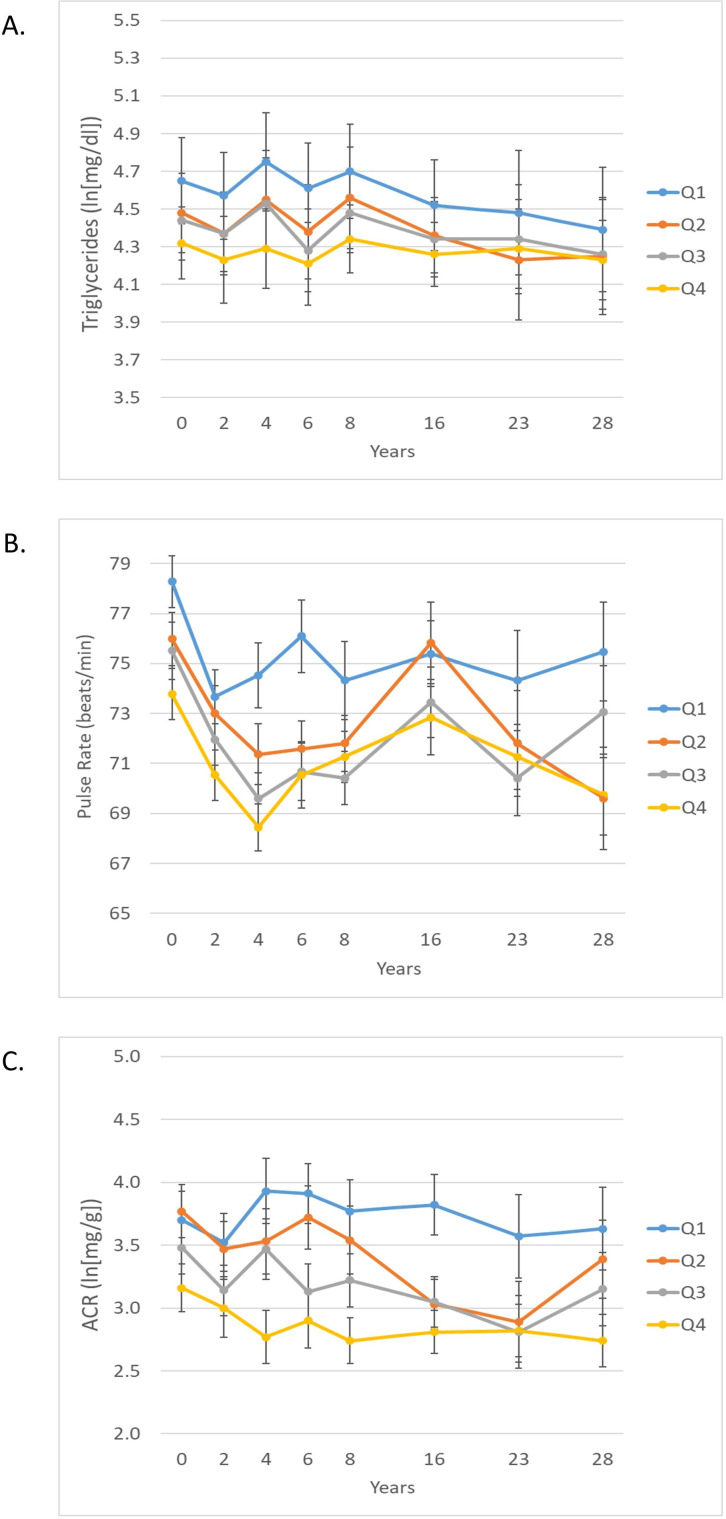
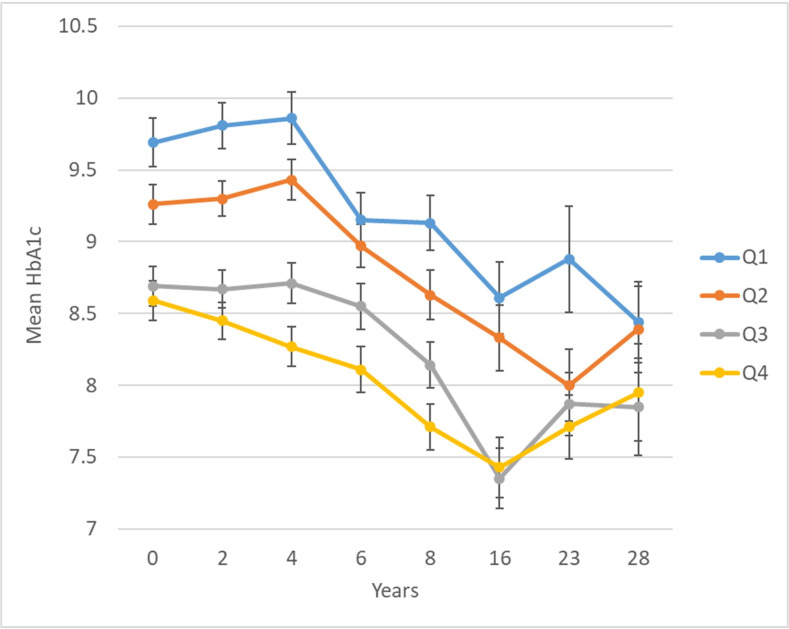
DNAme at cg19693031 (Chr 1, ()) and cg21534330 (Chr 17, ) was significantly inversely associated with concurrent HbA1c. In longitudinal analyses, hypomethylation of cg19693031 was associated with consistently higher HbA1c over 28 years, and with higher triglycerides, pulse rate, and albumin:creatinine ratio (ACR) independently of HbA1c. We further identified 34 meQTLs in significantly associated with cg19693031 DNAme.
Our results extend prior findings that hypomethylation relates to worse glycemic control in type 1 diabetes by demonstrating the association persists over the long term. Additionally, the associations with triglycerides, pulse rate, and ACR suggest DNAme could play a role in vascular damage independent of HbA1c. These findings strengthen potential for interventions targeting TXNIP to improve glycemic control in type 1 diabetes through its role in /glucose transporter 1-mediated glucose regulation.
在普通人群中,DNA 甲基化(DNAme)与 2 型糖尿病和血红蛋白 A1c(HbA1c)呈横断面相关。然而,目前关于 1 型糖尿病的纵向数据和数据非常有限。因此,我们在观察性 1 型糖尿病队列中进行了全基因组关联研究(EWAS),以确定与同时和未来的 HbA1c 以及其他临床危险因素相关的 DNAme 位点,时间跨度为 28 年。
在匹兹堡儿童期发病(<17 岁)1 型糖尿病的糖尿病并发症流行病学研究(Pittsburgh Epidemiology of Diabetes Complications study)中,对 683597 个 CpG 进行了全血 DNAme 分析(n=411)。使用线性模型对 DNAmeβ 值和同时的 HbA1c 进行 EWAS,模型调整了糖尿病病程、性别、吸烟包年数、估计的细胞组成变量以及技术/批次协变量。使用混合模型对随后重复的 HbA1c 测量值进行了纵向 EWAS。我们进一步鉴定了显著 CpG 的甲基化数量性状基因座(meQTL),并进行了孟德尔随机化分析。
cg19693031(Chr1, )和 cg21534330(Chr17, )处的 DNAme 与同时的 HbA1c 呈显著负相关。在纵向分析中,cg19693031 的低甲基化与 28 年内持续升高的 HbA1c 以及独立于 HbA1c 的甘油三酯、脉搏率和白蛋白:肌酐比值(ACR)升高相关。我们进一步鉴定了与 cg19693031 DNAme 显著相关的 34 个 meQTLs。
我们的结果通过证明关联在长期内持续存在,扩展了先前关于 1 型糖尿病中低甲基化与血糖控制恶化相关的发现。此外,与甘油三酯、脉搏率和 ACR 的关联表明,DNAme 可能通过其在 /葡萄糖转运蛋白 1 介导的葡萄糖调节中的作用,在独立于 HbA1c 的情况下在血管损伤中发挥作用。这些发现增强了通过靶向 TXNIP 改善 1 型糖尿病血糖控制的干预措施的潜力。