School of Psychology and Neuroscience, University of St Andrews, St Andrews, UK.
Department of Comparative Cognition, Institute of Biology, University of Neuchâtel, Neuchâtel, Switzerland.
Sci Rep. 2023 Jan 5;13(1):147. doi: 10.1038/s41598-022-25814-x.
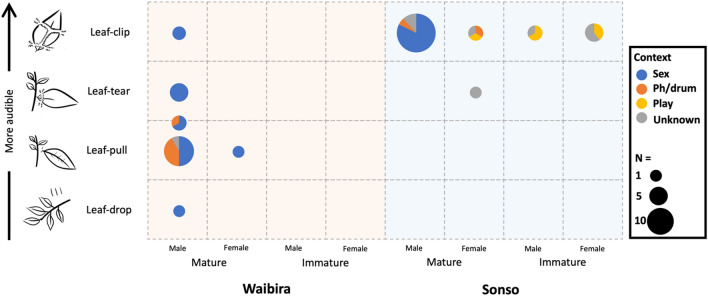
Dialects are a cultural property of animal communication previously described in the signals of several animal species. While dialects have predominantly been described in vocal signals, chimpanzee leaf-clipping and other 'leaf-modifying' gestures, used across chimpanzee and bonobo communities, have been suggested as a candidate for cultural variation in gestural communication. Here we combine direct observation with archaeological techniques to compare the form and use of leaf-modifying gestures in two neighbouring communities of East African chimpanzees. We found that while both communities used multiple forms, primarily within sexual solicitation, they showed a strong preference for a single, different gesture form. The observed variation in form preference between these neighbouring communities within the same context suggests that these differences are, at least in part, socially derived. Our results highlight an unexplored source of variation and flexibility in gestural communication, opening the door for future research to explore socially derived dialects in non-vocal communication.
方言是动物交流的一种文化财产,此前在多个动物物种的信号中都有描述。虽然方言主要在声音信号中描述,但黑猩猩的树叶夹取和其他“树叶修饰”手势,在黑猩猩和倭黑猩猩群体中都有使用,被认为是手势交流中存在文化变异的候选者。在这里,我们结合直接观察和考古技术,比较了东非两个相邻黑猩猩社区中树叶修饰手势的形式和用途。我们发现,虽然两个社区都使用了多种形式,主要用于性吸引,但它们强烈倾向于使用一种独特的、不同的手势形式。在同一背景下,这些相邻社区对手势形式偏好的观察到的差异表明,这些差异至少部分是由社会因素引起的。我们的研究结果突出了手势交流中一个未被探索的变化和灵活性来源,为未来研究探索非声音交流中的社会衍生方言开辟了道路。