School of Architecture, Tsinghua University, Beijing, China.
School of Architecture and Hang Lung Center for Real Estate, Key Laboratory of Eco Planning & Green Building, Ministry of Education, Tsinghua University, No. 1 Qinghuayuan, Haidian District, Beijing, 100084, China.
Environ Health. 2023 Jan 5;22(1):2. doi: 10.1186/s12940-022-00955-8.
With rapid urbanization, the urban environment, especially the neighborhood environment, has received increasing global attention. However, a comprehensive overview of the association between neighborhood risk factors and human health remains unclear due to the large number of neighborhood risk factor-human health outcome pairs.
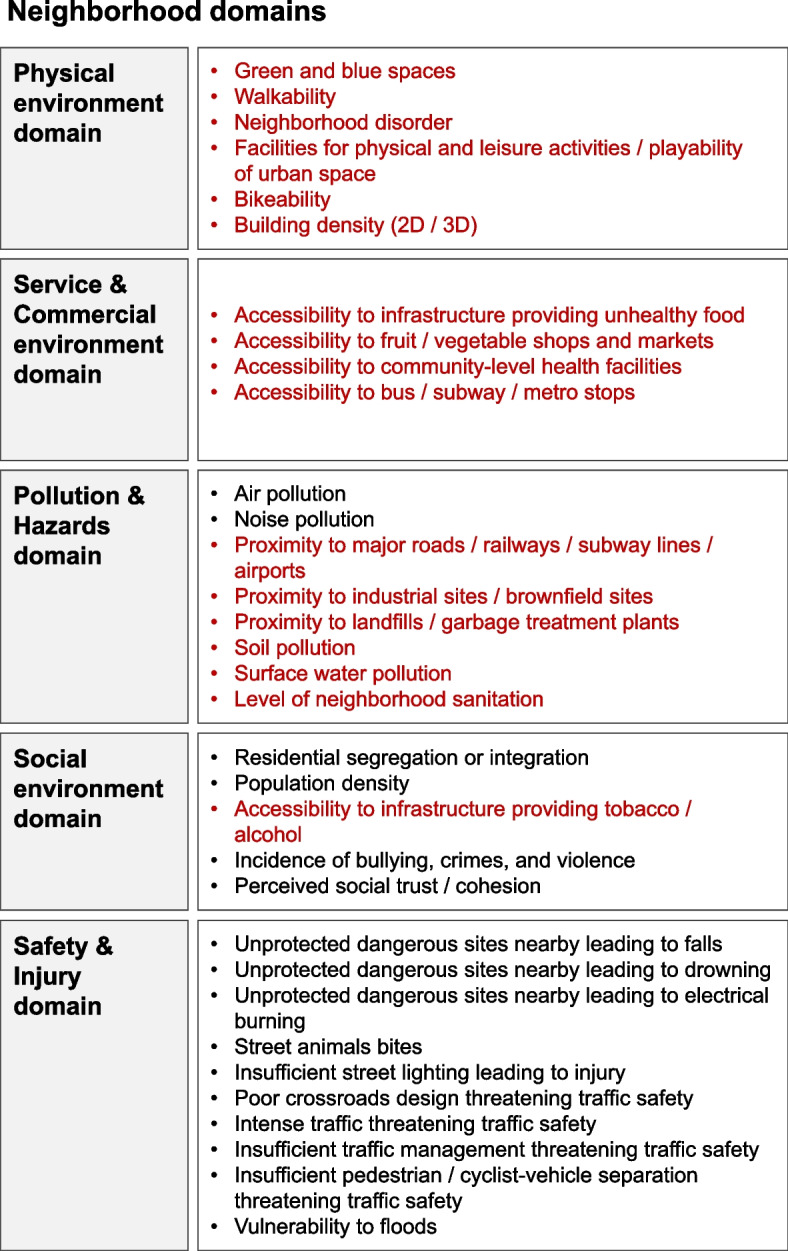
On the basis of a whole year of panel discussions, we first obtained a list of 5 neighborhood domains, containing 33 uniformly defined neighborhood risk factors. We only focused on neighborhood infrastructure-related risk factors with the potential for spatial interventions through urban design tools. Subsequently, following the Preferred Reporting Items for Systematic Reviews and Meta-Analyses (PRISMA) guidelines, a systematic meta-review of 17 infrastructure-related risk factors of the 33 neighborhood risk factors (e.g., green and blue spaces, proximity to major roads, and proximity to landfills) was conducted using four databases, Web of Science, PubMed, OVID, and Cochrane Library, from January 2000 to May 2021, and corresponding evidence for non-communicable diseases (NCDs) was synthesized. The review quality was assessed according to the A MeaSurement Tool to Assess Systematic Reviews (AMSTAR) standard.
Thirty-three moderate-and high-quality reviews were included in the analysis. Thirteen major NCD outcomes were found to be associated with neighborhood infrastructure-related risk factors. Green and blue spaces or walkability had protective effects on human health. In contrast, proximity to major roads, industry, and landfills posed serious threats to human health. Inconsistent results were obtained for four neighborhood risk factors: facilities for physical and leisure activities, accessibility to infrastructure providing unhealthy food, proximity to industry, and proximity to major roads.
This meta-review presents a comprehensive overview of the effects of neighborhood infrastructure-related risk factors on NCDs. Findings on the risk factors with strong evidence can help improve healthy city guidelines and promote urban sustainability. In addition, the unknown or uncertain association between many neighborhood risk factors and certain types of NCDs requires further research.
随着城市化的快速发展,城市环境,尤其是邻里环境,受到了越来越多的全球关注。然而,由于大量的邻里风险因素与人类健康结果之间的关系,全面了解这些关系仍不清楚。
在一整年的小组讨论的基础上,我们首先获得了一个包含 33 个统一定义的邻里风险因素的 5 个邻里领域列表。我们只关注具有通过城市设计工具进行空间干预潜力的邻里基础设施相关风险因素。随后,根据系统评价和荟萃分析的首选报告项目(PRISMA)指南,我们使用 Web of Science、PubMed、OVID 和 Cochrane Library 四个数据库,对 33 个邻里风险因素中的 17 个基础设施相关风险因素(如绿色和蓝色空间、与主要道路的接近度和与垃圾填埋场的接近度)进行了系统的荟萃综述,综述时间从 2000 年 1 月至 2021 年 5 月,综合了与非传染性疾病(NCD)相关的证据。根据评估系统评价的测量工具(AMSTAR)标准评估了综述质量。
纳入分析的有 33 项中等和高质量的综述。发现 13 种主要的 NCD 结果与邻里基础设施相关的风险因素有关。绿色和蓝色空间或步行的便利性对人类健康具有保护作用。相比之下,靠近主要道路、工业和垃圾填埋场对人类健康构成严重威胁。对于四个邻里风险因素,即体育和休闲设施、提供不健康食品的基础设施可达性、靠近工业和靠近主要道路,得到了不一致的结果。
本荟萃综述全面介绍了邻里基础设施相关风险因素对 NCD 的影响。对具有强证据的风险因素的研究结果可以帮助改善健康城市指南并促进城市可持续性。此外,许多邻里风险因素与某些类型的 NCD 之间的未知或不确定的关联需要进一步研究。