Katsouras Christos S, Papafaklis Michail I, Giannopoulos Sotirios, Karapanayiotides Theodoros, Tsivgoulis Georgios, Michalis Lampros K
2nd Department of Cardiology, University Hospital of Ioannina, University of Ioannina, Ioannina, Greece.
2nd Department of Neurology, ATTIKON University Hospital, National and Kapodistrian University of Athens, Athens, Greece.
J Clin Neurol. 2023 Jan;19(1):1-11. doi: 10.3988/jcn.2023.19.1.1.
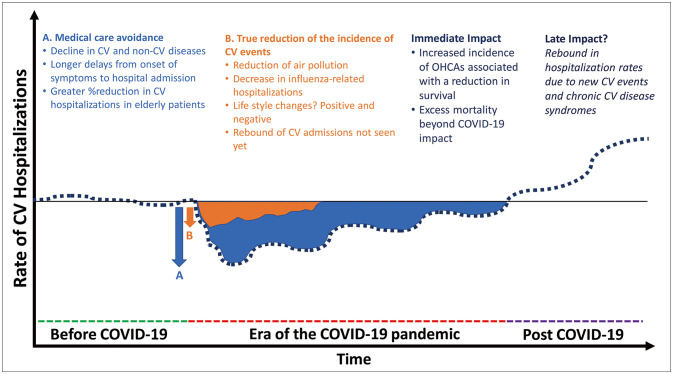
Numerous observational studies have identified a decline in cerebro-/cardiovascular (CV) admissions during the initial phase of the COVID-19 pandemic. Recent studies and meta-analyses indicated that the overall decrease was smaller than that found in initial studies during the first months of 2020. Two years later we still do not have clear evidence about the potential causes and impacts of the reduction of CV hospitalizations during the COVID-19 pandemic. It has becoming increasingly evident that collateral damage (i.e., incidental damage to the public and patients) from the COVID-19 outbreak is the main underlying cause that at least somewhat reflects the effects of imposed measures such as social distancing and self-isolation. However, a smaller true decline in CV events in the community due to a lack of triggers associated with such acute syndromes cannot be excluded. There is currently indirect epidemiological evidence about the immediate impact that the collateral damage had on excess mortality, but possible late consequences including a rebound increase in CV events are yet to be observed. In the present narrative review, we present the reporting milestones in the literature of the rates of CV admissions and collateral damage during the last 2 years, and discuss all possible factors contributing to the decline in CV hospitalizations during the COVID-19 pandemic. Healthcare systems need to be prepared so that they can cope with the increased hospitalization rates for CV events in the near future.
众多观察性研究发现,在新冠疫情初期,脑血管/心血管(CV)疾病的住院人数有所下降。近期的研究和荟萃分析表明,总体下降幅度小于2020年最初几个月的初步研究结果。两年过去了,我们仍未获得关于新冠疫情期间心血管疾病住院人数减少的潜在原因及影响的确切证据。越来越明显的是,新冠疫情的附带损害(即对公众和患者的附带伤害)是至少在一定程度上反映诸如社交距离和自我隔离等强制措施效果的主要潜在原因。然而,由于缺乏与此类急性综合征相关的触发因素,社区中心血管事件真正出现较小幅度下降的可能性也不能排除。目前有间接的流行病学证据表明附带损害对超额死亡率的直接影响,但包括心血管事件反弹增加在内的可能的后期后果尚未观察到。在本叙述性综述中,我们介绍了过去两年文献中关于心血管疾病住院率和附带损害的报告里程碑,并讨论了导致新冠疫情期间心血管疾病住院人数下降的所有可能因素。医疗系统需要做好准备,以便能够应对近期心血管事件住院率上升的情况。