Agència de Salut Pública de Barcelona, Public Health Agency, 08023 Barcelona, Spain.
Departament de Ciències Experimentals i de la Salut (DCEXS), Universitat Pompeu Fabra, 08003 Barcelona, Spain.
Int J Environ Res Public Health. 2022 Dec 30;20(1):649. doi: 10.3390/ijerph20010649.
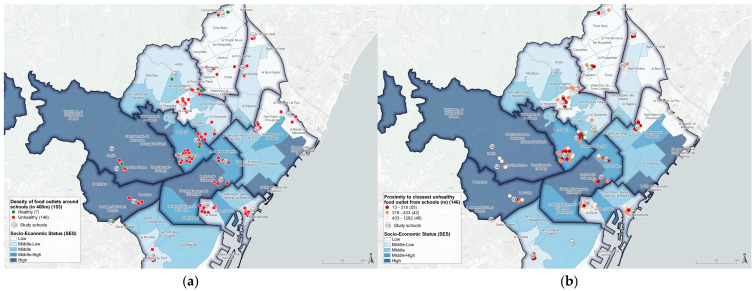
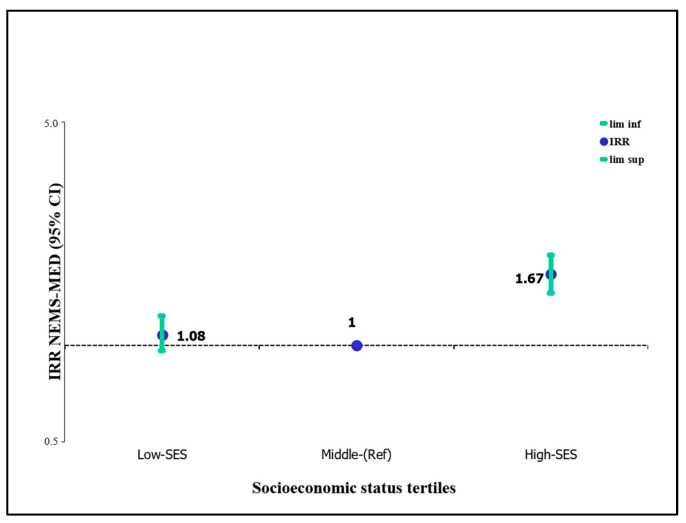
Childhood obesity is a relevant public health problem. The school food environment has been identified as an important factor for promoting healthy eating behaviors. This study assessed the availability of and proximity to unhealthy food stores around schools (n = 22) in the city of Barcelona and its association with neighborhood socioeconomic status (NSES). We conducted this cross-sectional study between 2019 and 2020. First, we identified all food retailers (n = 153) within a 400-m buffer around each school and identified those selling unhealthy food products. Then, we used Poison regression models to measure the association between NSES and the healthy food availability index (HFAI), adjusting for population density and distance. A total of 95% of the food establishments studied were classified as unhealthy (n = 146). In all, 90% of schools that had, at least, two unhealthy retailers in their proximity. There were significant differences in the mean distance to unhealthy establishments according to neighborhood SES and population density (p < 0.05). We found a positive association between schools located in higher SES neighborhoods and a higher availability and affordability of healthy food products (IIR = 1.67, 95% CI = 1.45−1.91 p = 0.000). We found strong social inequalities in the supply of healthy foods in Barcelona. Local food policy interventions addressing retail food environment around schools should consider socioeconomic inequalities.
儿童肥胖是一个相关的公共卫生问题。学校食品环境已被确定为促进健康饮食行为的重要因素。本研究评估了巴塞罗那市学校周围(n=22)不健康食品商店的供应情况及其与邻里社会经济地位(NSES)的关系。我们在 2019 年至 2020 年期间进行了这项横断面研究。首先,我们在每个学校周围 400 米缓冲区识别了所有食品零售商(n=153),并确定了销售不健康食品的零售商。然后,我们使用泊松回归模型来衡量 NSES 与健康食品供应指数(HFAI)之间的关联,同时调整人口密度和距离。研究中 95%的食品店被归类为不健康(n=146)。所有学校中,有 90%的学校附近至少有两家不健康的零售商。根据邻里 SES 和人口密度,到不健康机构的平均距离存在显著差异(p<0.05)。我们发现,位于 SES 较高的邻里的学校与更丰富和更实惠的健康食品供应之间存在正相关关系(IIR=1.67,95%CI=1.45-1.91,p=0.000)。我们发现,巴塞罗那在健康食品供应方面存在着强烈的社会不平等。针对学校周围零售食品环境的地方食品政策干预措施应考虑社会经济不平等。