Zhou Yongheng, Fu Qiang, Shao Zhiqiang, Zhang Keqin, Qi Wenqiang, Geng Shangzhen, Wang Wenfu, Cui Jianfeng, Jiang Xin, Li Rongyang, Zhu Yaofeng, Chen Shouzhen, Shi Benkang
Department of Urology, Qilu Hospital of Shandong University, Jinan 250012, China.
Department of Urology, Shandong Provincial Hospital, Jinan 250000, China.
J Clin Med. 2023 Jan 1;12(1):339. doi: 10.3390/jcm12010339.
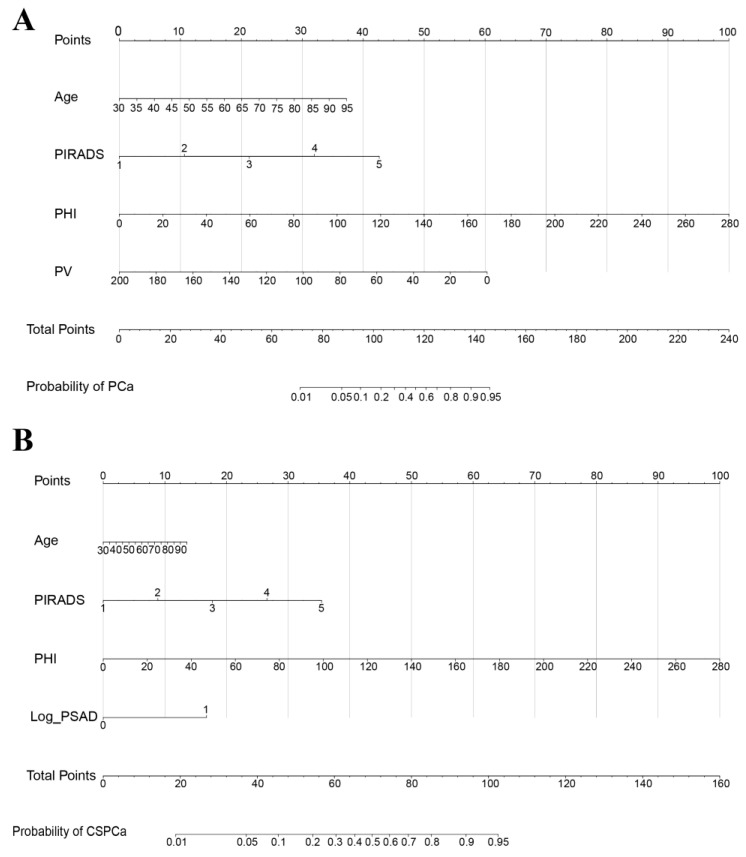
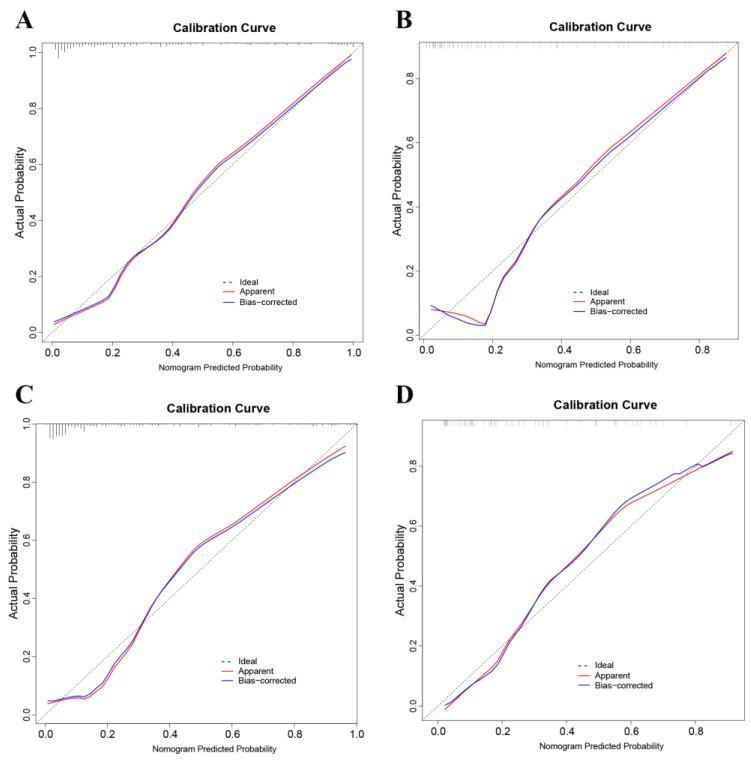
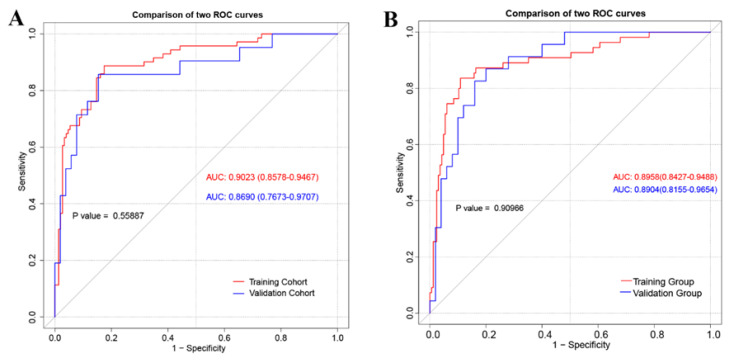
(1) Background: The study aimed to construct nomograms to improve the detection rates of prostate cancer (PCa) and clinically significant prostate cancer (CSPCa) in the Asian population. (2) Methods: This multicenter prospective study included a group of 293 patients from three hospitals. Univariable and multivariable logistic regression analysis was performed to identify potential risk factors and construct nomograms. Discrimination, calibration, and clinical utility were used to assess the performance of the nomogram. The web-based dynamic nomograms were subsequently built based on multivariable logistic analysis. (3) Results: A total of 293 patients were included in our study with 201 negative and 92 positive results in PCa. Four independent predictive factors (age, prostate health index (PHI), prostate volume, and prostate imaging reporting and data system score (PI-RADS)) for PCa were included, and four factors (age, PHI, PI-RADS, and Log PSA Density) for CSPCa were included. The area under the ROC curve (AUC) for PCa was 0.902 in the training cohort and 0.869 in the validation cohort. The AUC for CSPCa was 0.896 in the training cohort and 0.890 in the validation cohort. (4) Conclusions: The combined diagnosis of PHI and PI-RADS can avoid more unnecessary biopsies and improve the detection rate of PCa and CSPCa. The nomogram with the combination of age, PHI, PV, and PI-RADS could improve the detection of PCa, and the nomogram with the combination of age, PHI, PI-RADS, and Log PSAD could improve the detection of CSPCa.
(1) 背景:本研究旨在构建列线图以提高亚洲人群中前列腺癌(PCa)和临床显著前列腺癌(CSPCa)的检出率。(2) 方法:这项多中心前瞻性研究纳入了来自三家医院的293例患者。进行单变量和多变量逻辑回归分析以识别潜在风险因素并构建列线图。使用辨别力、校准和临床实用性来评估列线图的性能。随后基于多变量逻辑分析构建了基于网络的动态列线图。(3) 结果:我们的研究共纳入293例患者,其中PCa检测结果为阴性201例,阳性92例。纳入了PCa的四个独立预测因素(年龄、前列腺健康指数(PHI)、前列腺体积和前列腺影像报告和数据系统评分(PI-RADS)),以及CSPCa的四个因素(年龄、PHI、PI-RADS和Log PSA密度)。PCa在训练队列中的ROC曲线下面积(AUC)为0.902,在验证队列中为0.869。CSPCa在训练队列中的AUC为0.896,在验证队列中为0.890。(4) 结论:PHI和PI-RADS的联合诊断可以避免更多不必要的活检,并提高PCa和CSPCa的检出率。年龄、PHI、PV和PI-RADS相结合的列线图可以提高PCa的检测率,年龄、PHI、PI-RADS和Log PSAD相结合的列线图可以提高CSPCa的检测率。