Department of Arboriculture-Viticulture, Ecole Nationale d'Agriculture de Meknès, Km10, Rte Haj Kaddour, BP S/40, Meknes 50001, Morocco.
Faculty of Sciences, Moulay Ismail University, Meknes 50001, Morocco.
Molecules. 2022 Dec 26;28(1):186. doi: 10.3390/molecules28010186.
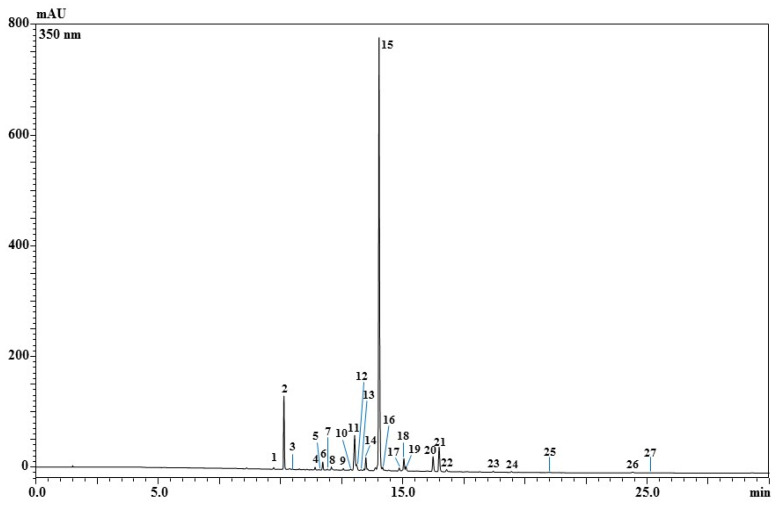
Saffron petals, which are the main by-products of Crocus sativus L. (Iridaceae family), are produced in large quantities and are known for their many beneficial properties. In this regard, this study aims to investigate the phenolic composition and antibacterial properties of hydroethanolic extracts from Crocus sativus L. petals collected from Serghina (province of Boulmane) in Morocco. The phenolic profiles were characterized using high-performance liquid chromatography coupled to a photodiode array and electrospray ionization mass spectrometry (HPLC-PDA-ESI/MS). The antibacterial potential was evaluated against four bacterial strains potentially causing food-borne disease (Staphylococcus aureus, Salmonella typhimurium, Escherichia coli, and Listeria monocytogenes) using disc diffusion and broth micro-dilution assays. Results showed that a total of 27 phenolic compounds was detected in the Crocus sativus L. petal extracts, which were assigned to flavonoids (kaempferol, quercetin, isorhamnetin, and myricetin derivatives). The most abundant compound was represented by kaempferol-sophoroside isomer (20.82 mg/g ± 0.152), followed by kaempferol-sophoroside-hexoside (2.63 mg/g ± 0.001). The hydroethanolic extracts of Crocus sativus L. petals demonstrated bactericidal effects against Staphylococcus aureus and Listeria monocetogenes and bacteriostatic effects against Escherichia coli and Salmonella typhimurium. Therefore, the by-product Crocus sativus L. petal extracts might be considered as valuable sources of natural antibacterial agents with potential applications in the food and pharmaceutical industries.
藏红花花瓣是藏红花(鸢尾科)的主要副产物,产量大,具有许多有益特性。有鉴于此,本研究旨在研究从摩洛哥布尔马尼省塞尔吉纳(Serghina)收集的藏红花花瓣的水醇提取物的酚类成分和抗菌性能。使用高效液相色谱法与光电二极管阵列和电喷雾电离质谱联用(HPLC-PDA-ESI/MS)对酚类成分进行了特征描述。使用圆盘扩散和肉汤微稀释试验评估了抗菌潜力,针对四种可能引起食源性疾病的细菌菌株(金黄色葡萄球菌、鼠伤寒沙门氏菌、大肠杆菌和单核细胞增生李斯特菌)进行了评估。结果表明,在藏红花花瓣提取物中检测到 27 种酚类化合物,这些化合物被分配为类黄酮(山奈酚、槲皮素、异鼠李素和杨梅素衍生物)。最丰富的化合物是山奈酚-槐糖苷异构体(20.82mg/g±0.152),其次是山奈酚-槐糖苷-己糖苷(2.63mg/g±0.001)。藏红花花瓣的水醇提取物对金黄色葡萄球菌和单核细胞增生李斯特菌具有杀菌作用,对大肠杆菌和鼠伤寒沙门氏菌具有抑菌作用。因此,藏红花副产物花瓣提取物可能被认为是具有潜在应用价值的天然抗菌剂的有价值来源,可应用于食品和制药行业。