Xu Ziheng, Wang Can, Li Changcheng, Wang Min, Chen Wenyan, Zhou Chenyu, Wei Ping
Institute for Poultry Science and Health, Guangxi University, Nanning, Guangxi, China.
School of Public Health and Management, Guang University of Chinese Medical, Nanning, Guangxi, China.
Front Vet Sci. 2022 Dec 21;9:1058844. doi: 10.3389/fvets.2022.1058844. eCollection 2022.
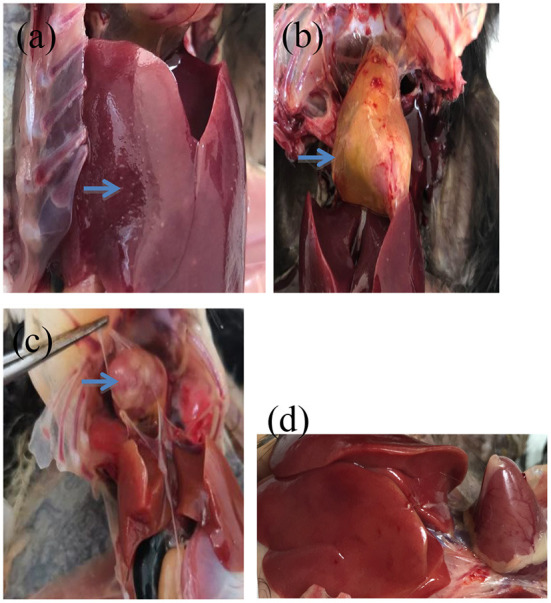
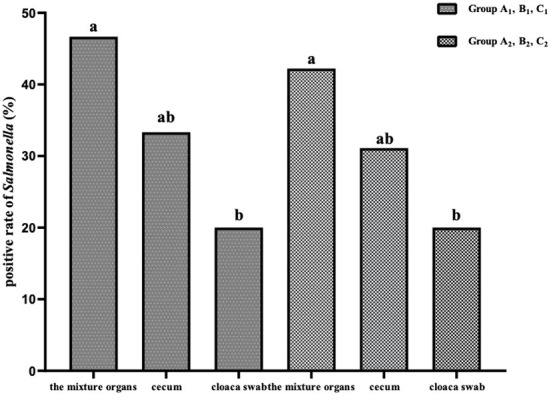
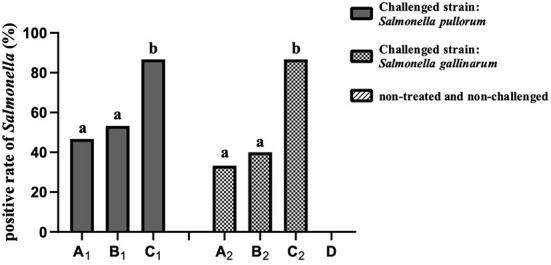
In order to prevent pullorum disease and fowl typhoid in breeders, the use of oregano essential oil (OEO) was tested for the prevention and treatment of infections of multidrug-resistant (SP) and (SG) in commercial Yellow-chicken breeders. In the challenge-protection experiment, commercial Hongguang-Black 1-day-old breeder chicks were randomly divided into four groups, including A (challenged, preventive dose), B (challenged, treatment dose), C (challenged, untreated), and D (unchallenged, untreated). Group A was supplemented with 200 μL/L OEO in the drinking water during the whole trial (1-35 days of age) and group B was supplemented with 400 μL/L OEO during 8-12 days of age, while groups C and D were kept as untreated controls. At 7 days of age, birds of groups A, B, and C were divided into two subgroups with equal number of birds (A-A, B-B, and C-C), and then subgroups A, B, and C were challenged with SP, while subgroups A, B, and C were challenged with SG. Clinical symptoms and death were observed and recorded daily. Every week during the experiment, serum antibodies against SP and SG of all the groups were detected by the plate agglutinate test (PAT). At the age of 35 days, all birds were weighed and necropsied, lesions were recorded and the challenging pathogens were isolated. The results showed that the positive rates of SP and SG isolation in groups A, A and B, B were significantly lower ( < 0.05) than those of groups C and C, respectively, while groups A and A were slightly lower ( > 0.05) than those of groups B and B. The average body weight (BW) of groups A and A were significantly higher ( < 0.05) than those of groups B, B and C, C, respectively, but there was no significant difference ( > 0.05) with that of group D. The -value between PAT positive and the recovery rates of was 0.99, which means they are highly positively correlated. The results of this study demonstrated that the prevention dose (200μL/L) and the treatment dose (400 μL/L) of OEO supplemented in the drinking water could all effectively decrease infections of SP and SG and that the effect of the prevention was greater than that of the treatment and finally that the prevention could also significantly reduce the BW decline of birds challenged with SP and SG.
为预防种鸡的鸡白痢和禽伤寒,对牛至精油(OEO)用于预防和治疗商品黄羽种鸡多重耐药(SP)和(SG)感染进行了测试。在攻毒保护试验中,将1日龄商品红光黑种雏鸡随机分为四组,包括A组(攻毒、预防剂量)、B组(攻毒、治疗剂量)、C组(攻毒、未处理)和D组(未攻毒、未处理)。A组在整个试验期(1至35日龄)饮水中添加200μL/L OEO,B组在8至12日龄饮水中添加400μL/L OEO,而C组和D组作为未处理对照。7日龄时,将A、B、C组鸡只等分为两个亚组(A - A、B - B和C - C),然后A、B、C亚组用SP攻毒,A、B、C亚组用SG攻毒。每天观察并记录临床症状和死亡情况。试验期间每周用平板凝集试验(PAT)检测所有组针对SP和SG的血清抗体。35日龄时,对所有鸡只称重并进行剖检,记录病变情况并分离攻毒病原体。结果表明,A组、A亚组以及B组、B亚组中SP和SG的分离阳性率分别显著低于C组、C亚组(P<0.05),而A组和A亚组略低于B组和B亚组(P>0.05)。A组和A亚组的平均体重(BW)分别显著高于B组、B亚组和C组、C亚组(P<0.05),但与D组无显著差异(P>0.05)。PAT阳性与 的恢复率之间的相关系数为0.99,表明它们高度正相关。本研究结果表明,饮水中添加OEO的预防剂量(200μL/L)和治疗剂量(400μL/L)均可有效降低SP和SG感染,且预防效果大于治疗效果,最终预防还可显著减少受SP和SG攻毒鸡只的体重下降。