Department of Respiratory and Critical Care Medicine, Zhongnan Hospital of Wuhan University, Wuhan, China.
Department of Respiratory Medicine, Shanghai New International Expo Center Fangcang Shelter Hospital, Shanghai, China.
Front Public Health. 2022 Dec 22;10:1032957. doi: 10.3389/fpubh.2022.1032957. eCollection 2022.
Coronavirus disease 2019 (COVID-19) is a respiratory-related disease caused by severe acute respiratory syndrome coronavirus 2 (SARS-CoV-2). More than 200 countries worldwide are affected by this disease. The Omicron variant of SARS-CoV-2 is the major epidemic variant worldwide and is characterized by higher infectivity. However, the immunity and risk factors for prolonged viral elimination in patients with non-severe SARS-CoV-2 Omicron variant infections are unclear. Therefore, this study aimed to examine the relationship between immunity and duration of viral elimination in non-severe SARS-CoV-2 Omicron variant-infected patients in Shanghai.
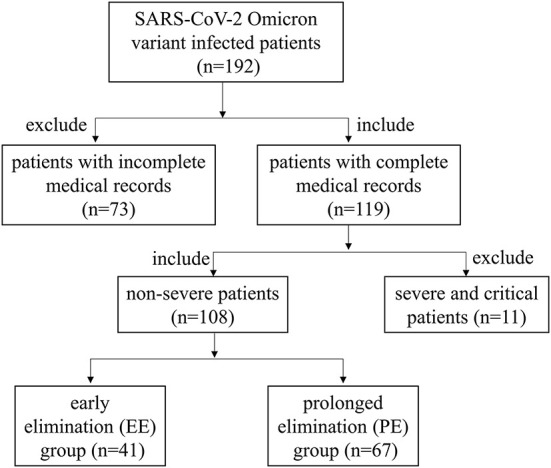
In total, 108 non-severe SARS-CoV-2 Omicron variant-infected patients from Shanghai New International Expo Center Fangcang Shelter Hospital were recruited in this study. They were further allocated to the early elimination (EE) and prolonged elimination (PE) groups according to SARS-CoV-2 nucleic acid positivity duration.
Compared to patients with EE, those with PE had increased serum concentrations of interleukin (IL)-5, IL-6, and IL-8; higher neutrophil count and neutrophil-to-lymphocyte ratio (NLR); lower lymphocyte, eosinophil, and red blood cell counts; and lower concentrations of hemoglobin and albumin (ALB). In lymphocyte subpopulation analysis, lower numbers of CD3 T cells, CD4 T cells, CD8 T cells, and NK cells and a higher CD4/CD8 ratio were observed in patients with PE. In addition, correlation analysis results revealed that cycle threshold values of SARS-CoV-2 Omicron variant ORF1ab and N were negatively correlated with IL-6 and IL-8 levels and positively correlated with eosinophil count in patients with COVID-19. Finally, multivariate regression analysis showed that ALB, CD4/CD8 ratio, NLR, and eosinophil count were predictors of the SARS-CoV-2 Omicron variant elimination.
In this study, we identified that the ALB, CD4/CD8 ratio, NLR, and eosinophil count were risk factors for prolonged viral elimination in non-severe SARS-CoV-2 Omicron variant-infected patients. These factors might be efficient indicators in the diagnosis, evaluation, and prognosis monitoring of the disease.
新型冠状病毒病(COVID-19)是一种由严重急性呼吸综合征冠状病毒 2(SARS-CoV-2)引起的呼吸道相关疾病。全球有 200 多个国家受到这种疾病的影响。SARS-CoV-2 的奥密克戎变体是全球主要的流行变体,其特点是传染性更高。然而,非重症 SARS-CoV-2 奥密克戎变体感染患者的免疫功能和病毒清除时间延长的风险因素尚不清楚。因此,本研究旨在研究上海非重症 SARS-CoV-2 奥密克戎变体感染患者的免疫功能与病毒清除时间之间的关系。
本研究共纳入上海新国际博览中心方舱医院 108 例非重症 SARS-CoV-2 奥密克戎变体感染患者,根据 SARS-CoV-2 核酸阳性持续时间将其进一步分为早期清除(EE)和延长清除(PE)组。
与 EE 患者相比,PE 患者的血清白细胞介素(IL)-5、IL-6 和 IL-8 浓度升高;中性粒细胞计数和中性粒细胞与淋巴细胞比值(NLR)升高;淋巴细胞、嗜酸性粒细胞和红细胞计数降低;血红蛋白和白蛋白(ALB)浓度降低。淋巴细胞亚群分析显示,PE 患者的 CD3 T 细胞、CD4 T 细胞、CD8 T 细胞和自然杀伤(NK)细胞数量减少,CD4/CD8 比值升高。此外,相关分析结果显示,COVID-19 患者的 SARS-CoV-2 奥密克戎变体 ORF1ab 和 N 的循环阈值与 IL-6 和 IL-8 水平呈负相关,与嗜酸性粒细胞计数呈正相关。最后,多变量回归分析显示,ALB、CD4/CD8 比值、NLR 和嗜酸性粒细胞计数是 SARS-CoV-2 奥密克戎变体清除的预测因素。
本研究发现,ALB、CD4/CD8 比值、NLR 和嗜酸性粒细胞计数是非重症 SARS-CoV-2 奥密克戎变体感染患者病毒清除时间延长的危险因素。这些因素可能是疾病诊断、评估和预后监测的有效指标。