Department of Nephrology, Tongji Hospital, Tongji University School of Medicine, Shanghai, China.
Department of Emergency Medicine, Tongji University School of Medicine, Shanghai, China.
BMC Pulm Med. 2023 May 22;23(1):177. doi: 10.1186/s12890-023-02473-w.
This study aimed to investigate the longitudinal circulating eosinophil (EOS) data impacted by the COVID-19 vaccine, the predictive role of circulating EOS in the disease severity, and its association with T cell immunity in patients with SARS-CoV-2 Omicron BA.2 variant infection in Shanghai, China.
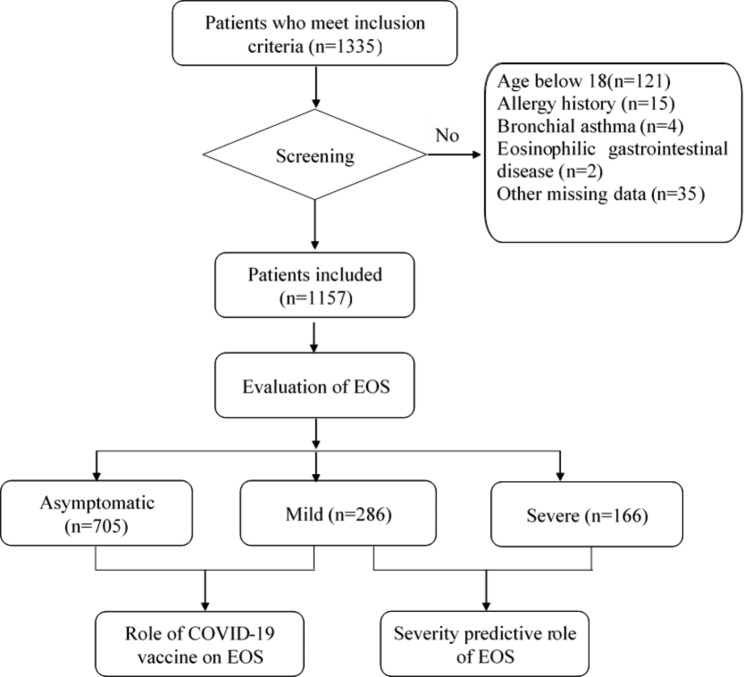
We collected a cohort of 1,157 patients infected with SARS-CoV-2 Omicron/BA.2 variant in Shanghai, China. These patients were diagnosed or admitted between Feb 20, 2022, and May 10, 2022, and were classified as asymptomatic (n = 705), mild (n = 286) and severe (n = 166) groups. We compiled and analyzed data of patients' clinical demographic characteristics, laboratory findings, and clinical outcomes.
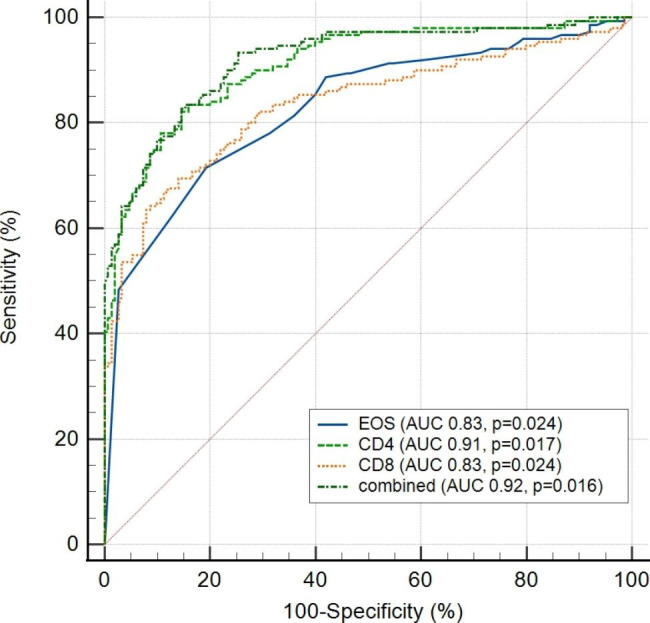
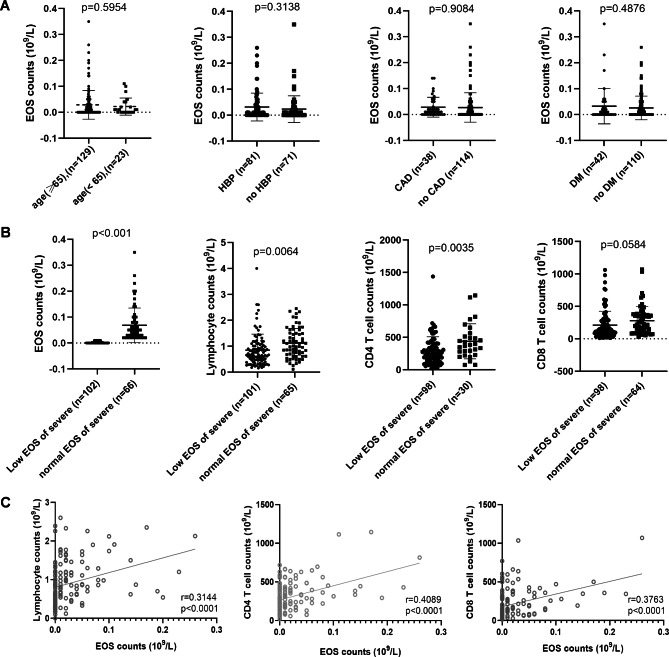
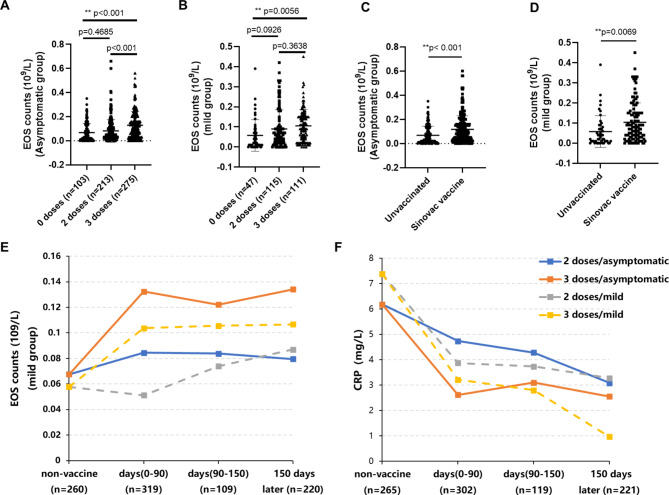
COVID-19 vaccine reduced the incidence of severe cases. Severe patients were shown to have declined peripheral blood EOS. Both the 2 doses and 3 doses of inactivated COVID-19 vaccines promoted the circulating EOS levels. In particular, the 3rd booster shot of inactivated COVID-19 vaccine was shown to have a sustained promoting effect on circulating EOS. Univariate analysis showed that there was a significant difference in age, underlying comorbidities, EOS, lymphocytes, CRP, CD4, and CD8 T cell counts between the mild and the severe patients. Multivariate logistic regression analysis and ROC curve analysis indicate that circulating EOS (AUC = 0.828, p = 0.025), the combination of EOS and CD4 T cell (AUC = 0.920, p = 0.017) can predict the risk of disease severity in patients with SARS-CoV-2 Omicron BA.2 variant infection.
COVID-19 vaccine promotes circulating EOS and reduces the risk of severe illness, and particularly the 3rd booster dose of COVID-19 vaccine sustainedly promotes EOS. Circulating EOS, along with T cell immunity, may have a predictive value for the disease severity in SARS-CoV-2 Omicron infected patients.
本研究旨在探讨 COVID-19 疫苗对循环嗜酸性粒细胞(EOS)的纵向数据的影响、循环 EOS 在疾病严重程度中的预测作用,以及其与中国上海 SARS-CoV-2 Omicron BA.2 变异感染患者 T 细胞免疫的关系。
我们收集了中国上海 SARS-CoV-2 Omicron/BA.2 变异感染的 1157 例患者队列。这些患者于 2022 年 2 月 20 日至 5 月 10 日期间确诊或入院,并分为无症状(n=705)、轻症(n=286)和重症(n=166)组。我们汇编和分析了患者临床人口统计学特征、实验室发现和临床结局的数据。
COVID-19 疫苗降低了重症病例的发生率。重症患者外周血 EOS 下降。灭活 COVID-19 疫苗的 2 剂和 3 剂均促进了循环 EOS 水平。特别是,灭活 COVID-19 疫苗的第 3 次加强针显示出对循环 EOS 的持续促进作用。单因素分析显示,轻症和重症患者在年龄、基础合并症、EOS、淋巴细胞、CRP、CD4 和 CD8 T 细胞计数方面存在显著差异。多变量逻辑回归分析和 ROC 曲线分析表明,循环 EOS(AUC=0.828,p=0.025)和 EOS 与 CD4 T 细胞的组合(AUC=0.920,p=0.017)可以预测 SARS-CoV-2 Omicron BA.2 变异感染患者疾病严重程度的风险。
COVID-19 疫苗促进循环 EOS 并降低重症疾病的风险,特别是 COVID-19 疫苗的第 3 次加强针持续促进 EOS。循环 EOS 与 T 细胞免疫一起,可能对 SARS-CoV-2 感染患者的疾病严重程度具有预测价值。