• 文献检索
  • 文档翻译
  • 深度研究
  • 学术资讯
  • Suppr Zotero 插件Zotero 插件
  • 邀请有礼
  • 套餐&价格
  • 历史记录
应用&插件
Suppr Zotero 插件Zotero 插件浏览器插件Mac 客户端Windows 客户端微信小程序
定价
高级版会员购买积分包购买API积分包
服务
文献检索文档翻译深度研究API 文档MCP 服务
关于我们
关于 Suppr公司介绍联系我们用户协议隐私条款
关注我们

Suppr 超能文献

核心技术专利:CN118964589B侵权必究
粤ICP备2023148730 号-1Suppr @ 2026

文献检索

告别复杂PubMed语法,用中文像聊天一样搜索,搜遍4000万医学文献。AI智能推荐,让科研检索更轻松。

立即免费搜索

文件翻译

保留排版,准确专业,支持PDF/Word/PPT等文件格式,支持 12+语言互译。

免费翻译文档

深度研究

AI帮你快速写综述,25分钟生成高质量综述,智能提取关键信息,辅助科研写作。

立即免费体验

永不停歇的歌曲:重复暴露对耳虫发展的影响。

The song that never ends: The effect of repeated exposure on the development of an earworm.

机构信息

School of Psychology & Counselling, Faculty of Health, Queensland University of Technology (QUT), Brisbane, QLD, Australia.

School of Early Childhood and Inclusive Education, Faculty of Education, Queensland University of Technology (QUT), Brisbane, QLD, Australia.

出版信息

Q J Exp Psychol (Hove). 2023 Nov;76(11):2535-2545. doi: 10.1177/17470218231152368. Epub 2023 Feb 4.

DOI:10.1177/17470218231152368
PMID:36622014
原文链接:https://pmc.ncbi.nlm.nih.gov/articles/PMC10585939/
Abstract

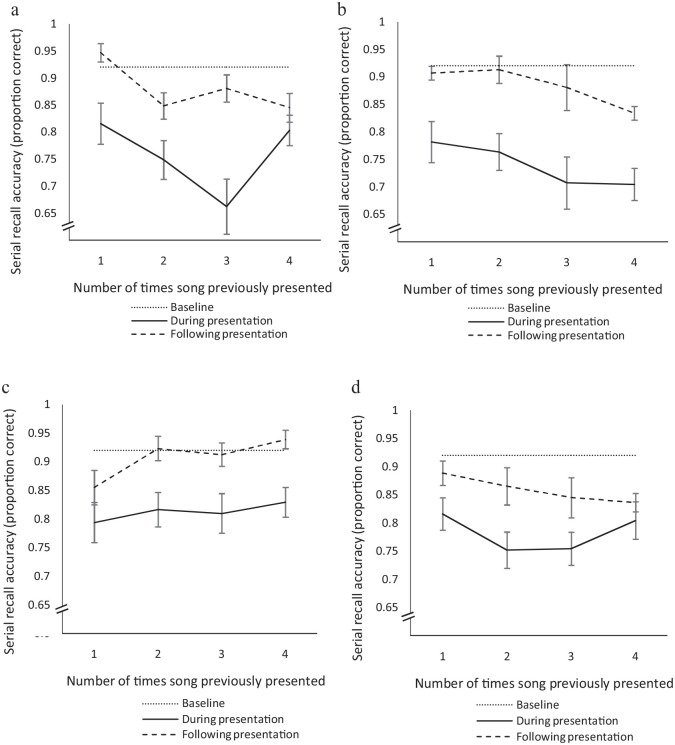
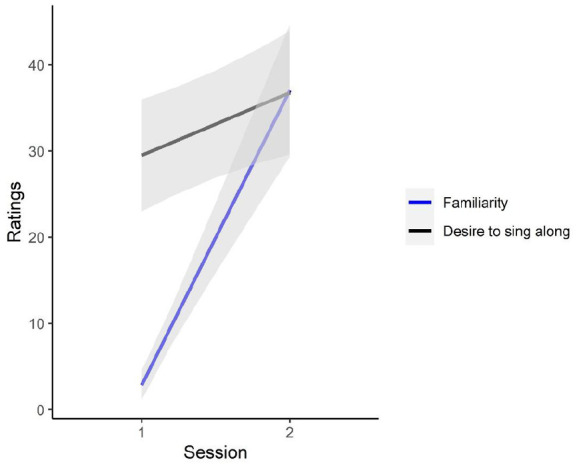
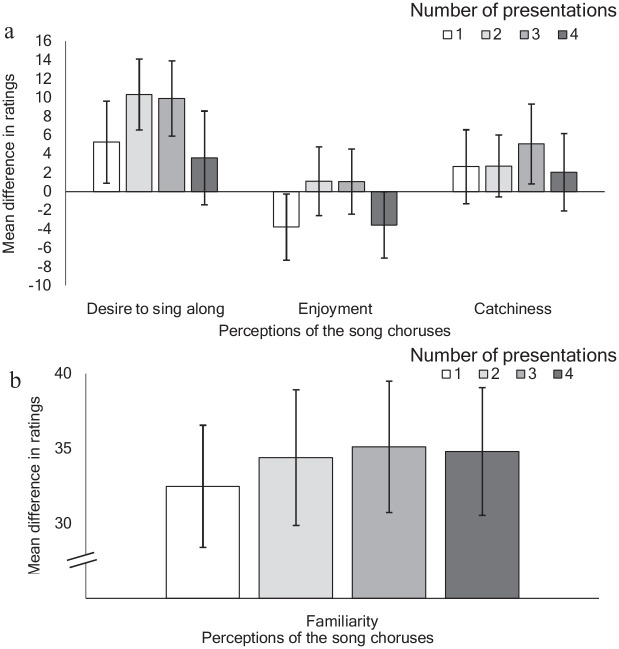
An "earworm"-the experience of a catchy melody that repeats persistently in the mind-is a ubiquitous yet mysterious cognitive phenomenon. Previous research demonstrates that earworms for vocal music engage working memory resources, manifesting as "inner singing." This study investigated whether this effect is moderated by prior exposure to music. In one experimental session, participants ( = 44) were presented with four novel song choruses. To manipulate exposure, each song was presented between one and four times, counterbalanced across participants. The following day, participants undertook a serial recall task during and following presentation of each song. In addition, they rated the music on familiarity, enjoyment, their desire to sing along, and perceived catchiness, both before and following the experiment. Increased exposure to novel songs on the first day tended to result in greater interference on task performance during and following their presentation on the second day, yet the effect varied depending on the song. Ratings of the desire to sing along and perceived familiarity increased significantly between the sessions for all songs. These findings are important in understanding the relative influence of familiarity and song-level characteristics on the development of an earworm.

摘要

“耳虫”——即一段旋律不断在脑海中重复的令人难以忘怀的体验——是一种普遍而神秘的认知现象。先前的研究表明,人声音乐的“耳虫”会占用工作记忆资源,表现为“内心歌唱”。本研究探讨了这种效应是否受到音乐先前暴露的影响。在一个实验环节中,参与者(n=44)被呈现了四个新的歌曲片段。为了操纵暴露,每个歌曲在参与者之间以一到四次的方式平衡呈现。第二天,参与者在每个歌曲呈现期间和之后进行了一系列的回忆任务。此外,他们在实验前后对音乐的熟悉度、享受程度、想要哼唱的愿望以及感知的感染力进行了评价。第一天对新歌的接触增加往往会导致第二天在歌曲呈现期间和之后的任务表现受到更大的干扰,但这种效果取决于歌曲。在两次会议期间,所有歌曲的哼唱愿望和感知熟悉度的评分都显著增加。这些发现对于理解熟悉度和歌曲特征对“耳虫”发展的相对影响很重要。
https://cdn.ncbi.nlm.nih.gov/pmc/blobs/e607/10585939/348a7ad6e344/10.1177_17470218231152368-fig3.jpg
https://cdn.ncbi.nlm.nih.gov/pmc/blobs/e607/10585939/359ee5d3bfcd/10.1177_17470218231152368-fig1.jpg
https://cdn.ncbi.nlm.nih.gov/pmc/blobs/e607/10585939/4668722998f5/10.1177_17470218231152368-fig2.jpg
https://cdn.ncbi.nlm.nih.gov/pmc/blobs/e607/10585939/348a7ad6e344/10.1177_17470218231152368-fig3.jpg
https://cdn.ncbi.nlm.nih.gov/pmc/blobs/e607/10585939/359ee5d3bfcd/10.1177_17470218231152368-fig1.jpg
https://cdn.ncbi.nlm.nih.gov/pmc/blobs/e607/10585939/4668722998f5/10.1177_17470218231152368-fig2.jpg
https://cdn.ncbi.nlm.nih.gov/pmc/blobs/e607/10585939/348a7ad6e344/10.1177_17470218231152368-fig3.jpg

相似文献

1
The song that never ends: The effect of repeated exposure on the development of an earworm.永不停歇的歌曲:重复暴露对耳虫发展的影响。
Q J Exp Psychol (Hove). 2023 Nov;76(11):2535-2545. doi: 10.1177/17470218231152368. Epub 2023 Feb 4.
2
Neural substrates for semantic memory of familiar songs: is there an interface between lyrics and melodies?熟悉歌曲语义记忆的神经基础:歌词和旋律之间存在界面吗?
PLoS One. 2012;7(9):e46354. doi: 10.1371/journal.pone.0046354. Epub 2012 Sep 28.
3
Familiarity modulates neural tracking of sung and spoken utterances.熟悉程度会调节对歌唱和言语发声的神经追踪。
Neuroimage. 2022 May 15;252:119049. doi: 10.1016/j.neuroimage.2022.119049. Epub 2022 Mar 4.
4
Please don't stop the music: Song completion in patients with aphasia.请别停止音乐:失语症患者的歌曲补全任务
J Commun Disord. 2018 Sep-Oct;75:72-86. doi: 10.1016/j.jcomdis.2018.06.005. Epub 2018 Jun 22.
5
A nonmusician with severe Alzheimer's dementia learns a new song.一位患有重度阿尔茨海默病痴呆症的非音乐家学会了一首新歌。
Neurocase. 2017 Feb;23(1):36-40. doi: 10.1080/13554794.2017.1287278. Epub 2017 Feb 21.
6
[Role of lyrics and melody in song recognition: why is song recognition faster?].[歌词与旋律在歌曲识别中的作用:为何歌曲识别更快?]
Shinrigaku Kenkyu. 2009 Dec;80(5):405-13. doi: 10.4992/jjpsy.80.405.
7
Dissociation between singing and speaking in expressive aphasia: the role of song familiarity.表达性失语症中唱歌与说话的分离:歌曲熟悉度的作用。
Neuropsychologia. 2008 Apr;46(5):1505-12. doi: 10.1016/j.neuropsychologia.2008.01.008. Epub 2008 Jan 19.
8
Learning lyrics: to sing or not to sing?学习歌词:唱还是不唱?
Mem Cognit. 2007 Mar;35(2):242-53. doi: 10.3758/bf03193445.
9
Vocal singing skills by cochlear implanted children without formal musical training: Familiar versus unfamiliar songs.未经过正式音乐训练的人工耳蜗植入儿童的歌唱技巧:熟悉歌曲与不熟悉歌曲。
Int J Pediatr Otorhinolaryngol. 2023 Jul;170:111605. doi: 10.1016/j.ijporl.2023.111605. Epub 2023 May 22.
10
The organisation of musical semantic memory: evidence from false memories for familiar songs.音乐语义记忆的组织:来自熟悉歌曲错误记忆的证据。
Memory. 2014;22(7):852-60. doi: 10.1080/09658211.2013.839709. Epub 2013 Oct 10.

引用本文的文献

1
Effects of singing on vascular health in older adults with coronary artery disease: a randomized, crossover trial.唱歌对老年冠心病患者血管健康的影响:一项随机交叉试验。
Front Cardiovasc Med. 2025 Apr 28;12:1546462. doi: 10.3389/fcvm.2025.1546462. eCollection 2025.
2
Effects of Singing on Vascular Health in Older Adults with Coronary Artery Disease: A Randomized Trial.唱歌对老年冠心病患者血管健康的影响:一项随机试验。
medRxiv. 2024 Jul 27:2024.07.25.24311033. doi: 10.1101/2024.07.25.24311033.

本文引用的文献

1
Spontaneous mental replay of music improves memory for incidentally associated event knowledge.自发的音乐心理回放有助于提高与事件相关的偶然知识记忆。
J Exp Psychol Gen. 2022 Jan;151(1):1-24. doi: 10.1037/xge0001050. Epub 2021 Jun 10.
2
The articulatory determinants of verbal sequence learning.言语序列学习的发音决定因素。
J Exp Psychol Learn Mem Cogn. 2020 Oct;46(10):1977-1997. doi: 10.1037/xlm0000926. Epub 2020 Jul 23.
3
A novel indirect method for capturing involuntary musical imagery under varying cognitive load.一种在不同认知负荷下捕捉非自愿音乐意象的新型间接方法。
Q J Exp Psychol (Hove). 2017 Nov;70(11):2189-2199. doi: 10.1080/17470218.2016.1227860. Epub 2016 Nov 4.
4
Don't forget the lyrics! Spatiotemporal dynamics of neural mechanisms spontaneously evoked by gaps of silence in familiar and newly learned songs.别忘了歌词!熟悉歌曲和新学歌曲中沉默间隙自发诱发的神经机制的时空动态。
Neurobiol Learn Mem. 2016 Jul;132:18-28. doi: 10.1016/j.nlm.2016.04.011. Epub 2016 Apr 27.
5
The impact of music on learning and consolidation of novel words.音乐对新单词学习与巩固的影响。
Memory. 2017 Jan;25(1):107-121. doi: 10.1080/09658211.2015.1130843. Epub 2015 Dec 29.
6
Want to block earworms from conscious awareness? B(u)y gum!想阻止耳虫进入意识层面吗?嚼口香糖! (注:这里的“B(u)y gum”是一种双关语,“B(u)y”听起来像“bye”,有“再见”之意,同时“gum”是口香糖,整体意思是通过嚼口香糖来摆脱耳虫这种反复出现的曲调,即阻止其在意识中出现,这里按字面意思并结合双关含义翻译为上述译文。) 括号内内容为辅助理解,答题时按要求不要添加。 正式译文为:想阻止耳虫进入意识层面吗?嚼口香糖!
Q J Exp Psychol (Hove). 2015;68(6):1049-57. doi: 10.1080/17470218.2015.1034142. Epub 2015 Apr 21.
7
Singing can facilitate foreign language learning.唱歌有助于外语学习。
Mem Cognit. 2014 Jan;42(1):41-52. doi: 10.3758/s13421-013-0342-5.
8
Earworms (stuck song syndrome): towards a natural history of intrusive thoughts.耳虫(被困住的歌曲综合征):侵入性思维的自然史。
Br J Psychol. 2010 Nov;101(Pt 4):637-53. doi: 10.1348/000712609X479636. Epub 2009 Nov 30.
9
Motormouth: mere exposure depends on stimulus-specific motor simulations.健谈者:单纯暴露效应取决于特定刺激的运动模拟。
J Exp Psychol Learn Mem Cogn. 2009 Mar;35(2):423-33. doi: 10.1037/a0014504.
10
Songs as an aid for language acquisition.歌曲作为语言习得的辅助手段。
Cognition. 2008 Feb;106(2):975-83. doi: 10.1016/j.cognition.2007.03.005. Epub 2007 May 1.