Department of Microbiology and Immunology, University of North Carolina School of Medicine, Chapel Hill, North Carolina, United States of America.
Program in Emerging Infectious Diseases, Duke-National University of Singapore Medical School, Singapore, Singapore.
PLoS Pathog. 2023 Jan 10;19(1):e1010814. doi: 10.1371/journal.ppat.1010814. eCollection 2023 Jan.
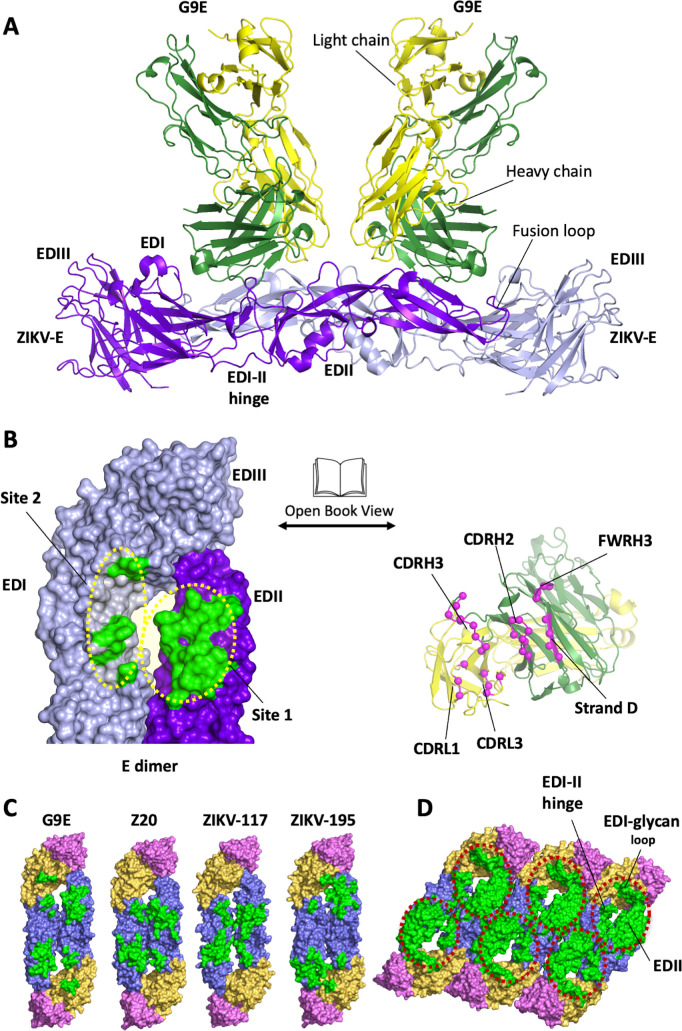
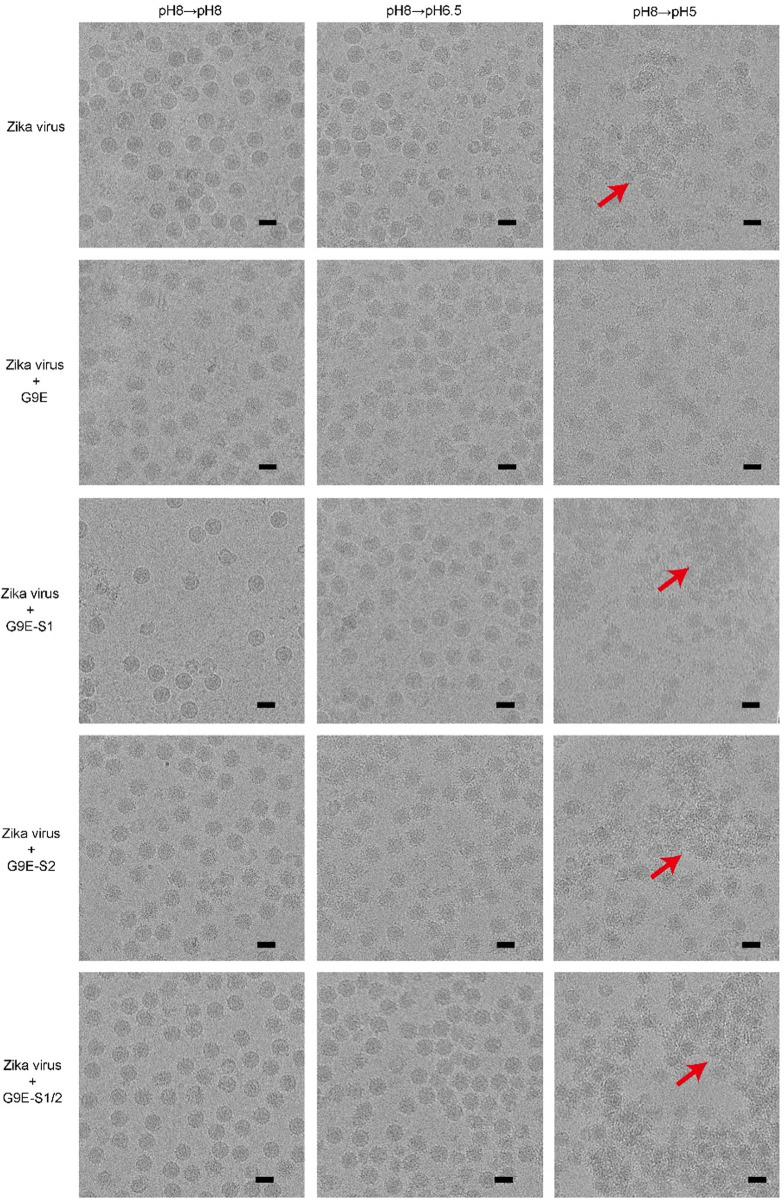
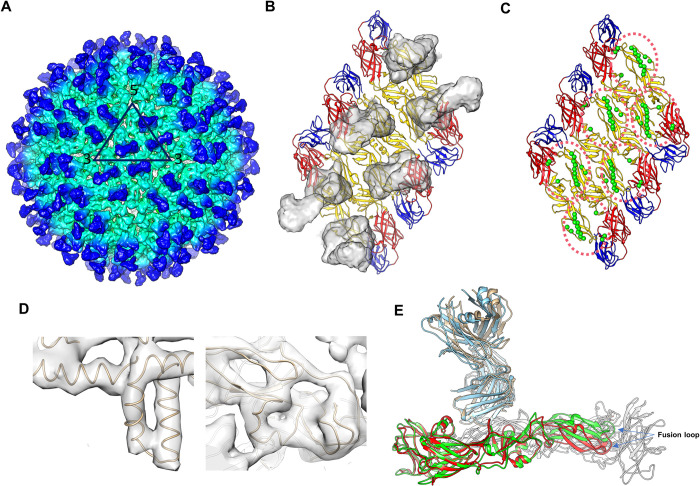
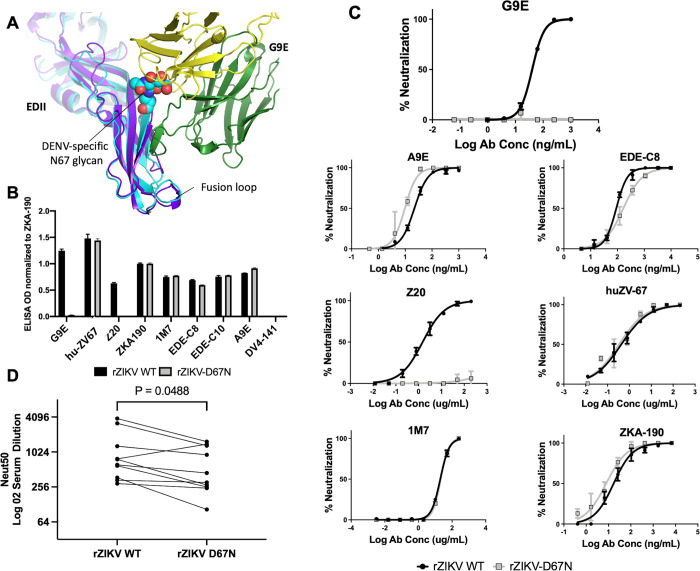
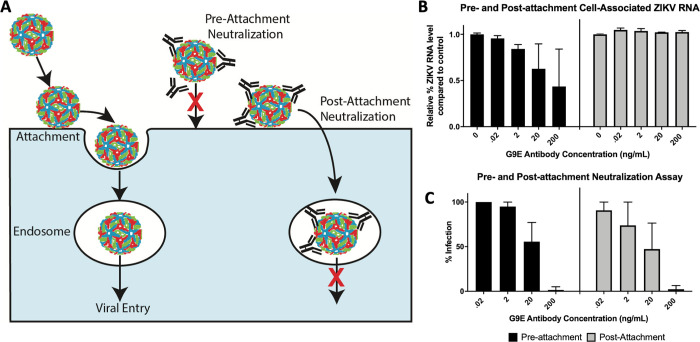
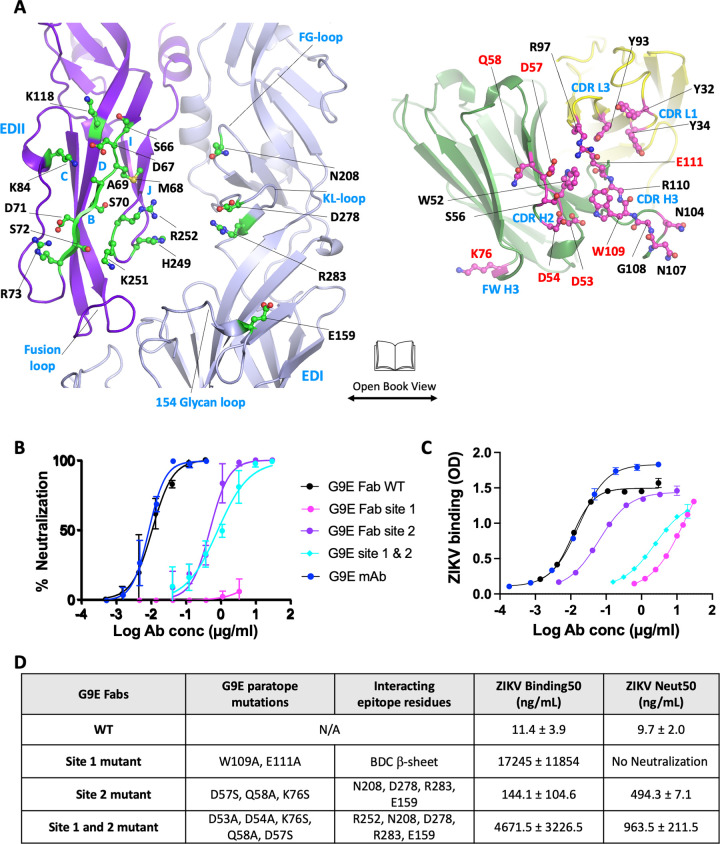
We currently have an incomplete understanding of why only a fraction of human antibodies that bind to flaviviruses block infection of cells. Here we define the footprint of a strongly neutralizing human monoclonal antibody (mAb G9E) with Zika virus (ZIKV) by both X-ray crystallography and cryo-electron microscopy. Flavivirus envelope (E) glycoproteins are present as homodimers on the virion surface, and G9E bound to a quaternary structure epitope spanning both E protomers forming a homodimer. As G9E mainly neutralized ZIKV by blocking a step after viral attachment to cells, we tested if the neutralization mechanism of G9E was dependent on the mAb cross-linking E molecules and blocking low-pH triggered conformational changes required for viral membrane fusion. We introduced targeted mutations to the G9E paratope to create recombinant antibodies that bound to the ZIKV envelope without cross-linking E protomers. The G9E paratope mutants that bound to a restricted epitope on one protomer poorly neutralized ZIKV compared to the wild-type mAb, demonstrating that the neutralization mechanism depended on the ability of G9E to cross-link E proteins. In cell-free low pH triggered viral fusion assay, both wild-type G9E, and epitope restricted paratope mutant G9E bound to ZIKV but only the wild-type G9E blocked fusion. We propose that, beyond antibody binding strength, the ability of human antibodies to cross-link E-proteins is a critical determinant of flavivirus neutralization potency.
目前,我们对于为何只有一部分能与黄病毒结合的抗体能阻止病毒感染细胞还没有完全理解。在这里,我们通过 X 射线晶体学和冷冻电镜技术确定了具有强大中和能力的人源单克隆抗体(mAb G9E)与寨卡病毒(ZIKV)的结合部位。黄病毒包膜(E)糖蛋白以同源二聚体的形式存在于病毒表面,G9E 结合于跨越两个 E 原聚体的四元结构表位,形成同源二聚体。由于 G9E 主要通过阻止病毒与细胞附着后的一个步骤来中和 ZIKV,我们测试了 G9E 的中和机制是否依赖于 mAb 交联 E 分子并阻断低 pH 触发的病毒膜融合所需的构象变化。我们引入了针对 G9E 变构区的靶向突变,以创建结合 ZIKV 包膜但不交联 E 原聚体的重组抗体。与野生型 mAb 相比,结合于一个原聚体上受限表位的 G9E 变构区突变体对 ZIKV 的中和能力较差,这表明中和机制依赖于 G9E 交联 E 蛋白的能力。在无细胞低 pH 触发的病毒融合试验中,野生型 G9E 和表位受限的变构区突变体 G9E 都能结合 ZIKV,但只有野生型 G9E 能阻断融合。我们提出,除了抗体结合强度外,人类抗体交联 E 蛋白的能力是黄病毒中和效力的一个关键决定因素。