Department of Epidemiology and Data Science, Amsterdam Public Health Institute, Amsterdam UMC, Vrije Universiteit Amsterdam, De Boelelaan, 1117, Amsterdam, The Netherlands.
College of Public Health, University of South Florida, Tampa, FL, USA.
BMC Med Res Methodol. 2023 Jan 12;23(1):11. doi: 10.1186/s12874-022-01817-0.
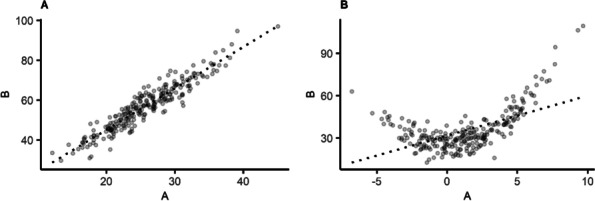
Confounding is a common issue in epidemiological research. Commonly used confounder-adjustment methods include multivariable regression analysis and propensity score methods. Although it is common practice to assess the linearity assumption for the exposure-outcome effect, most researchers do not assess linearity of the relationship between the confounder and the exposure and between the confounder and the outcome before adjusting for the confounder in the analysis. Failing to take the true non-linear functional form of the confounder-exposure and confounder-outcome associations into account may result in an under- or overestimation of the true exposure effect. Therefore, this paper aims to demonstrate the importance of assessing the linearity assumption for confounder-exposure and confounder-outcome associations and the importance of correctly specifying these associations when the linearity assumption is violated.
A Monte Carlo simulation study was used to assess and compare the performance of confounder-adjustment methods when the functional form of the confounder-exposure and confounder-outcome associations were misspecified (i.e., linearity was wrongly assumed) and correctly specified (i.e., linearity was rightly assumed) under multiple sample sizes. An empirical data example was used to illustrate that the misspecification of confounder-exposure and confounder-outcome associations leads to bias.
The simulation study illustrated that the exposure effect estimate will be biased when for propensity score (PS) methods the confounder-exposure association is misspecified. For methods in which the outcome is regressed on the confounder or the PS, the exposure effect estimate will be biased if the confounder-outcome association is misspecified. In the empirical data example, correct specification of the confounder-exposure and confounder-outcome associations resulted in smaller exposure effect estimates.
When attempting to remove bias by adjusting for confounding, misspecification of the confounder-exposure and confounder-outcome associations might actually introduce bias. It is therefore important that researchers not only assess the linearity of the exposure-outcome effect, but also of the confounder-exposure or confounder-outcome associations depending on the confounder-adjustment method used.
混杂是流行病学研究中的一个常见问题。常用的混杂因素调整方法包括多变量回归分析和倾向评分方法。虽然评估暴露-结局效应的线性假设是常见做法,但大多数研究人员在分析中调整混杂因素之前,并不评估混杂因素与暴露以及混杂因素与结局之间关系的线性。未能考虑混杂因素-暴露和混杂因素-结局关联的真实非线性函数形式,可能导致对真实暴露效应的低估或高估。因此,本文旨在演示评估混杂因素-暴露和混杂因素-结局关联的线性假设的重要性,以及在违反线性假设时正确指定这些关联的重要性。
使用蒙特卡罗模拟研究来评估和比较混杂因素调整方法的性能,当混杂因素-暴露和混杂因素-结局关联的函数形式被错误指定(即线性被错误假设)和正确指定(即线性被正确假设)时,在多个样本量下进行。使用一个实证数据示例来说明混杂因素-暴露和混杂因素-结局关联的错误指定会导致偏差。
模拟研究表明,当倾向评分(PS)方法中混杂因素-暴露关联被错误指定时,暴露效应估计会有偏差。对于将结局回归到混杂因素或 PS 的方法,如果混杂因素-结局关联被错误指定,则暴露效应估计会有偏差。在实证数据示例中,正确指定混杂因素-暴露和混杂因素-结局关联会导致较小的暴露效应估计。
当试图通过调整混杂因素来消除偏差时,混杂因素-暴露和混杂因素-结局关联的错误指定实际上可能会引入偏差。因此,研究人员不仅要评估暴露-结局效应的线性,还要根据所使用的混杂因素调整方法评估混杂因素-暴露或混杂因素-结局关联的线性,这一点很重要。