Department of Animal Health and Production, Faculty of Veterinary Medicine, University of Nigeria, Nsukka, Nigeria.
Department of Veterinary Public Health and Preventive Medicine, Faculty of Veterinary Medicine, University of Nigeria, Nsukka, Nigeria.
PLoS One. 2023 Jan 17;18(1):e0280524. doi: 10.1371/journal.pone.0280524. eCollection 2023.
The indiscriminate slaughter of pregnant goats (SPGs) undermines meat production and food security especially in developing countries. It also connotes animal cruelty, depletion of goat population and may enhance the spread of zoonotic pathogens inhabiting the female reproductive tract during carcass processing. Consequently, this study determined the causes and prevalence of slaughtering pregnant goats for meat in Enugu, Nigeria. The study also estimated the economic losses associated with SPGs, discussed the negative public health consequences and suggested the ways-out.
Structured, validated and pilot-tested questionnaire was used to ascertain the reasons for SPGs for meat among 78 willing and randomly selected respondents. The questionnaire survey was conducted in the form of interview. Pregnancy statuses of the goats slaughtered were ascertained by visual inspection and palpation of the eviscerated and longitudinally incised uteri and the horns for macroscopic evidence of pregnancy. Ages of the dams were estimated by dentition method. Estimation of the gestational age was performed by crown-rump length method. The study lasted for six months, comprised of three months (December to March) during the dry/hot season and another three months (May to August) during the wet/rainy season. Economic loss estimation was based on the current monetary values of a matured (30 kilogram) goat and one kilogram of chevon in Enugu, Nigeria; which was determined through market survey. Pearson's Chi-square test was used to determine whether there were significant (P<0.05) statistical associations between SPGs and age and season.
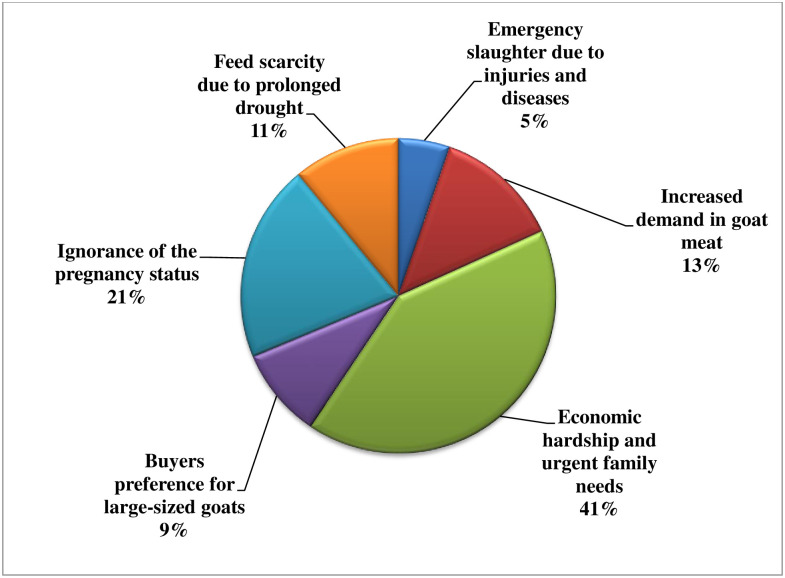
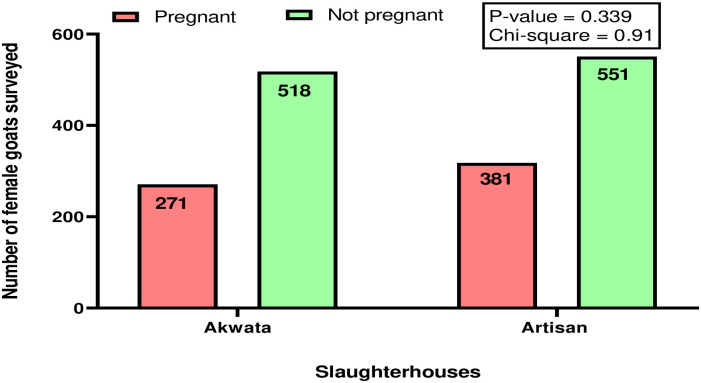
Major reasons adduced for SPGs were: economic hardship (41%), ignorance of the goat's pregnancy status (21%), increased demand for chevon (13%) and feed scarcity during drought (11%). Of the 1,658 does examined during the six months study, 589 (35.5%) were pregnant. The majority (876/1658, 52.8%) of the female goats slaughtered were in their active reproductive age of ≤ 4 years, while 782 (47.2%) were aged > 4 years. Similarly, majority (1007/1658, 60.7%) of the does/nannies were slaughtered during the dry/hot season. A total of 907 foetuses at first (n = 332, 36.6%), second (n = 486, 53.6%) and third (n = 89, 9.8%) trimesters of gestation were recovered from the 589 PGs. Singleton, twin and triplet pregnancies were observed in 312 (53%), 236 (40%) and 41 (7%) PGs, respectively. About ₦34.44 million ($83,390) would have been earned if the foetuses were born alive and raised to maturity. Additionally, 19,136 kg of chevon, valued at ₦47,841, 000 ($115,838), which would have accrued from the wasted foetuses was also lost.
Considering the economic, zoonotic and livestock production implications of this work, frantic efforts to reduce SPGs in Enugu, Nigeria is imperative. This could be achieved through advocacy, goat farmers' enlightenment, ante-mortem pregnancy diagnosis, provision of subsidized feed materials during the dry season and strict enforcement of the Nigerian Meat Edict law, which proscribes unapproved slaughter of gravid animals. These measures may improve food safety and security, improve goat reproduction and production, reduce protein malnutrition, limit dissemination of zoonotic pathogens during carcass processing and hence protect public health in Nigeria.
滥杀怀孕山羊(SPG)会破坏肉类生产和粮食安全,尤其是在发展中国家。这也意味着动物受到虐待,山羊数量减少,并且在屠宰过程中可能会增强栖息在雌性生殖道中的人畜共患病原体的传播。因此,本研究旨在确定尼日利亚埃努古地区屠宰怀孕山羊用于肉类的原因和流行率。本研究还估计了与 SPG 相关的经济损失,讨论了负面的公共卫生后果,并提出了出路。
使用经过验证和试点测试的结构化问卷,对 78 名愿意且随机选择的受访者进行了关于 SPG 用于肉类的原因的调查。通过对屠宰后的山羊进行肉眼检查和子宫的纵向切开,以及角的宏观妊娠迹象来确定其妊娠状态。通过牙齿法估计母羊的年龄。通过头臀长法来估计妊娠期。研究持续六个月,包括干/热季节的三个月(12 月至 3 月)和湿/雨季的另外三个月(5 月至 8 月)。经济损失估计基于尼日利亚埃努古当前成熟(30 公斤)山羊和一公斤羊肉的货币价值;这是通过市场调查确定的。使用皮尔逊卡方检验来确定 SPG 与年龄和季节之间是否存在显著(P<0.05)的统计学关联。
SPG 的主要原因是:经济困难(41%)、不知道山羊的妊娠状态(21%)、对羊肉的需求增加(13%)和干旱期间饲料短缺(11%)。在六个月的研究中,检查了 1658 只母羊,其中 589 只(35.5%)怀孕。大多数(876/1658,52.8%)用于屠宰的雌性山羊处于其活跃的生殖年龄≤4 岁,而 782 只(47.2%)年龄大于 4 岁。同样,大多数(1007/1658,60.7%)的母羊/保姆在干/热季节被屠宰。从 589 只 PG 中总共回收了第一(n=332,36.6%)、第二(n=486,53.6%)和第三(n=89,9.8%)妊娠三个月的胎儿。在 312 只(53%)PG 中观察到单胎、双胎和三胎妊娠,在 236 只(40%)PG 中观察到 41 只(7%)PG 中观察到单胎、双胎和三胎妊娠。如果胎儿出生后存活并饲养至成熟,将获得约 3444 万奈拉(83390 美元)的收入。此外,还损失了 19136 公斤的羊肉,价值 47841000 奈拉(115838 美元),这些羊肉本可以从浪费的胎儿中获得。
考虑到这项工作的经济、人畜共患病和畜牧业生产的影响,尼日利亚埃努古地区迫切需要减少 SPG 的数量。这可以通过宣传、提高山羊养殖户的认识、产前妊娠诊断、在旱季提供补贴饲料材料以及严格执行尼日利亚肉类法令来实现,该法令禁止未经批准屠宰怀孕动物。这些措施可以提高食品安全和保障,改善山羊繁殖和生产,减少蛋白质营养不良,限制人畜共患病原体在屠宰过程中的传播,从而保护尼日利亚的公共卫生。