Division of Interventional Radiology and Image-Guided Medicine, Department of Radiology and Imaging Sciences, Emory University School of Medicine, Atlanta, GA, USA.
Division of Interventional Radiology, Department of Radiology, Mount Sinai School of Medicine, New York, NY, USA.
Eur J Nucl Med Mol Imaging. 2023 May;50(6):1743-1752. doi: 10.1007/s00259-023-06111-9. Epub 2023 Jan 18.
There is an increasing body of evidence indicating Y90 dose thresholds for tumor response and treatment-related toxicity. These thresholds are poorly studied in resin Y90, particularly in hepatocellular carcinoma (HCC).
To evaluate the efficacy of prospective voxel-based dosimetry for predicting treatment response and adverse events (AEs) in patients with HCC undergoing resin-based Y90 radioembolization.
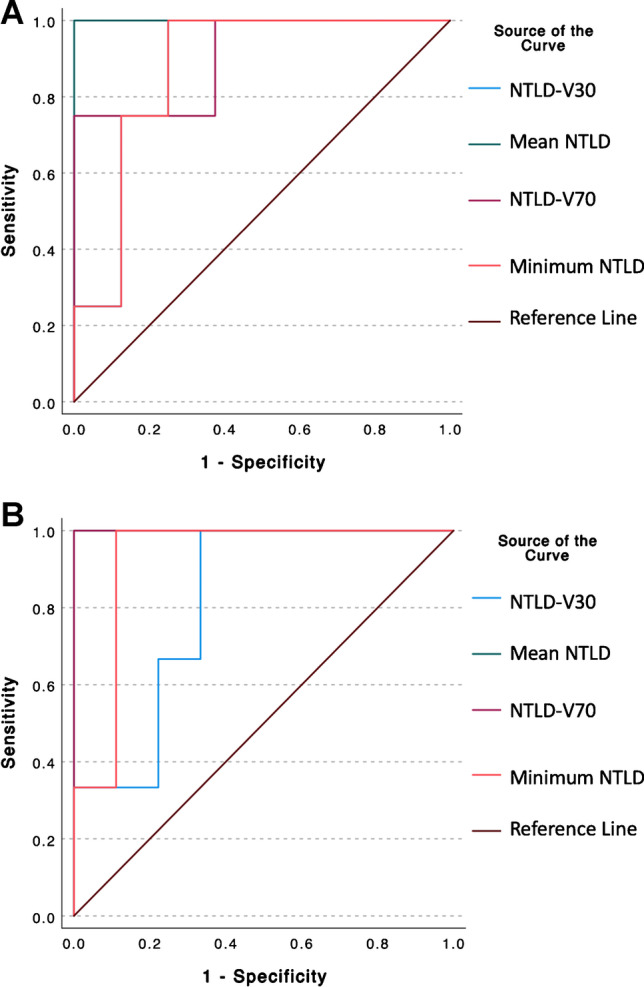
This correlative study was based on a prospective single-arm clinical trial (NCT04172714), which evaluated the efficacy of low/scout (555 MBq) activity of resin-based Y90 for treatment planning. Partition model was used with goal of tumor dose (TD) > 200 Gy and non-tumoral liver dose (NTLD) < 70 Gy for non-segmental therapies. Single compartment dose of 200 Gy was used for segmentectomies. Prescribed Y90 activity minus scout activity was administered for therapeutic Y90 followed by Y90-PET/CT. Sureplan® (MIM Software, Cleveland, OH) was used for dosimetry analysis. Treatment response was evaluated at 3 and 6 months. Receiver operating characteristic curve determined TD response threshold for objective response (OR) and complete response (CR) as well as non-tumor liver dose (NTLD) threshold that predicted AEs.
N = 30 patients were treated with 33 tumors (19 segmental and 14 non-segmental). One patient died before the first imaging, and clinical follow-up was excluded from this analysis. Overall, 26 (81%) of the tumors had an OR and 23 (72%) had a CR. A mean TD of 253 Gy predicted an OR with 92% sensitivity and 83% specificity (area under the curve (AUC = 0.929, p < 0.001). A mean TD of 337 Gy predicted a CR with 83% sensitivity and 89% specificity (AUC = 0.845, p < 0.001). A mean NTLD of 81 and 87 Gy predicted grade 3 AEs with 100% sensitivity and 100% specificity in the non-segmental cohort at 3- and 6-month post Y90, respectively.
In patients with HCC undergoing resin-based Y90, there are dose response and dose toxicity thresholds directly affecting outcomes.
NCT04172714.
越来越多的证据表明,Y90 剂量阈值与肿瘤反应和治疗相关毒性有关。这些阈值在树脂 Y90 中研究甚少,尤其是在肝细胞癌(HCC)中。
评估前瞻性体素剂量测定在预测接受树脂基 Y90 放射性栓塞治疗的 HCC 患者治疗反应和不良事件(AE)中的作用。
本研究为前瞻性单臂临床试验(NCT04172714)的相关性研究,该研究评估了低/扫描(555MBq)活性树脂基 Y90 用于治疗计划的疗效。采用分区模型,目标肿瘤剂量(TD)>200Gy,非肿瘤性肝脏剂量(NTLD)<70Gy 用于非节段性治疗。节段切除术采用 200Gy 的单室剂量。随后进行 Y90-PET/CT 治疗,给予治疗用 Y90 的处方 Y90 活性减去扫描活性。Sureplan®(MIM Software,克利夫兰,OH)用于剂量分析。治疗后 3 个月和 6 个月评估治疗反应。受试者工作特征曲线确定 TD 反应阈值,用于客观反应(OR)和完全反应(CR)以及预测 AE 的非肿瘤性肝脏剂量(NTLD)阈值。
30 例患者共 33 个肿瘤(19 个节段性和 14 个非节段性)接受治疗。1 例患者在首次影像学检查前死亡,临床随访被排除在本分析之外。总的来说,26(81%)个肿瘤有 OR,23(72%)个肿瘤有 CR。平均 TD 为 253Gy 预测 OR,敏感性为 92%,特异性为 83%(曲线下面积(AUC)=0.929,p<0.001)。平均 TD 为 337Gy 预测 CR,敏感性为 83%,特异性为 89%(AUC=0.845,p<0.001)。非节段性队列中,平均 NTLD 为 81 和 87Gy,在 Y90 治疗后 3 个月和 6 个月时,预测 3 级 AE 的敏感性和特异性均为 100%(AUC=0.845,p<0.001)。
在接受树脂基 Y90 治疗的 HCC 患者中,存在直接影响治疗结果的剂量反应和剂量毒性阈值。
NCT04172714。