Unité de Recherche Génomes et Milieux (GEMI), Université de Nouakchott, Nouveau Campus Universitaire, BP 5026, Nouakchott, Mauritania.
Unité de Recherche Ressources Génétique et Environnement, Institut Supérieur d'Enseignement Technologique (ISET), Rosso, Mauritania.
Malar J. 2023 Jan 17;22(1):18. doi: 10.1186/s12936-023-04451-3.
Plasmodium vivax malaria is one of the major infectious diseases of public health concern in Nouakchott, the capital city of Mauritania and the biggest urban setting in the Sahara. The assessment of the current trends in malaria epidemiology is primordial in understanding the dynamics of its transmission and developing an effective control strategy.
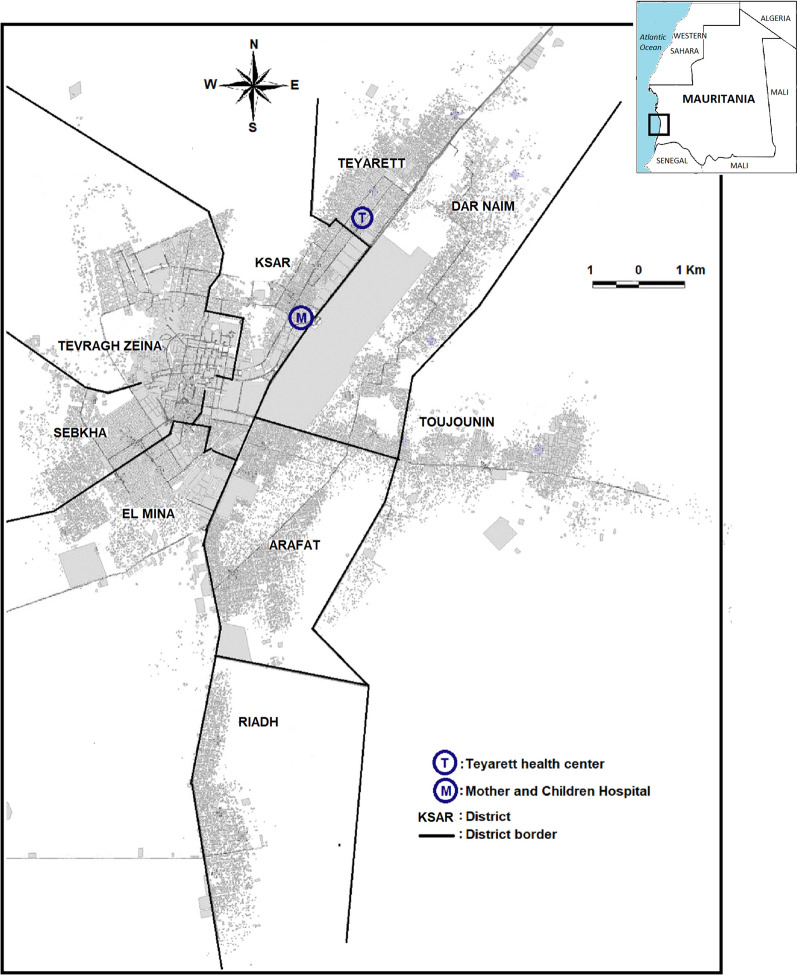
A 6 year (2015-2020) prospective study was carried out in Nouakchott. Febrile outpatients with a clinical suspicion of malaria presenting spontaneously at Teyarett Health Centre or the paediatric department of Mother and Children Hospital Centre were screened for malaria using a rapid diagnostic test, microscopic examination of Giemsa-stained blood films, and nested polymerase chain reaction. Data were analysed using Microsoft Excel and GraphPad Prism and InStat software.
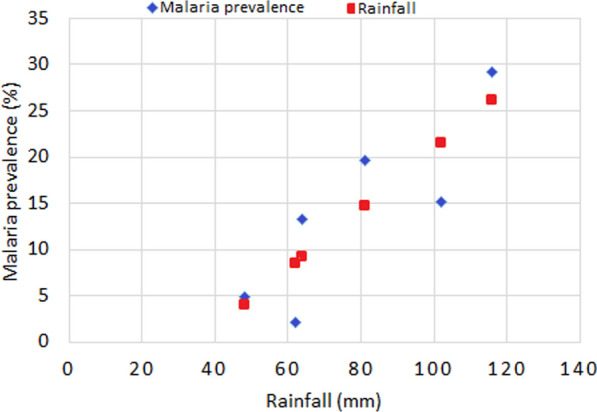
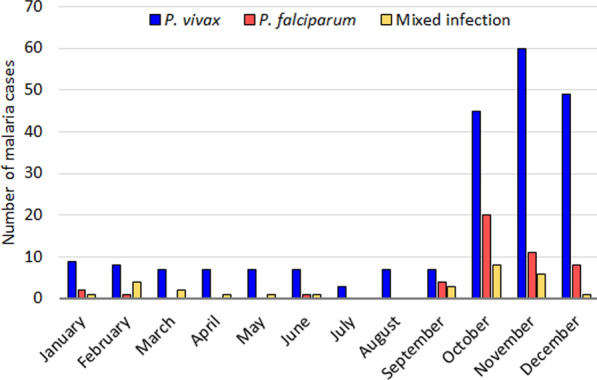
Of 1760 febrile patients included in this study, 274 (15.5%) were malaria-positive by rapid diagnostic test, 256 (14.5%) were malaria-positive by microscopy, and 291 (16.5%) were malaria-positive by PCR. Plasmodium vivax accounted for 216 of 291 (74.2%) PCR-positive patients; 47 (16.1%) and 28 (9.6%) had P. falciparum monoinfection or P. vivax-P. falciparum mixed infection, respectively. During the study period, the annual prevalence of malaria declined from 29.2% in 2015 to 13.2% in 2019 and 2.1% in 2020 (P < 0.05). Malaria transmission was essentially seasonal, with a peak occurring soon after the rainy season (October-November), and P. vivax infections, but not P. falciparum infections, occurred at low levels during the rest of the year. The most affected subset of patient population was adult male white and black Moors. The decline in malaria prevalence was correlated with decreasing annual rainfall (r = 0.85; P = 0.03) and was also associated with better management of the potable water supply system. A large majority of included patients did not possess or did not use bed nets.
Control interventions based on prevention, diagnosis, and treatment should be reinforced in Nouakchott, and P. vivax-specific control measures, including chloroquine and 8-aminoquinolines (primaquine, tafenoquine) for treatment, should be considered to further improve the efficacy of interventions and aim for malaria elimination.
在毛里塔尼亚首都努瓦克肖特,间日疟原虫疟疾是最主要的公共卫生关注的传染病之一,也是撒哈拉沙漠最大的城市环境中的主要传染病之一。评估疟疾流行病学的当前趋势对于了解其传播动态和制定有效的控制策略至关重要。
在努瓦克肖特进行了一项为期 6 年(2015-2020 年)的前瞻性研究。在 Teyarett 保健中心或儿童医院中心儿科部门就诊的有疟疾临床疑似症状的发热门诊患者,使用快速诊断检测、吉姆萨染色血片显微镜检查和巢式聚合酶链反应来筛查疟疾。使用 Microsoft Excel 和 GraphPad Prism 和 InStat 软件对数据进行分析。
本研究共纳入 1760 例发热患者,其中 274 例(15.5%)快速诊断检测阳性,256 例(14.5%)显微镜检查阳性,291 例(16.5%)PCR 阳性。291 例 PCR 阳性患者中,间日疟原虫占 216 例(74.2%);47 例(16.1%)和 28 例(9.6%)分别为恶性疟原虫单感染或间日疟原虫-恶性疟原虫混合感染。研究期间,疟疾的年患病率从 2015 年的 29.2%下降到 2019 年的 13.2%和 2020 年的 2.1%(P<0.05)。疟疾传播主要呈季节性,雨季过后不久(10 月至 11 月)出现高峰,而恶性疟原虫感染在其余时间则处于低水平。受影响最大的患者人群是成年男性白人和黑人摩尔人。疟疾流行率的下降与年降雨量的减少(r=0.85;P=0.03)相关,也与饮用水供应系统管理的改善有关。大多数纳入的患者没有或不使用蚊帐。
应加强在努瓦克肖特的预防、诊断和治疗为基础的控制干预措施,还应考虑针对间日疟原虫的具体控制措施,包括氯喹和 8-氨基喹啉(伯氨喹、tafenoquine)作为治疗药物,以进一步提高干预措施的效果,实现消除疟疾的目标。