Cleland Lana, Kennedy Hannah L, Pettie Michaela A, Kennedy Martin A, Bulik Cynthia M, Jordan Jennifer
Department of Psychological Medicine, University of Otago, PO Box 4345, Christchurch, 8140, New Zealand.
Department of Pathology and Biomedical Science, University of Otago, Christchurch, New Zealand.
J Eat Disord. 2023 Jan 17;11(1):7. doi: 10.1186/s40337-022-00728-1.
The prevention and treatment of eating disorders relies on an extensive body of research that includes various foci and methodologies. This scoping review identified relevant studies of eating disorders, body image, and disordered eating with New Zealand samples; charted the methodologies, sample characteristics, and findings reported; and identified several gaps that should be addressed by further research.
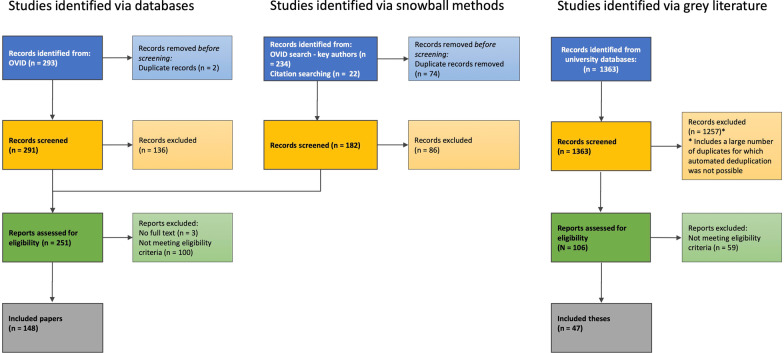
Using scoping review methodology, two databases were searched for studies examining eating disorders, disordered eating, or body image with New Zealand samples. Snowball methods were further used to identify additional relevant articles that did not appear in initial searches. Two independent reviewers screened the titles and abstracts of 473 records. Full text assessment of the remaining 251 records resulted in 148 peer-reviewed articles being identified as eligible for the final review. A search of institutional databases yielded 106 Masters and Doctoral theses for assessment, with a total of 47 theses being identified as eligible for the final review. The included studies were classified by methodology, and the extracted information included the study foci, data collected, sample size, demographic information, and key findings.
The eligible studies examined a variety of eating disorder categories including binge-eating disorder, bulimia nervosa, and anorexia nervosa, in addition to disordered eating behaviours and body image in nonclinical or community samples. Methodologies included treatment trials, secondary analysis of existing datasets, non-treatment experimental interventions, cross-sectional observation, case-control studies, qualitative and mixed-methods studies, and case studies or series. Across all of the studies, questionnaire and interview data were most commonly utilised. A wide range of sample sizes were evident, and studies often reported all-female or mostly-female participants, with minimal inclusion of males and gender minorities. There was also an underrepresentation of minority ethnicities in many studies, highlighting the need for future research to increase diversity within samples.
This study provides a comprehensive and detailed overview of research into eating disorders and body image in New Zealand, while highlighting important considerations for both local and international research.
饮食失调的预防和治疗依赖于大量的研究,这些研究涵盖了各种重点领域和方法。本范围综述确定了以新西兰样本为研究对象的饮食失调、身体意象和饮食紊乱的相关研究;梳理了所报告的研究方法、样本特征和研究结果;并确定了几个有待进一步研究解决的空白领域。
采用范围综述方法,检索了两个数据库,以查找以新西兰样本为研究对象,探讨饮食失调、饮食紊乱或身体意象的研究。进一步采用滚雪球法来识别在初始检索中未出现的其他相关文章。两名独立评审员筛选了473条记录的标题和摘要。对其余251条记录进行全文评估后,确定有148篇经同行评审的文章符合最终评审要求。对机构数据库的检索产生了106篇硕士和博士论文以供评估,其中共有47篇论文被确定符合最终评审要求。纳入的研究按方法进行分类,提取的信息包括研究重点、收集的数据、样本量、人口统计学信息和主要研究结果。
符合要求的研究除了考察非临床或社区样本中的饮食紊乱行为和身体意象外,还研究了多种饮食失调类别,包括暴饮暴食症、神经性贪食症和神经性厌食症。研究方法包括治疗试验、现有数据集的二次分析、非治疗性实验干预、横断面观察、病例对照研究、定性和混合方法研究以及病例研究或系列研究。在所有研究中,问卷和访谈数据最为常用。样本量范围很广,而且研究经常报告全部为女性或大部分为女性的参与者,男性和性别少数群体的纳入极少。许多研究中少数族裔的代表性也不足,这凸显了未来研究增加样本多样性的必要性。
本研究全面详细地概述了新西兰饮食失调和身体意象的研究情况,同时突出了本地和国际研究的重要考量因素。