Department of Pediatric Neurology, Xi'an Children's hospital, Xi'an City, Shaanxi Province, China.
Department of Scientific Affaires, Hugobiotech Co., Ltd., Beijing, China.
Microbiol Spectr. 2023 Feb 14;11(1):e0253022. doi: 10.1128/spectrum.02530-22. Epub 2023 Jan 18.
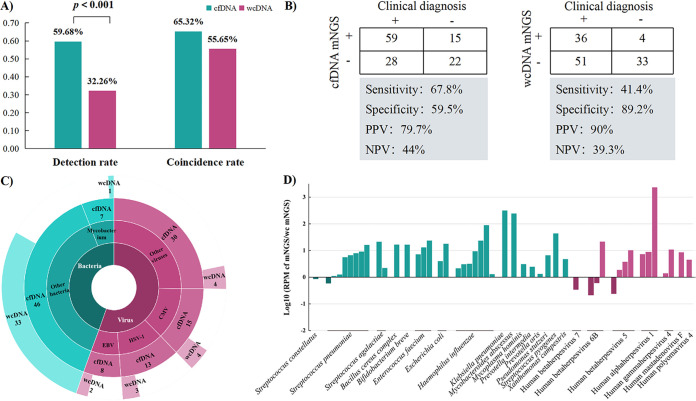
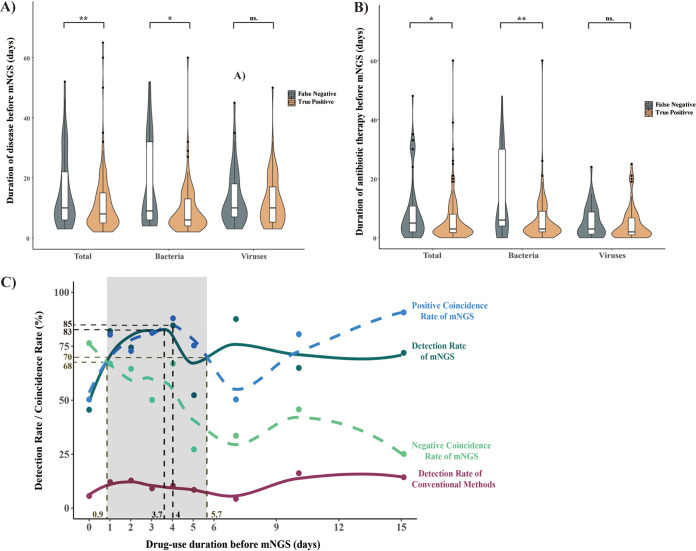
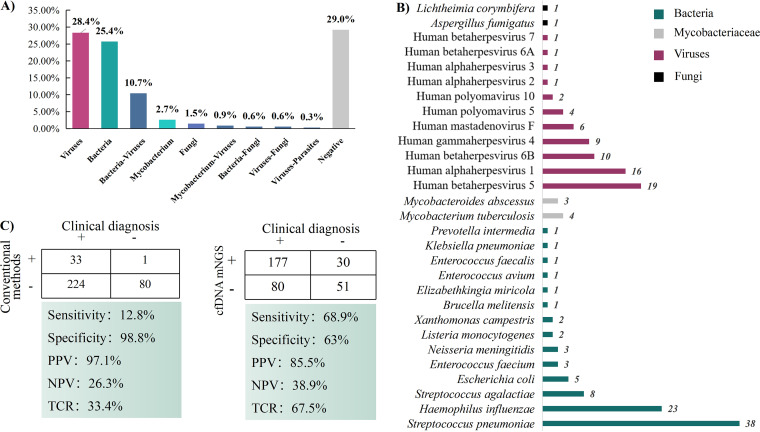
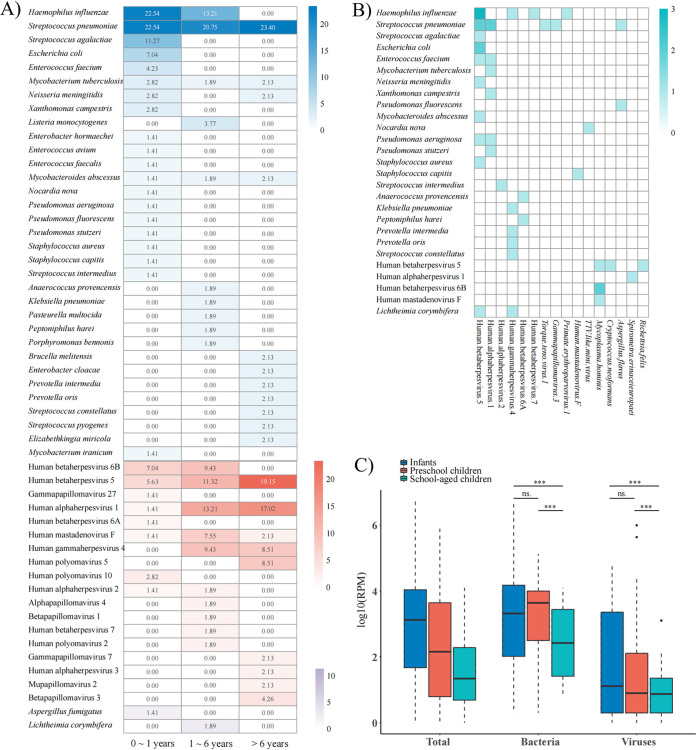
Central nervous system (CNS) infections can cause significant morbidity and mortality, especially in children. Rapid and accurate pathogenic detection in suspected CNS infections is essential for disease control at the early stage of infection. To evaluate the performance of metagenomic next-generation sequencing (mNGS) of cell-free DNA (cfDNA) in cerebrospinal fluid (CSF) in pediatric patients, we retrospectively analyzed the efficiency of cfDNA mNGS in children with CNS infections ( = 257) or noninfectious neurological disorders ( = 81). The CSF samples of 124 random subjects were used to evaluate the accuracy between mNGS of cfDNA and whole-cell DNA (wcDNA). In total, cfDNA mNGS detected a wide range of microbes with a detection rate of 71.0%, and the sensitivity and total coincidence rate with clinical diagnosis reached 68.9% and 67.5%, respectively. Compared with wcDNA mNGS, cfDNA mNGS had a higher efficacy in detecting viruses (66 versus 13) and Mycobacterium (7 versus 1), with significantly higher reads per million. The dominant causative pathogens were bacteria and viruses in CNS infections, but these presented with different pathogen spectra in different age categories. The best timing for the mNGS test ranged from 1 to 6 days after the start of anti-infection therapy, and the earlier mNGS started, the better was identification of bacterial CNS infections. This study emphasized that cfDNA mNGS had overall superiority to conventional methods on causative pathogen detection in pediatric CNS infections, and it was even better than wcDNA mNGS. Furthermore, research needs to be better validated in large-scale clinical trials to improve the clinical applications of cfDNA mNGS. Our study emphasized that cfDNA mNGS had overall superiority to conventional methods on causative pathogen detection in CNS-infected children, and it was even better than wcDNA mNGS. cfDNA mNGS detected a wide range of pathogens with a high total coincidence rate (67.5%) against clinical diagnosis. The best timing for cfDNA mNGS detection ranged from 1 to 6 days, rather than 0 days, after the start of empirical anti-infection therapy. The earlier mNGS started, the better the identifications of bacterial CNS infections. To the best of our knowledge, this research is the first report evaluating the clinical utility of mNGS with different methods (cfDNA versus wcDNA) of extracting DNA from CSF specimens in diagnosing pediatric CNS infections. Meanwhile, this is the largest cohort study that has evaluated the performance of mNGS using cfDNA from CSF specimens in pediatric patients with CNS infections.
中枢神经系统 (CNS) 感染可导致显著的发病率和死亡率,尤其是在儿童中。在感染的早期阶段,快速准确地检测疑似 CNS 感染的病原体对于疾病控制至关重要。为了评估细胞游离 DNA (cfDNA) 的宏基因组下一代测序 (mNGS) 在儿科 CNS 感染患者中的性能,我们回顾性分析了 cfDNA mNGS 在 CNS 感染患者( = 257)或非传染性神经疾病患者( = 81)中的效率。使用 124 名随机受试者的 CSF 样本评估 cfDNA mNGS 与全细胞 DNA (wcDNA) 之间的准确性。cfDNA mNGS 共检测到多种微生物,检出率为 71.0%,与临床诊断的灵敏度和总符合率分别达到 68.9%和 67.5%。与 wcDNA mNGS 相比,cfDNA mNGS 在检测病毒(66 比 13)和分枝杆菌(7 比 1)方面更有效,其读数值更高。CNS 感染的主要病原体为细菌和病毒,但在不同年龄段的病原体谱不同。mNGS 检测的最佳时间范围为抗感染治疗开始后 1 至 6 天,mNGS 开始得越早,对细菌性 CNS 感染的识别就越好。本研究强调 cfDNA mNGS 在儿科 CNS 感染的病原体检测方面总体优于传统方法,甚至优于 wcDNA mNGS。此外,需要在大规模临床试验中进一步验证研究,以提高 cfDNA mNGS 的临床应用。我们的研究强调,cfDNA mNGS 在儿科 CNS 感染患者的病原体检测方面总体优于传统方法,甚至优于 wcDNA mNGS。cfDNA mNGS 检测到广泛的病原体,与临床诊断的总符合率(67.5%)较高。cfDNA mNGS 检测的最佳时间范围为抗感染治疗开始后 1 至 6 天,而不是 0 天。mNGS 开始得越早,对细菌性 CNS 感染的识别就越好。据我们所知,这是第一项使用从 CSF 标本中提取 DNA 的不同方法(cfDNA 与 wcDNA)评估 mNGS 临床应用的研究,也是第一项评估使用 CSF 标本中 cfDNA 的 mNGS 在儿科 CNS 感染患者中的性能的最大队列研究。