• 文献检索
  • 文档翻译
  • 深度研究
  • 学术资讯
  • Suppr Zotero 插件Zotero 插件
  • 邀请有礼
  • 套餐&价格
  • 历史记录
应用&插件
Suppr Zotero 插件Zotero 插件浏览器插件Mac 客户端Windows 客户端微信小程序
定价
高级版会员购买积分包购买API积分包
服务
文献检索文档翻译深度研究API 文档MCP 服务
关于我们
关于 Suppr公司介绍联系我们用户协议隐私条款
关注我们

Suppr 超能文献

核心技术专利:CN118964589B侵权必究
粤ICP备2023148730 号-1Suppr @ 2026

文献检索

告别复杂PubMed语法,用中文像聊天一样搜索,搜遍4000万医学文献。AI智能推荐,让科研检索更轻松。

立即免费搜索

文件翻译

保留排版,准确专业,支持PDF/Word/PPT等文件格式,支持 12+语言互译。

免费翻译文档

深度研究

AI帮你快速写综述,25分钟生成高质量综述,智能提取关键信息,辅助科研写作。

立即免费体验

宏基因组下一代测序在检测社区获得性或医院获得性脓毒症病例中致病微生物方面的临床重要性。

The clinical importance of metagenomic next-generation sequencing in detecting disease-causing microorganisms in cases of sepsis acquired in the community or hospital setting.

作者信息

Zhang Dan, Li Xingxing, Wang Yu, Zhao Yong, Zhang Hong

机构信息

Department of Emergency Medicine, The First Affiliated Hospital of Anhui Medical University, Anhui, Hefei, China.

出版信息

Front Microbiol. 2024 Apr 15;15:1384166. doi: 10.3389/fmicb.2024.1384166. eCollection 2024.

DOI:10.3389/fmicb.2024.1384166
PMID:38686114
原文链接:https://pmc.ncbi.nlm.nih.gov/articles/PMC11056561/
Abstract

OBJECTIVES

Although metagenomic next-generation sequencing (mNGS) is commonly used for diagnosing infectious diseases, clinicians face limited options due to the high costs that are not covered by basic medical insurance. The goal of this research is to challenge this bias through a thorough examination and evaluation of the clinical importance of mNGS in precisely identifying pathogenic microorganisms in cases of sepsis acquired in the community or in hospitals.

METHODS

A retrospective observational study took place at a tertiary teaching hospital in China from January to December 2021. Data on 308 sepsis patients were collected, and the performance of etiological examination was compared between mNGS and traditional culture method.

RESULTS

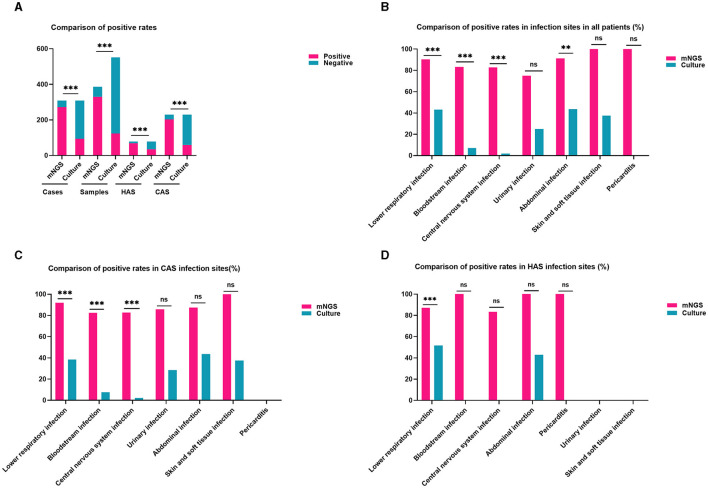
Two hundred twenty-nine cases were observed in the community-acquired sepsis (CAS) group and 79 cases in the hospital-acquired sepsis (HAS) group. In comparison with conventional culture, mNGS showed a significantly higher rate of positivity in both the CAS group (88.21% vs. 25.76%, adj. < 0.001) and the HAS group (87.34% vs. 44.30%, adj. < 0.001), particularly across various infection sites and specimens, which were not influenced by factors like antibiotic exposure or the timing and frequency of mNGS technology. Sepsis pathogens detected by mNGS were broad, especially viruses, , and atypical pathogens, with mixed pathogens being common, particularly bacterial-viral co-detection. Based on the optimization of antimicrobial therapy using mNGS, 58 patients underwent antibiotic de-escalation, two patients were switched to antiviral therapy, and 14 patients initiated treatment for tuberculosis, resulting in a reduction in antibiotic overuse but without significant impact on sepsis prognosis. The HAS group exhibited a critical condition, poor prognosis, high medical expenses, and variations in etiology, yet the mNGS results did not result in increased medical costs for either group.

CONCLUSIONS

mNGS demonstrates efficacy in identifying multiple pathogens responsible for sepsis, with mixed pathogens of bacteria and viruses being prevalent. Variability in microbiological profiles among different infection setting underscores the importance of clinical vigilance. Therefore, the adoption of mNGS for microbiological diagnosis of sepsis warrants acknowledgment and promotion.

摘要

目的

尽管宏基因组下一代测序(mNGS)常用于诊断感染性疾病,但由于基本医疗保险不涵盖其高昂费用,临床医生面临的选择有限。本研究的目的是通过全面检查和评估mNGS在准确识别社区获得性或医院获得性败血症病例中的致病微生物方面的临床重要性,来挑战这种偏见。

方法

2021年1月至12月在中国一家三级教学医院进行了一项回顾性观察研究。收集了308例败血症患者的数据,并比较了mNGS和传统培养方法在病因学检查方面的表现。

结果

社区获得性败血症(CAS)组观察到229例,医院获得性败血症(HAS)组观察到79例。与传统培养相比,mNGS在CAS组(88.21%对25.76%,校正后<0.001)和HAS组(87.34%对44.30%,校正后<0.001)中的阳性率均显著更高,特别是在各种感染部位和标本中,且不受抗生素暴露或mNGS技术的时间和频率等因素影响。mNGS检测到的败血症病原体种类广泛,尤其是病毒和非典型病原体,混合病原体很常见,特别是细菌-病毒联合检测。基于mNGS优化抗菌治疗后,58例患者抗生素降级,2例患者改为抗病毒治疗,14例患者开始抗结核治疗,减少了抗生素的过度使用,但对败血症预后无显著影响。HAS组病情危急、预后差、医疗费用高且病因各异,但mNGS结果并未导致两组医疗费用增加。

结论

mNGS在识别导致败血症的多种病原体方面显示出有效性,细菌和病毒的混合病原体很普遍。不同感染环境下微生物谱的差异凸显了临床警惕的重要性。因此,采用mNGS进行败血症的微生物诊断值得认可和推广。
https://cdn.ncbi.nlm.nih.gov/pmc/blobs/6aff/11056561/5c8db1176cb2/fmicb-15-1384166-g0005.jpg
https://cdn.ncbi.nlm.nih.gov/pmc/blobs/6aff/11056561/1ad881dd7930/fmicb-15-1384166-g0001.jpg
https://cdn.ncbi.nlm.nih.gov/pmc/blobs/6aff/11056561/67077c8430f6/fmicb-15-1384166-g0002.jpg
https://cdn.ncbi.nlm.nih.gov/pmc/blobs/6aff/11056561/7b2bafa2868a/fmicb-15-1384166-g0003.jpg
https://cdn.ncbi.nlm.nih.gov/pmc/blobs/6aff/11056561/5701acb47498/fmicb-15-1384166-g0004.jpg
https://cdn.ncbi.nlm.nih.gov/pmc/blobs/6aff/11056561/5c8db1176cb2/fmicb-15-1384166-g0005.jpg
https://cdn.ncbi.nlm.nih.gov/pmc/blobs/6aff/11056561/1ad881dd7930/fmicb-15-1384166-g0001.jpg
https://cdn.ncbi.nlm.nih.gov/pmc/blobs/6aff/11056561/67077c8430f6/fmicb-15-1384166-g0002.jpg
https://cdn.ncbi.nlm.nih.gov/pmc/blobs/6aff/11056561/7b2bafa2868a/fmicb-15-1384166-g0003.jpg
https://cdn.ncbi.nlm.nih.gov/pmc/blobs/6aff/11056561/5701acb47498/fmicb-15-1384166-g0004.jpg
https://cdn.ncbi.nlm.nih.gov/pmc/blobs/6aff/11056561/5c8db1176cb2/fmicb-15-1384166-g0005.jpg

相似文献

1
The clinical importance of metagenomic next-generation sequencing in detecting disease-causing microorganisms in cases of sepsis acquired in the community or hospital setting.宏基因组下一代测序在检测社区获得性或医院获得性脓毒症病例中致病微生物方面的临床重要性。
Front Microbiol. 2024 Apr 15;15:1384166. doi: 10.3389/fmicb.2024.1384166. eCollection 2024.
2
Metagenomic Next-Generation Sequencing for the Microbiological Diagnosis of Abdominal Sepsis Patients.宏基因组下一代测序在腹部脓毒症患者微生物诊断中的应用
Front Microbiol. 2022 Feb 2;13:816631. doi: 10.3389/fmicb.2022.816631. eCollection 2022.
3
Utility of Metagenomic Next-Generation Sequencing for Etiological Diagnosis of Patients with Sepsis in Intensive Care Units.宏基因组下一代测序在重症监护病房脓毒症患者病因诊断中的应用。
Microbiol Spectr. 2022 Aug 31;10(4):e0074622. doi: 10.1128/spectrum.00746-22. Epub 2022 Jul 21.
4
The clinical value of metagenomic next-generation sequencing in the microbiological diagnosis of skin and soft tissue infections.宏基因组下一代测序在皮肤和软组织感染微生物诊断中的临床价值。
Int J Infect Dis. 2020 Nov;100:414-420. doi: 10.1016/j.ijid.2020.09.007. Epub 2020 Sep 6.
5
[Application of metagenomic next-generation sequencing technology in preterm infants with sepsis following antibiotic use].宏基因组下一代测序技术在抗生素使用后脓毒症早产儿中的应用
Zhongguo Dang Dai Er Ke Za Zhi. 2024 May 15;26(5):456-460. doi: 10.7499/j.issn.1008-8830.2311079.
6
Composition of pathogenic microorganism in chronic osteomyelitis based on metagenomic sequencing and its application value in etiological diagnosis.基于宏基因组测序的慢性骨髓炎感染病原菌构成及其在病因诊断中的应用价值。
BMC Microbiol. 2023 Oct 28;23(1):313. doi: 10.1186/s12866-023-03046-x.
7
Diagnostic Significance of Metagenomic Next-Generation Sequencing for Community-Acquired Pneumonia in Southern China.宏基因组下一代测序在中国南方社区获得性肺炎中的诊断意义
Front Med (Lausanne). 2022 Feb 15;9:807174. doi: 10.3389/fmed.2022.807174. eCollection 2022.
8
Improving Suspected Pulmonary Infection Diagnosis by Bronchoalveolar Lavage Fluid Metagenomic Next-Generation Sequencing: a Multicenter Retrospective Study.通过支气管肺泡灌洗液宏基因组下一代测序提高疑似肺部感染诊断:一项多中心回顾性研究。
Microbiol Spectr. 2022 Aug 31;10(4):e0247321. doi: 10.1128/spectrum.02473-21. Epub 2022 Aug 9.
9
Clinical Evaluation of Metagenomic Next-Generation Sequencing for the detection of pathogens in BALF in severe community acquired pneumonia.临床评估宏基因组下一代测序在严重社区获得性肺炎患者支气管肺泡灌洗液中病原体检测中的应用。
Ital J Pediatr. 2023 Feb 18;49(1):25. doi: 10.1186/s13052-023-01431-w.
10
The clinical significance of simultaneous detection of pathogens from bronchoalveolar lavage fluid and blood samples by metagenomic next-generation sequencing in patients with severe pneumonia.宏基因组下一代测序同时检测重症肺炎患者支气管肺泡灌洗液和血液样本中的病原体的临床意义。
J Med Microbiol. 2021 Jan;70(1). doi: 10.1099/jmm.0.001259.

引用本文的文献

1
An overview of rapid non-culture-based techniques in various clinical specimens for the laboratory diagnosis of .用于实验室诊断的各种临床标本中基于非培养的快速技术概述 。 (原文句子不完整,翻译可能不太符合完整语境表达)
Front Cell Infect Microbiol. 2025 May 23;15:1591429. doi: 10.3389/fcimb.2025.1591429. eCollection 2025.
2
Correlation between the gut microbiota characteristics of hosts with severe acute pancreatitis and secondary intra-abdominal infection.重症急性胰腺炎宿主肠道微生物群特征与继发性腹腔内感染的相关性。
Front Med (Lausanne). 2024 Aug 21;11:1409409. doi: 10.3389/fmed.2024.1409409. eCollection 2024.

本文引用的文献

1
Does Prehospital Suspicion of Sepsis Shorten Time to Administration of Antibiotics in the Emergency Department? A Retrospective Study in One University Hospital.院前对脓毒症的怀疑能否缩短急诊科抗生素给药时间?一项在某大学医院开展的回顾性研究。
J Clin Med. 2023 Aug 30;12(17):5639. doi: 10.3390/jcm12175639.
2
Comparison of pathogen detection consistency between metagenomic next-generation sequencing and blood culture in patients with suspected bloodstream infection.比较宏基因组下一代测序与血培养在疑似血流感染患者中病原体检测一致性。
Sci Rep. 2023 Jun 10;13(1):9460. doi: 10.1038/s41598-023-36681-5.
3
The clinical application of metagenomic next-generation sequencing in sepsis of immunocompromised patients.
免疫功能低下患者脓毒症的宏基因组下一代测序的临床应用。
Front Cell Infect Microbiol. 2023 Apr 24;13:1170687. doi: 10.3389/fcimb.2023.1170687. eCollection 2023.
4
Antibiogram of Multidrug-Resistant Bacteria Based on Sepsis Onset Location in Korea: A Multicenter Cohort Study.基于韩国脓毒症发病部位的多药耐药菌抗生素谱分析:一项多中心队列研究。
J Korean Med Sci. 2023 Mar 13;38(10):e75. doi: 10.3346/jkms.2023.38.e75.
5
Diagnostic value of metagenomic next-generation sequencing in sepsis and bloodstream infection.宏基因组下一代测序在脓毒症和血流感染中的诊断价值。
Front Cell Infect Microbiol. 2023 Feb 10;13:1117987. doi: 10.3389/fcimb.2023.1117987. eCollection 2023.
6
Clinical Diagnosis Application of Metagenomic Next-Generation Sequencing of Plasma in Suspected Sepsis.宏基因组二代测序在疑似脓毒症患者血浆中的临床诊断应用
Infect Drug Resist. 2023 Feb 14;16:891-901. doi: 10.2147/IDR.S395700. eCollection 2023.
7
The Clinical Impact of Metagenomic Next-Generation Sequencing (mNGS) Test in Hospitalized Patients with Suspected Sepsis: A Multicenter Prospective Study.宏基因组下一代测序(mNGS)检测对疑似脓毒症住院患者的临床影响:一项多中心前瞻性研究
Diagnostics (Basel). 2023 Jan 16;13(2):323. doi: 10.3390/diagnostics13020323.
8
Diagnosis of Neurological Infections in Pediatric Patients from Cell-Free DNA Specimens by Using Metagenomic Next-Generation Sequencing.采用宏基因组下一代测序技术对细胞游离 DNA 标本进行儿科患者神经感染的诊断。
Microbiol Spectr. 2023 Feb 14;11(1):e0253022. doi: 10.1128/spectrum.02530-22. Epub 2023 Jan 18.
9
Metagenomic next-generation sequencing for detection of pathogens in children with hematological diseases complicated with infection.宏基因组下一代测序技术在检测合并感染的血液病患儿病原体中的应用
Mol Cell Probes. 2023 Feb;67:101889. doi: 10.1016/j.mcp.2022.101889. Epub 2022 Dec 10.
10
Clinical features, treatment outcomes and mortality risk of tuberculosis sepsis in HIV-negative patients: a systematic review and meta-analysis of case reports.HIV 阴性结核病脓毒症患者的临床特征、治疗结局和死亡风险:病例报告的系统评价和荟萃分析。
Infection. 2023 Jun;51(3):609-621. doi: 10.1007/s15010-022-01950-4. Epub 2022 Nov 16.