Department of Internal Medicine III and IZKF, Gastroenterology, Metabolic Diseases and Intensive Care, University Hospital Aachen, Pauwelsstraße 30, 52074, Aachen, Germany.
Department of Internal Medicine IV, Jena University Hospital, Friedrich Schiller University, Jena, Germany.
Hepatol Int. 2023 Jun;17(3):698-708. doi: 10.1007/s12072-022-10473-x. Epub 2023 Jan 18.
Since hepatocytes produce majority of serum proteins, patients with cirrhosis display substantial alterations in the serum proteome. The aim of the current study was to characterize these changes and to study the prognostic utility of hepatocellular proteins available in routine clinical testing.
Sera from 29 healthy controls and 43 patients with cirrhosis were subjected to untargeted proteomic analysis. Unsupervised hierarchical clustering was performed with Perseus software and R. Ingenuity pathway analysis (IPA) suggested upstream regulators that were validated in liver tissues. The behavior and prognostic usefulness of selected biomarkers was investigated in 61 controls and 285 subjects with decompensated cirrhosis.
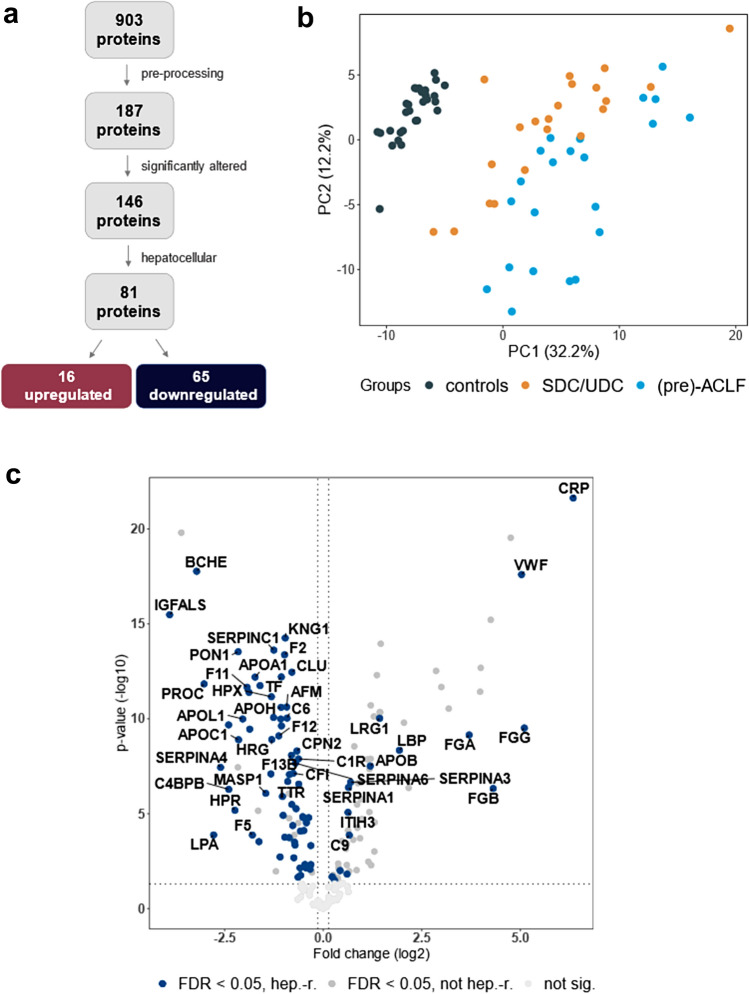
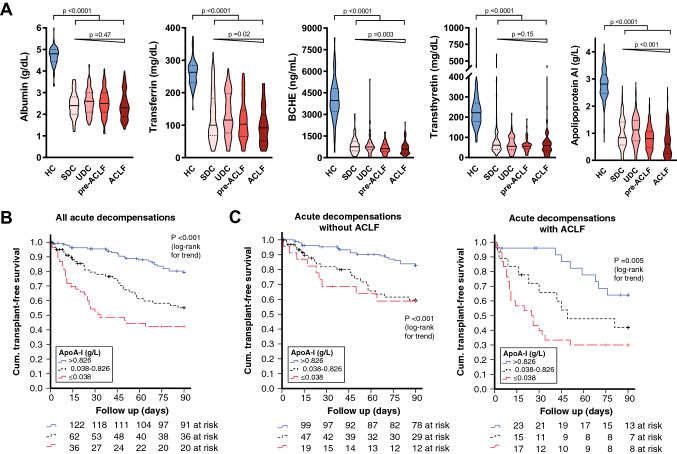
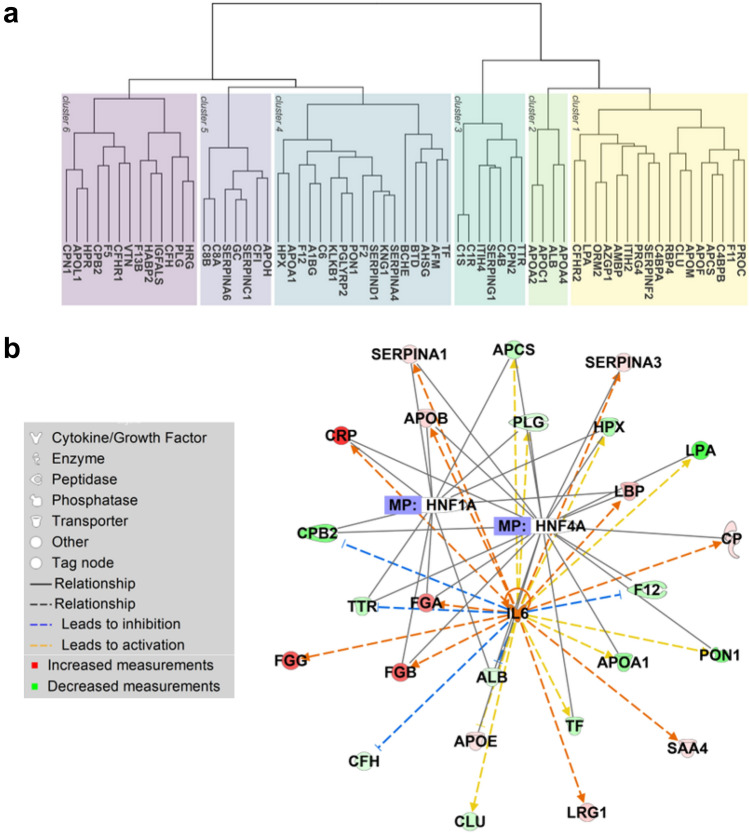
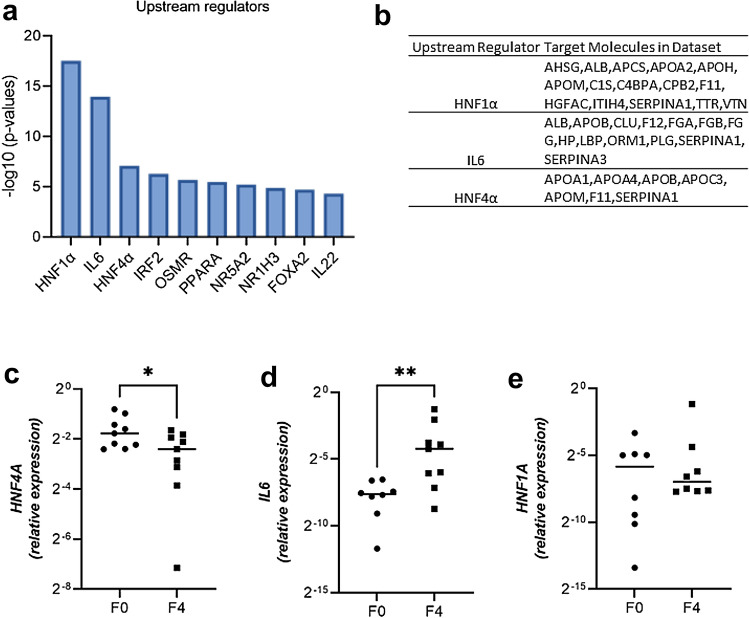
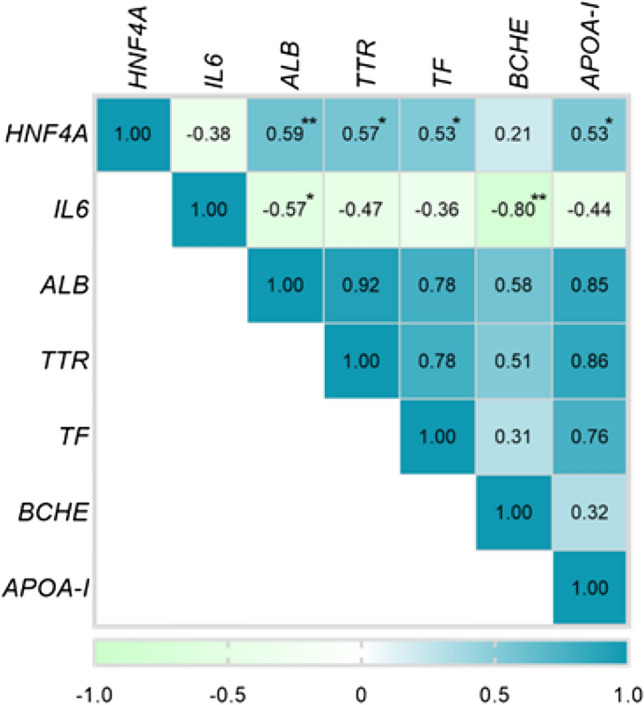
Proteomics uncovered 65 and 16 hepatocellular serum proteins that are significantly downregulated or upregulated in patients with cirrhosis vs. controls. Hierarchical clustering revealed two main clusters and six sub-clusters. IPA identified HNF4α and IL-6 as the two major upstream regulators that were confirmed by hepatic gene expression analyses. Among pseudocholinesterase, transferrin, transthyretin, albumin, and apolipoprotein AI (Apo-AI), Apo-AI was the best predictor of 90-days transplant-free survival (AUROC 0.678; p = 0.0001) and remained an independent predictor in multivariable Cox independently of the presence of acute-on-chronic liver failure.
Our study reveals cirrhosis-associated changes in hepatocellular serum proteins and underlying transcription factors. Serum apolipoprotein AI may constitute a useful prognostic adjunct in patients with decompensated cirrhosis.
由于肝细胞产生了大部分的血清蛋白,肝硬化患者的血清蛋白质组会发生显著改变。本研究旨在对这些变化进行描述,并研究常规临床检测中可用的肝细胞蛋白的预后效用。
对 29 名健康对照者和 43 名肝硬化患者的血清进行非靶向蛋白质组学分析。使用 Perseus 软件和 R 进行无监督层次聚类。Ingenuity 通路分析(IPA)提示了在肝组织中得到验证的上游调控因子。在 61 名对照者和 285 名代偿性肝硬化患者中,对选定的生物标志物的行为和预后有用性进行了研究。
蛋白质组学揭示了 65 种和 16 种肝细胞血清蛋白在肝硬化患者中显著下调或上调。层次聚类显示了两个主要聚类和六个子聚类。IPA 确定 HNF4α 和 IL-6 为两个主要的上游调控因子,这两个因子通过肝基因表达分析得到了证实。在假性胆碱酯酶、转铁蛋白、甲状腺素结合蛋白、白蛋白和载脂蛋白 AI(Apo-AI)中,Apo-AI 是 90 天无移植生存率的最佳预测因子(AUROC 0.678;p = 0.0001),并且在多变量 Cox 分析中独立于慢性肝衰竭的存在,仍然是独立的预测因子。
本研究揭示了肝硬化相关的肝细胞血清蛋白和潜在的转录因子变化。血清载脂蛋白 AI 可能是失代偿性肝硬化患者有用的预后辅助指标。