Wirtz Theresa H, Reuken Philipp A, Jansen Christian, Fischer Petra, Bergmann Irina, Backhaus Christina, Emontzpohl Christoph, Reißing Johanna, Brandt Elisa F, Koenen M Teresa, Schneider Kai M, Schierwagen Robert, Brol Maximilian J, Chang Johannes, Zimmermann Henning W, Köse-Vogel Nilay, Eggermann Thomas, Kurth Ingo, Stoppe Christian, Bucala Richard, Bernhagen Jürgen, Praktiknjo Michael, Stallmach Andreas, Trautwein Christian, Trebicka Jonel, Bruns Tony, Berres Marie-Luise
Department of Internal Medicine III, RWTH Aachen University Hospital, Aachen, Germany.
Department of Internal Medicine IV, Jena University Hospital, Friedrich Schiller University, Jena, Germany.
JHEP Rep. 2020 Dec 17;3(2):100221. doi: 10.1016/j.jhepr.2020.100221. eCollection 2021 Apr.
BACKGROUND & AIMS: Macrophage migration inhibitory factor (MIF) is an inflammatory cytokine and an important regulator of innate immune responses. We hypothesised that serum concentrations of MIF are associated with disease severity and outcome in patients with decompensated cirrhosis and acute-on-chronic liver failure (ACLF).
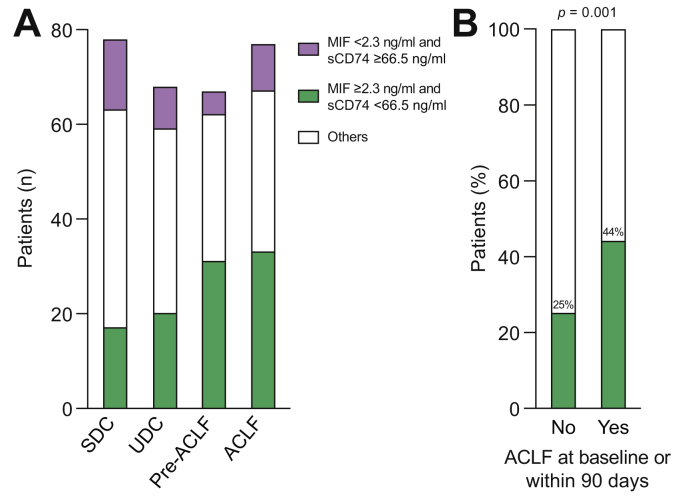
Circulating concentrations of MIF and its soluble receptor CD74 (sCD74) were determined in sera from 292 patients with acute decompensation of cirrhosis defined as new onset or worsening of ascites requiring hospitalisation. Of those, 78 (27%) had ACLF. Short-term mortality was assessed 90 days after inclusion.
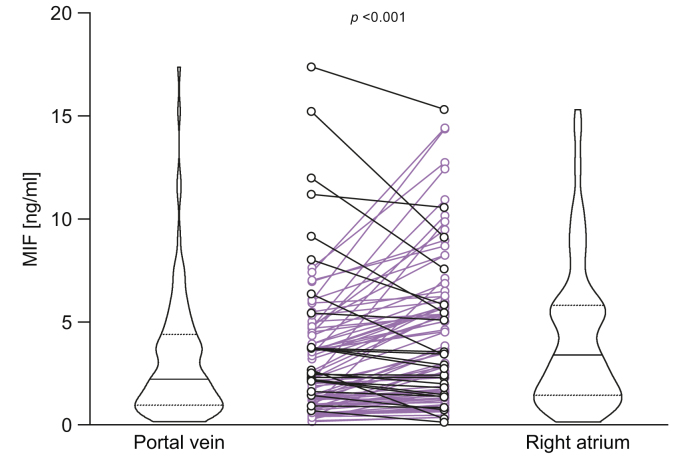
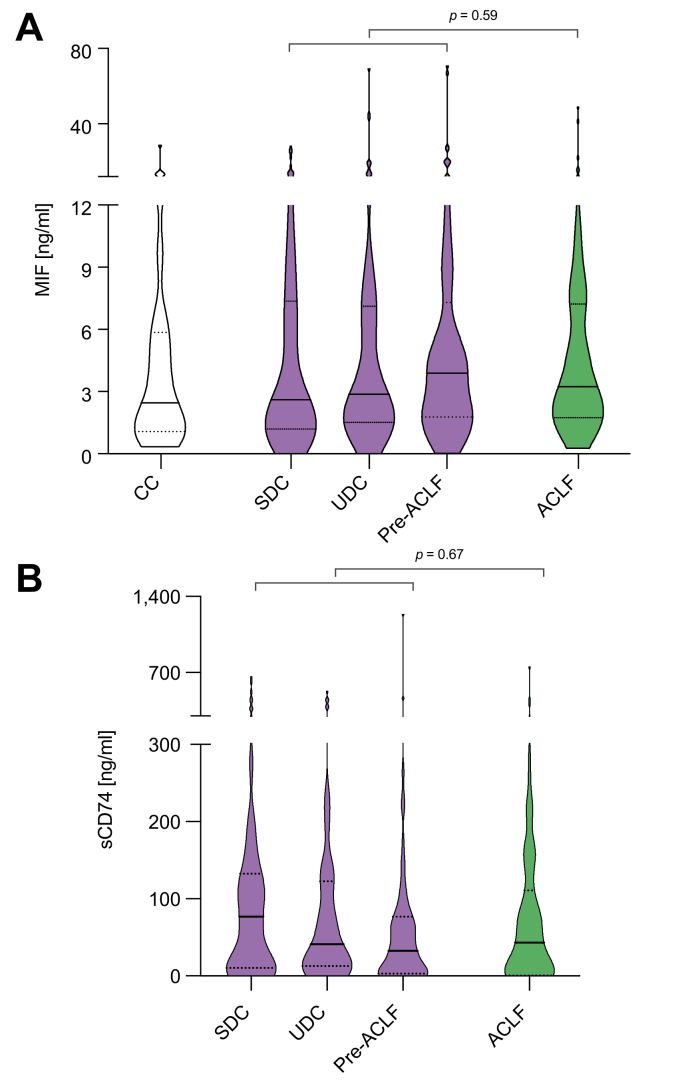
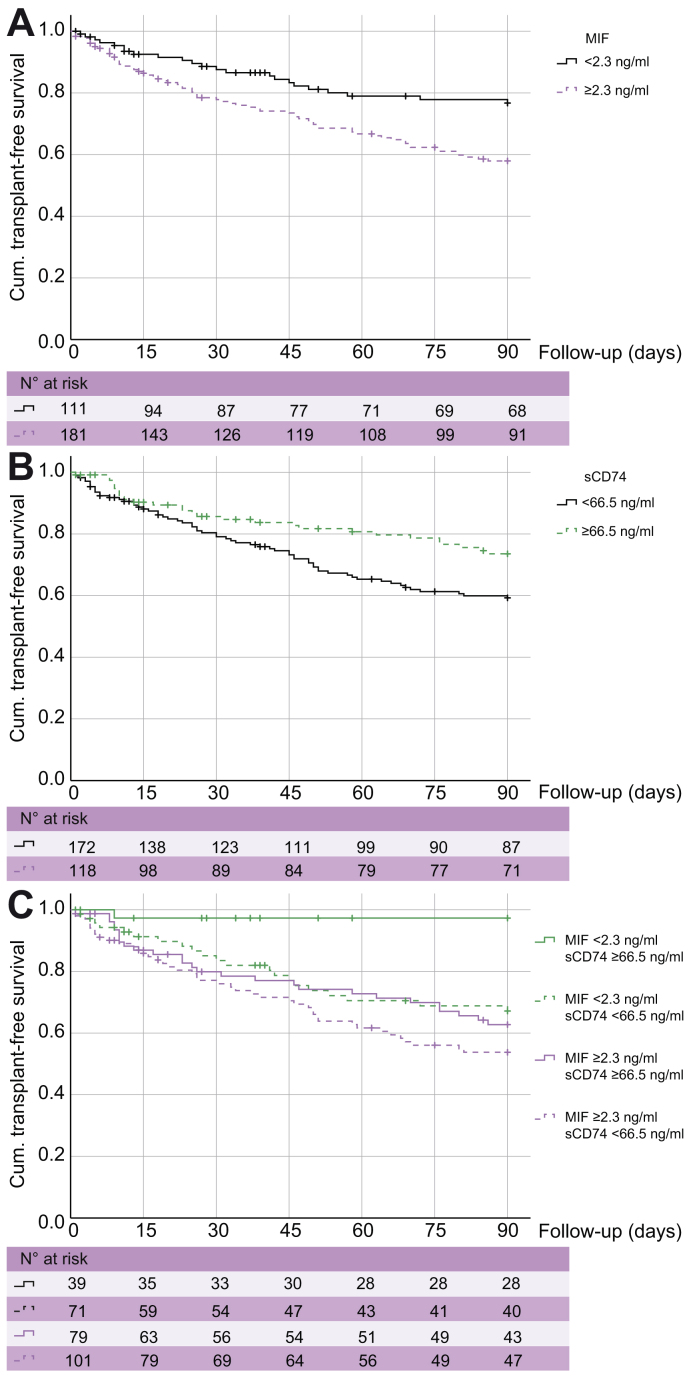
Although serum concentrations of MIF and sCD74 did not correlate with liver function parameters or ACLF, higher MIF (optimum cut-off >2.3 ng/ml) and lower concentrations of sCD74 (optimum cut-off <66.5 ng/ml) both indicated poorer 90-day transplant-free survival in univariate analyses (unadjusted hazard ratio [HR] 2.01 [1.26-3.22]; = 0.004 for MIF; HR 0.59 [0.38-0.92]; = 0.02 for sCD74) and after adjustment in multivariable models. Higher MIF concentrations correlated with surrogates of systemic inflammation (white blood cells, = 0.005; C-reactive protein, = 0.05) and were independent of genetic MIF promoter polymorphisms. Assessment of MIF plasma concentrations in portal venous blood and matched blood samples from the right atrium in a second cohort of patients undergoing transjugular intrahepatic portosystemic shunt insertion revealed a transhepatic MIF gradient with higher concentrations in the right atrial blood.
Serum concentrations of MIF and its soluble receptor CD74 predict 90-day transplant-free survival in patients with acute decompensation of cirrhosis. This effect was independent of liver function and genetic predispositions, but rather reflected systemic inflammation. Therefore, MIF and sCD74 represent promising prognostic markers beyond classical scoring systems in patients at risk of ACLF.
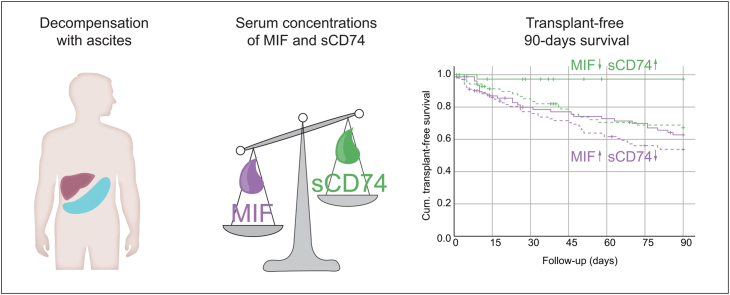
Inflammatory processes contribute to the increased risk of death in patients with cirrhosis and ascites. We show that patients with high serum levels of the inflammatory cytokine macrophage migration inhibitory factor (MIF) alongside low levels of its binding receptor sCD74 in blood indicate an increased mortality risk in patients with ascites. The cirrhotic liver is a relevant source of elevated circulating MIF levels.
巨噬细胞移动抑制因子(MIF)是一种炎性细胞因子,也是先天性免疫反应的重要调节因子。我们假设,失代偿期肝硬化和慢加急性肝衰竭(ACLF)患者的血清MIF浓度与疾病严重程度及预后相关。
测定了292例肝硬化急性失代偿患者(定义为新发腹水或腹水恶化需住院治疗)血清中MIF及其可溶性受体CD74(sCD74)的循环浓度。其中78例(27%)为ACLF患者。纳入研究90天后评估短期死亡率。
虽然血清MIF和sCD74浓度与肝功能参数或ACLF无关,但在单变量分析中,较高的MIF(最佳截断值>2.3 ng/ml)和较低的sCD74浓度(最佳截断值<66.5 ng/ml)均提示90天无移植生存率较差(未调整的风险比[HR] 2.01 [1.26 - 3.22];MIF的P = 0.004;HR 0.59 [0.38 - 0.92];sCD74的P = 0.02),多变量模型调整后也是如此。较高的MIF浓度与全身炎症指标相关(白细胞,P = 0.005;C反应蛋白,P = 0.05),且与MIF基因启动子多态性无关。在第二组接受经颈静脉肝内门体分流术的患者中,对门静脉血和右心房匹配血样中的MIF血浆浓度进行评估,发现存在经肝的MIF梯度,右心房血中浓度更高。
血清MIF及其可溶性受体CD74浓度可预测肝硬化急性失代偿患者90天无移植生存率。这种作用独立于肝功能和遗传易感性,而是反映全身炎症。因此,在有ACLF风险的患者中,MIF和sCD74是超越传统评分系统的有前景的预后标志物。
炎症过程导致肝硬化和腹水患者死亡风险增加。我们发现,血液中炎性细胞因子巨噬细胞移动抑制因子(MIF)血清水平高且其结合受体sCD74水平低的腹水患者死亡风险增加。肝硬化肝脏是循环中MIF水平升高的一个相关来源。